Category Archives: Native

Plant of the day: redwood sorrel

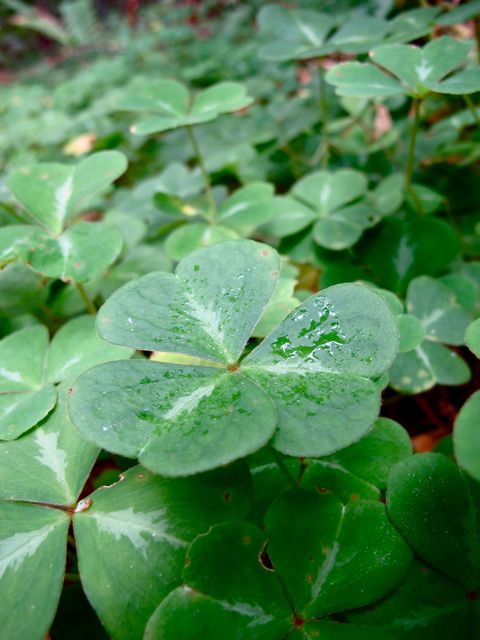
Deep under the shade of the redwood trees is a brilliant swathe of green. A field of tiny three-leaved plants carpet the forest floor. This is redwood sorrel, or Oxalis oregana. Each heart-shaped leaf has a pale splotch along its midrib, as though it had been folded around a dab of light green paint in a kindergarten art class.

When I was a kid, this little plant was a favorite treat. It’s edible and easy to spot, so I would eat it all the time. The leaves have a fresh, lightly bitter flavor like a mild lemon. You can add them to salad or other foods, and since they love to grow in shade they are a nice addition to a garden that doesn’t get full sunlight. In late spring they sprout an attractive, pale-pink flower.

An interesting list of historical uses is described on the Native American Ethnobotany Database: chewed redwood sorrel roots were applied to sore eyes. It was given to anyone who didn’t feel like eating, and used as a wash to treat rheumatism. Poultices were applied to boils, sores and infections. Leaves were eaten raw, cooked with grease, or with dried fish. One source says the stems could also be used to make a rhubarb-like pie–but wow, that would need a LOT of stems.Oxalis_oregana

Leave a comment

Filed under Edible, Good for gardens, Native, Plant of the day

Plant of the day: toyon

Heteromeles arbutifolia

Small, dark green trees with clusters of white flowers are scattered here and there across the hillsides. This is toyon (Heteromeles arbutifolia). It will truly come into its own in a few months, when clusters of brilliant red berries begin to ripen. Toyon is also called “christmas berry” for these cheerful December fruit, which once were sold as a local substitute for similarly colored holly sprigs.

Don’t get any ideas about collecting your own–it’s now illegal to harvest wild toyon. This species is often a part of the scrubby chaparral community, but you can also see it in oak woodlands and other forests and shrublands across the state. The berries are described as having a “sweet and spicy” flavor, and a tea made from the leaves was used for irregular menses, aches, pains, stomachaches, and to wash wounds. Californians once ate the fruit regularly–roasted, toasted and fresh. Spanish settlers made a drink from the bark, and Channel Island fishermen used it to tan their fishing lines.

Leave a comment

Filed under Edible, Medicinal, Native, Plant of the day

Plant of the day: leather oak

Oaks are generally thought of as tall, graceful trees. But you can also find them in the sea of waist-high bushes known as chaparral. Leather oak (Quercus durata var. durata) is a common sight on serpentine soils in this area.

This slideshow requires JavaScript.

Leather oak can grow to around nine feet tall, but I have mainly noticed them growing much closer to the ground. Look close to spot acorns or clusters of catkin-like flowers among the small, grayish green leaves. The leaves of this species are dull, dusted with a pale fuzz (paler on the top than on the bottom). They also are concavely curled towards the ground–you could flip one over and use it for a little spoon, if they didn’t have a tendency to be spiny.

As with all acorns, the nut of the leather oak is edible once its bitter tannins have been leached out. Acorns were historically a major food source for local Native American tribes, and still are a major part of the food chain for wildlife. People generally remove tannins by soaking the nut in water (or a running stream). But some tribes would plant the acorn in a bog and wait until it sprouted in the spring–a system which apparently got rid of most tannins but preserved more nutrients than the water method.

Acorns can be eaten whole, or ground into a floury powder for cooking. Roasted acorns can be used as a coffee substitute.

Leave a comment

Filed under Edible, Native, Plant of the day

Plant of the day: coyote brush

Small white flowers are beginning to bud and bloom on a sweet-smelling bush of the chaparral. This is coyote brush, or Baccharis pilularis. For some reason that I can’t put my finger on, I find this a particularly charming plant. Its small leaves are scalloped at the edges and rough (and sometimes sticky) to the touch. On hot days, you can tell it’s nearby just from the resinous, pleasant smell.

This slideshow requires JavaScript.

Coyote brush blooms in late summer and early fall, and bears its male and female flowers on separate plants (the botanical word for this is “dioecious”, as opposed to most plants which are “monoecious” and have their male and female parts on the same plant, usually in the same flower).

You can find coyote brush growing from Baja California to Tillamook County, Oregon; from coastal scrub to foothill forests. Generally its an upright shrub, but along the coast it can also grow in a prostrate form that once was (but no longer is) considered a different species.

1 Comment

Filed under Native, Plant of the day

Plant of the day: wax myrtle

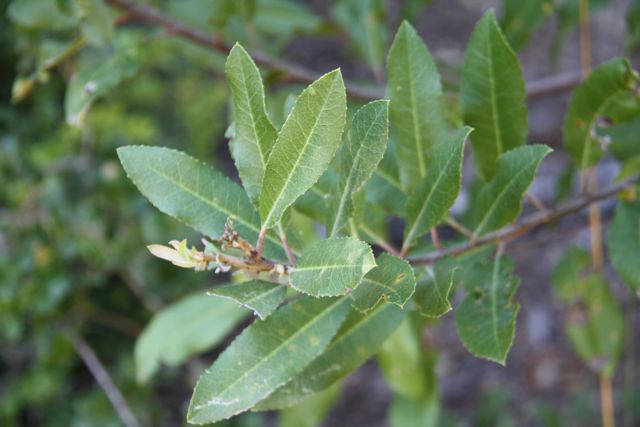
The berries of the California wax myrtle look like they are made from grains of purple wax, all pressed together into a ball. You can see them now, growing close to the stem in the Bishop pine forests of Point Reyes (and elsewhere). This small tree (Morella californica) has long, narrow leaves with pointy tips.

This slideshow requires JavaScript.

Both the coating and the pulp of the berries contain wax, which can be gleaned by boiling them. The wax is said to make a pleasant-smelling candle if enough is collected. The berries, while not toxic, are not said to be tasty either (I admit I’ve never tried them). They also can be used to make a purple dye.

Leave a comment

Filed under Native, Plant of the day

Plant of the day: salal

Gaultheria shallon

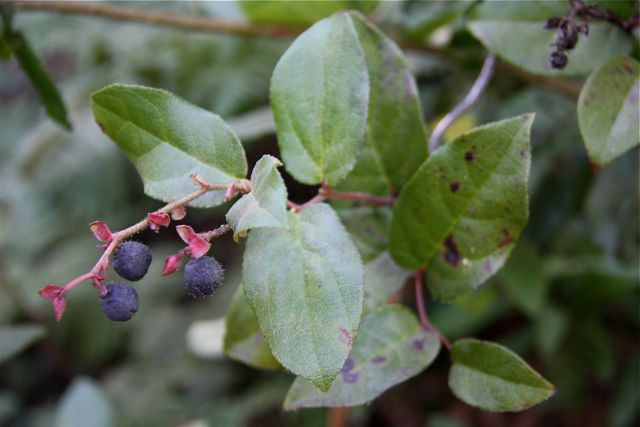
Salal is a familiar companion of the forest underbrush from Alaska to Santa Barbara. It is unadorned for most of the year, a simple shrub with largish (~4 inch) leathery leaves that dance up alternate sides of a slightly zig-zagged stem. In between the large veins, the leaves are traced with an intricate lacey pattern somewhat like the crease on the palm of a hand.

Small bell-shaped flowers of pinkish white appear at the tips of the stems in the early summer, and by now the dark purple fruit has ripened. Each berry is lightly hairy, and they are fairly sparse on the plant. Though edible, I have found them to be bland the few times I’ve tasted them. The leaves can be made into “a pleasant tea“, and poultices made of the leaves were traditionally applied to cuts, burns and sores. The fruit or leaves were also used to make dyes (of purple or yellow).

Leave a comment

Filed under Edible, Native, Plant of the day

Plant of the day: fivefinger cinquefoil

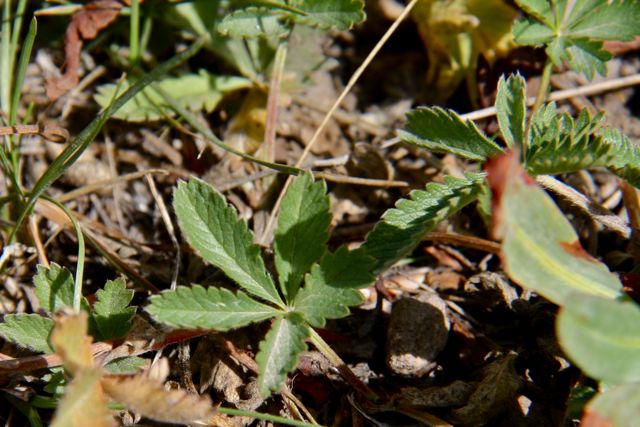
Here in a moist mountain meadow I find a little yellow flower with five petals surrounding many stamens. Five jagged-edged leaves spread like a palm at the end of their stalk (and the term for this leaf arrangement is, indeed, “palmate”). This is fivefinger cinquefoil, or Potentilla gracilis.

The flower, plus the deeply creased, jagged leaves, are the signature of most Potentilla species. But unlike our lowland silverweed cinquefoil, which I wrote about a few months ago, the fivefinger cinquefoil can’t be found at sea level (though it does have quite a wide range, growing as low as 400 feet in elevation and up to nearly 12,000 feet). Look at that post, here, to see the similarities and differences between the leaves.

It’s also called northwest cinquefoil and slender cinquefoil. Native American tribes used the roots medicinally (either pounded or as a poultice) to treat aches and pains.

Note the fan-shaped “palmate” pattern of leaves

Leave a comment

Filed under Native, Plant of the day

Plant of the day: primrose monkeyflower

Mimulus primuloides

On a mossy lake shore, a small yellow flower gapes its red-spotted tongue towards passing insects. It stands only a few inches tall, balancing a single bloom on a thread-thin, leafless stalk. A rosette of green leaves surrounds it at the base. This is primrose monkeyflower (Mimulus primuloides), which only likes to grow above 2,000 feet in elevation.

At first glance, this little yellow monkeyflowers of the alpine country look a lot like those of the lowlands–but look close! Even though we are used to seeing Mimulus guttatis around here, there are many other species with bright yellow blossoms that are dotted with red… But this is the only one (that I know of) to bear a single flower on a leafless stem.

1 Comment

Filed under Native, Plant of the day

Plant of the day: desert mountain mahogany

From a distance, the small trees seemed to be covered in gray flowers. Once up close, the “flowers” turned out to be curlicue seedpods covered in long silver hairs. The pods are striking, each tipped with a long curling tail like that on a squirrel or a frightened cat. This is desert mountain mahogany (Cercocarpus ledifolius), which grows in dry parts of California at 4,000+ feet in elevation. 

This slideshow requires JavaScript.

This small evergreen tree has oval, leathery leaves that are slightly hairy. I didn’t see it in bloom, but the flowers are described as unobtrusive–small and slightly hairy, with many stamens indicative of its membership in the Rosaceae family.

Mountain mahogany was used medicinally by Native American tribes such as the Paiute and the Shoshone to treat colds, burns, heart troubles and diarrhea. The inner bark was used as a red dye for buckskins Fish spears and bows were made from the wood, which is so hard and dense that it won’t float in water.

Leave a comment

Filed under Native, Plant of the day

Plant of the day: explorer’s gentian

Beautiful deep-blue flowers top tufts of green on an alpine slope. The vase-shaped blossom spreads into five gracefully rounded petals at the mouth; each petal is dotted with pale yellow spots that fade into green deeper in the throat of the flower.

This is explorer’s gentian, or Gentiana calycosaanother high-elevation beauty (also called the Ranier gentian, or the Ranier pleated gentian). It likes cold climates and wet soil near streams or in low meadows (although I saw it outside this typical range, growing on an exposed and rocky slope, so this can happen as well). Bees and other insects love to rummage in it’s deep flowers, and it has been cultivated as an ornamental. In the Bay Area, you can keep your eye out for the similar-looking pleated gentian (Gentiana affinis), a cousin that prefers low elevation.

Leave a comment

Filed under Native, Plant of the day