Category Archives: Native

Plant of the day: blue elderberry

Clusters of grayish-blue fruits hang from the branches of a small tree. Blue elderberry (Sambucus nigra) is a beautiful plant with arching branches. Its shaggy bark is wrapped around with furrows in older plants. The leaves are a fresh green and paired; each pinnate leaf actually looks like several leaves, since it is composed of 3–9 little leaflets.

Elderberry has a rich history of being used in cuisine, crafts, and medicine–but it must be approached with caution since the green parts of the plant and the unripe berries are quite toxic. The roots are the most toxic of all. But ripe berries make a delicious syrup, jam or wine, and the plant has long been cherished by traditional cultures. Petals can be eaten raw, made into a tea, or used to flavor pancakes. Some have even dipped the entire flower head in batter and fried it! Elderberry syrup is said to be an effective treatment for the flu; you can buy bottles of it at most health food stores. Native Americans used the branches for baskets, flutes and arrow shafts, and the fruit was a main food source.

Before the fruit is ripe, you can tell blue elderberry from its cousin, red elderberry, by the shape of the flower head. Blue elderberry has a flat-topped cluster, whereas red elderberry flowers are arranged in a pyramidal or roundish shape.

Notice the flower head is flat, not cone-shaped

Leave a comment

Filed under Edible, Good for gardens, Medicinal, Native, Plant of the day, Poisonous

Plant of the day: narrow leaf cattail

This tall reed rustles its leaves above a small pond. Long cylindrical flower heads look like two plump brown sausages on a spit. The sausages are actually flower heads, with the female flowers clustered in the lower, plumper segment while the male flowers are clustered together above.

These are narrow leaf cat-tails, a common sight in wetlands or roadside ditches. There are actually three species here in the Bay Area that hybridize with one another; the main way to tell them apart is by the flower heads (if the skinnier flower head is stacked immediately above the fatter one with no gap of stem visible in between, you’re looking at common cattail, or Typha latifolia). The two species of narrowleaf cattail (T. domingensis and T. angustifolia) are harder to tell apart–look for orange or yellow flowers, and dark dots on the inside of the lower leaf, to ID T. domingensis.

Leave a comment

Filed under Native, Plant of the day

Plant of the day: salty Susan

Jaumea carnosa

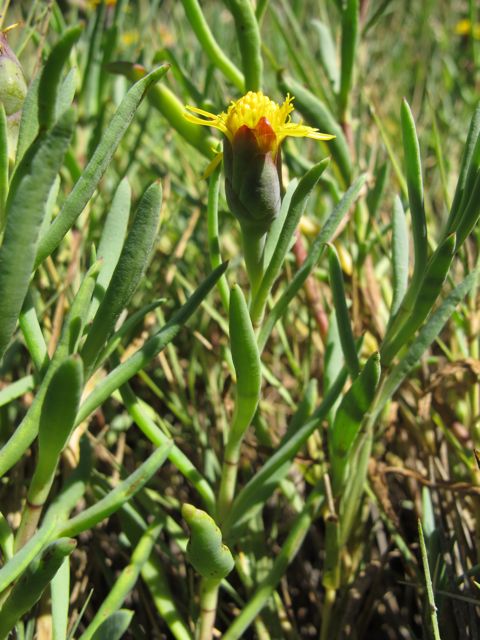
Nestled among the pickleweed are patches of grayish-green plants with bright yellow flowers. This fleshy-leaved little aster is Jaumea carnosa  (also known as marsh jaumea or salty Susan), and the patchiness is because it spreads by rhizome, or underground stem. Jaumea is common in the upper reaches of salt marshes along the Pacific coast from California to Canada. It’s affinity to the sea is a strong one: you won’t find it growing above 16 feet in elevation!

Even though Jaumea stands out as one of the comparatively few plants that grow in salt marshes, there’s not much information on this little plant. As far as I can tell, it’s not edible and hasn’t got any significant cultural or historical uses. It’s just an upstanding citizen that likes to grow at the upper edge of the tide, quietly going about its business of flowering and photosynthesizing.

Leave a comment

Filed under Native, Plant of the day

Plant of the day: wood rose

Rosa sp.

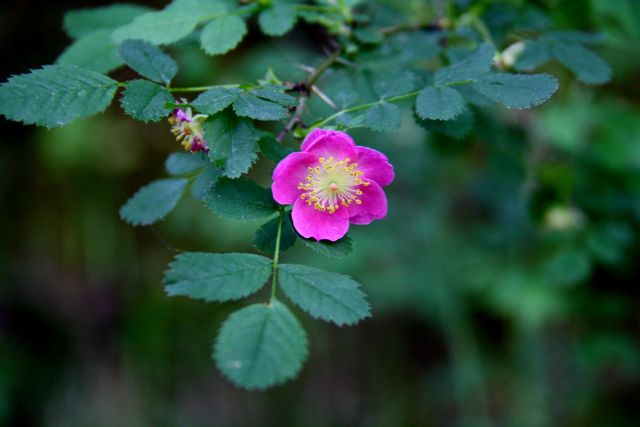
In spring, the native roses bloom with graceful pink blossoms. In the summer, they are decked with clusters of red fruit. And year-round, the elegant bushes are lush with small round leaves. A wild rose is a treat in any season or any setting, whether forest or garden. Telling the different species apart can be tricky (the local key requires fruit which isn’t helpful in spring). But at this time of year, the wood rose–Rosa gymnocarpa–stands out because it loses its sepals as its fruit begins to ripen; other species retain the sepals (and sometimes the dried remains of the stamens too) on the ends of the fruit. One of its other common names is “bald hip rose”.

Though technically edible, the small red hips are packed full of seeds that are nestled inside a dense layer of hair that grows on the inside of the fleshy shell. Not exactly succulent, they have a tart, good-for-you, vitamin-C kind of tang. I read that the seeds are a good source of Vitamin E. The petals also can be eaten, and both petal and hip can be steeped for a tea. Historically, leaves were sometimes chewed as a remedy for bee stings, while the soaked bark was a wash for sore eyes.

See how the end of the fruit is smooth?

Leave a comment

Filed under Edible, Good for gardens, Medicinal, Native, Plant of the day

Plant of the day: California hemp

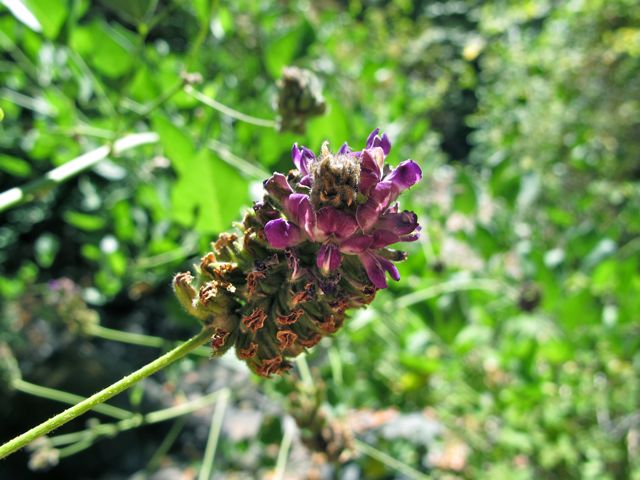
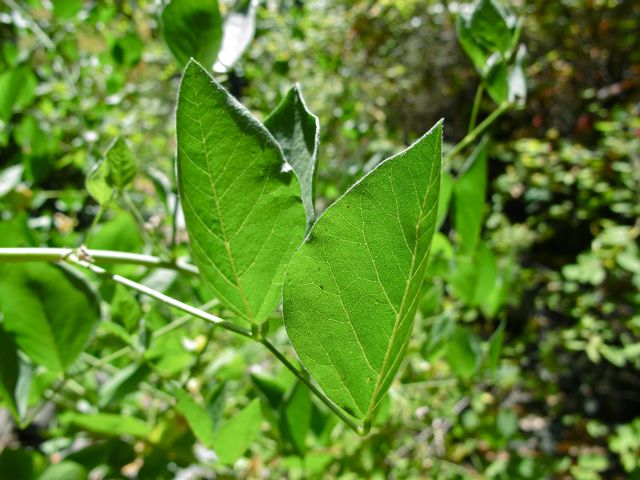
A tall, sprawling bush grows in a rocky creek bed, decorated with cone-shaped heads of purple pea flowers. Plain, broadly pointed leaves are arranged in threes. Often the leaves are folded slightly towards their central vein, and also bent at a sharp angle to the stem so they look upraised, like a hand cocked at the wrist.

This is California hemp (Hoita macrostachya). This leggy plant has hollow stems and likes to live in moist places and is a good indicator of wetlands. It is found almost exclusively in California, as are the other two species in the Hoita tribe. All have purple flowers and similar leaves, but one is a creeping, low-growing plant and the other is found in serpentine chaparral, not in wetlands.

The name California hemp likely derives from this plants historic use as a textile. The fibers of its stem are strong enough that they reputedly have been used for sewing, as well as been woven into ropes or bags. A yellow dye can be made from its roots.

Leave a comment

Filed under Native, Plant of the day

Plant of the day: coastal gumweed

Masses of yellow flowers are blooming beside the lagoon. Bees swarm over the blossoms, rummaging for pollen in their daisy-like centers. Nearby, white goo that looks like Elmer’s glue coats the younger, unopened buds. The green bracts surrounding the petals are fleshy spikes, curved strongly backward.

This slideshow requires JavaScript.

This is coastal gumweed, or Grindelia stricta. The species is highly variable, growing either upright to about waist height, or prostrate along the ground. You can find it along the Pacific coast from Los Angeles to Washington state. The erect version shown above (Grindelia stricta var. angustifolia) was photographed at the Bolinas Lagoon; it’s usually found in salt marshes. This is the only local species of Grindelia to have woody stems so it is easy to tell apart from other gumweeds. Other names for this species include Oregon gumweed and marsh gum plant.

Leave a comment

Filed under Native, Plant of the day

Plant of the day: sticky sandspurry

Spergularia macrotheca

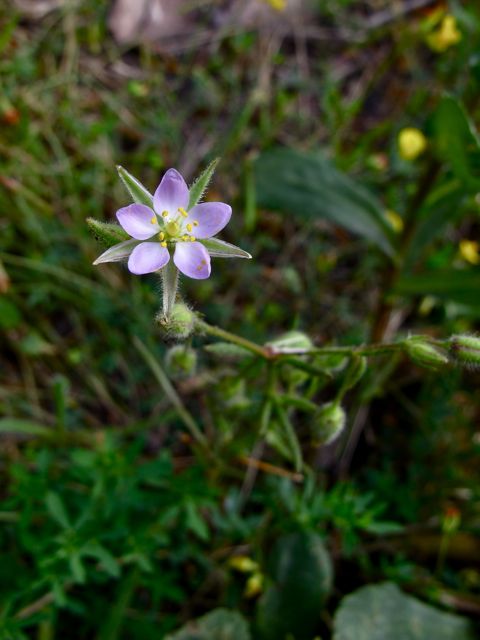
On the upper edge of a salt marsh, pale purple flowers grow low to the ground. This is sticky sandspurry, or Spergularia macrotheca. There are several different species of spurrys in the area, and all are very similar. To identify S. macrotheca I had to get out my hand lens and look close at the tiny seeds. In this species, each seed is surrounded by a narrow, papery halo (or “wing”).

With its five pale petals surrounding cheery yellow stamens, sticky sandspurry can be found along the Pacific coast states up to Canada and southeast Alaska. The plant earns its name by being covered with short, sticky hairs. Clustered leaves, rising from a swollen spot in the stem, give a clue that it’s in the Caryophyllaceae family.

It prefers to grow in wet places, often near saltwater, but it also can be found by freshwater seeps, springs and vernal pools–and in non-wetlands as well.

Notice the swollen stem at the leaf nodes


1 Comment

Filed under Native, Plant of the day

Plant of the day: saltmarsh dodder

Bright orange patches dot the green swath of a salt marsh. Look close and you will see what looks like a mat of fishing line or straw. Hundreds–thousands–of narrow orange threads are wrapped tightly around bright green pickleweed stems. Copious white flowers often bloom off the threads. This is saltmarsh dodder (Cuscuta salina), a parasitic native plant that mooches nutrients off its host plant. Instead of photosynthesizing its own food, it sinks tiny root-like organs (called haustoria) into the flesh of the plant. Once it taps into the vascular system it can suck out all the water, minerals and carbohydrates that it needs.

Dodder seeds are scattered by wind, tides and animals so there is no guarantee that they will germinate near a suitable host plant. But they die if they can’t find one quickly. It sounds impossible for a  brainless, eyeless, noseless  plant to do, right? Nope–not if a host is anywhere close. They can detect the volatile compounds emitted by the host (basically, its smell) and then they grow towards it.

There are a lot of species of dodder in the US, and some of them are parasitic to some of our favorite crops like alfalfa, potatoes and petunias. Though the group is much maligned as a result, some ecologists make a case for the role that parasitic plants can play in the natural environment. Species like dodder or mistletoe don’t decimate their hosts’ population, but they do create patchiness. And in ecology, patchiness tends to lead to diversity, which is a good thing!

1 Comment

Filed under Native, Plant of the day

Plant of the day: pickleweed

The pickleweed is in bloom, but you probably won’t notice.

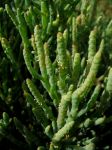
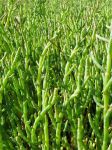
First, you would have to notice the plant itself. Sarcocornia pacifica is a fleshy, low-growing plant of the salt marshes. It is named for its leafless, segmented succulent stems, which resemble tiny pickles. Or, little green fingers. I think it’s an adorable plant, but it is undeniably unobtrusive. Often people just see it as something to step on while they are getting to the water, the beach or the view…

To see the flowers, you have to look even closer. The blooms themselves are simply tiny white threads emerging from the green wall of the plant; you can barely see them with the naked eye (click on the middle picture to get an idea).

I’ve never nibbled on it, but pickleweed (also called Virginia glasswort) is edible, with a mild salty flavor. Not surprising, since it often grows in a dense mat along the wet edges of marshes. Regularly drenched by the tide,  it has the ability to absorb large amounts of saltwater.

1 Comment

Filed under Edible, Native, Plant of the day

Plant of the day: alkali heath

Along the edge of a lagoon is a small purple flower perched atop dusky green leaves. This is alkali heath, or Frankenia salinaIt’s mainly found in California, though it also can be found occasionally in other parts of the US.

This plant often grows in dense clumps, but it is not very tall. I have only seen it growing to about a foot tall, and that is when it was using other plants for support.

Because it grows in areas that are often submerged by the tides, alkalai heath has the ability to withstand large amounts of salty water–unlike most plants. The technical description for this talent is “halophytic”, and the community of plants that shares this trait is comparatively small. With its five purple petals, comparatively long stamens, pale green leaves and ability to live in salty marshes, alkalai heath is fairly unique to identify.

Leave a comment

Filed under Native, Plant of the day