Category Archives: Native

Plant of the day: tall flatsedge

Cyperus eragrostis

It sort of looks like a grass, but not quite. The leaves are thicker than your typical grass, and the stem is triangular in cross-section. The leaves are in threes, not in pairs as in grasses. And the big, robust seeds are nestled among long splayed leaves at the end of the stalk.

This is tall flatsedge, or Cyperus eragrostis–one of the most common sedges in Marin. Though partial to wet meadows, seeps, springs and stream banks, it can be found in in dry areas as well. Sedges (and grasses, and rushes) are particularly hard to ID since they have tiny flowers and require a lot of specialized terminology. For more information on how to key these plants, check here and here.

Leave a comment

Filed under Native, Plant of the day

Plant of the day: Pacific blackberry

So you thought a blackberry was always a blackberry, huh? Well, no. Or rather, there are a few different kinds of blackberry, so you have to look close.

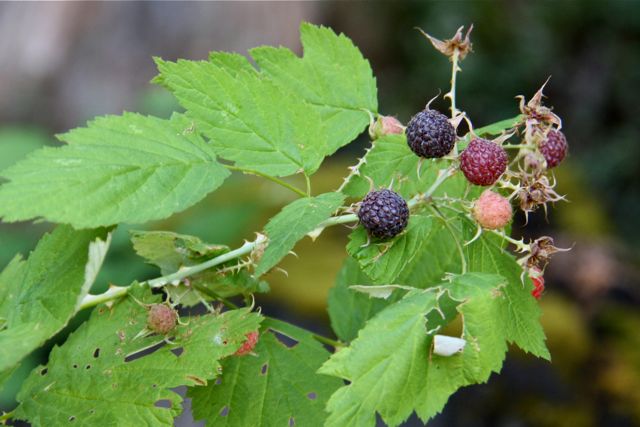
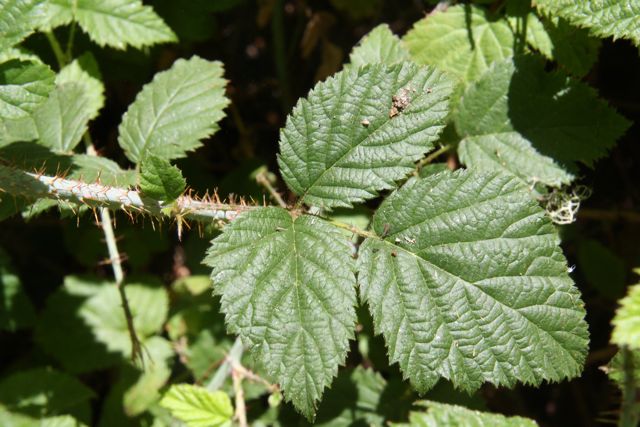
I wrote about the invasive Himalayan blackberry a few weeks ago–but now the native Pacific blackberries (Rubus ursinus) are beginning to ripen, so keep your eyes out for them as well. Superficially, these look similar to their invasive cousins. Both grow in prickly mounds of briars. Both have leaves that generally are in groups of three, and many-segmented berries. But Pacific blackberries are all-around more delicate: their berries and their thorns are both more delicate, and their leaves are a lighter green and a thinner texture. Flip one over, and the Pacific’s leaf will be green below while the Himalayan’s leaf will be white.

If you get a look at the flowers, the distinction gets even easier. Pacific blackberry is the only local member of the Rubus genus to have gender-segregated flowers. What this means is that instead of male stamens and female pistils being in the same bloom, some flowers only pack pistils while others only sport stamens.

And that is why botany is awesome.

Leave a comment

Filed under Edible, Good for gardens, Native, Plant of the day

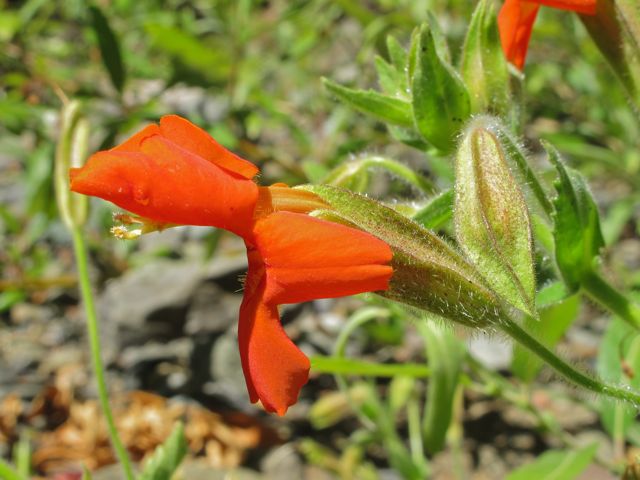
Plant of the day: scarlet monkey flower

Orange-red flowers grow in the dappled shade of a dry stream bed. This is the scarlet monkey flower, or Mimulus cardinalis–one of the most lovely of this group. With bright green leaves and flashy flowers it is a treat in gardens and wild places alike.

Hummingbirds, butterflies and other insects also love this plant, but deer do not. Native plant gardeners rave about the monkey flowers in general for this reason.

Scarlet monkey flower is usually found near water, and so when you see it you have a strong clue that you’re in a wetland or near a stream (and below 8,000 feet, which is the upper limit of its range). You can see them growing in most parts of California from the northern Sierra to San Diego. Outside of the state, it grows north into Washington state and east as far as New Mexico.

Leave a comment

Filed under Good for gardens, Native, Plant of the day

Plant of the day: California poppy

If you learn only one plant as a Californian, it should probably be this one. Our state flower is simply stunning. Rich orange flowers bloom lushly atop feathery foliage. The cup-shaped blossoms were originally pollinated by beetles, but they have also become a favorite of the introduced European honeybee.

This slideshow requires JavaScript.

California poppy (Eschscholzia californica) is one of the most beautiful flowers of the spring, and it blooms well into the summer with good showings still going on. In this area they usually grow in scattered patches, but in places you will see them blanketing hillsides or valleys in a carpet of orange (eg Santa Barbara’s Figueroa Mountain). In harsh places the flowers can be on the small side, but in good conditions each of the four petals can be over two inches long. This poppy is native to the west coast of North America, but because it is a beautiful and hardy garden flower it has been introduced to many other parts of the country and the world.

Native Americans are said to have used the pollen as a cosmetic. They also ate the leaves, and used the plant as a mild pain-killer to treat insomnia and toothache. Extract of poppy is still sold today, and was touted as an alternative to Oxycodone by television personality Dr. Oz.


Leave a comment

Filed under Good for gardens, Medicinal, Native, Plant of the day

Plant of the day: farewell to spring

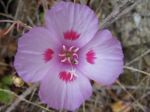
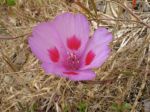
Pink, poppy-sized flowers show up with a flamboyant burst of color on the browning hillsides. Each of the four delicate petals are dotted with a dark red splotch. This is farewell to spring, or Clarkia amoena.

There are several species of Clarkia in Marin that differ slightly from one another; this species can be either white or pink. You can distinguish it from the other similar species because it has red splotches instead of a red ring on the petals, and the buds don’t droop. These flowers seem to thrive on dry road cuts – I’ve seen them growing along Highway One in several different places (these photos were taken just south of Tomales).

1 Comment

Filed under Native, Plant of the day

Plant of the day: cobweb thistle

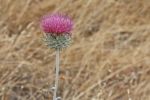
On an open hillside is a graceful thistle with whitish stems and leaves. Look close and you’ll see a cobweb-like webbing stretched between the spines. This is cobweb thistle (Cirsium occidentale), one of the most beautiful of the native thistles. A busy community of bees, ants and other insects also find it attractive! You’ll see them buzzing and crawling around the plant and (apparently) sometimes dozing in the flowers.

There are a LOT of thistles in the area; CalFlora lists eighteen different species, most of which are invasive. But unlike these non-native species, cobweb thistle tends to grow singly or in sparse groups. And plus, it’s cobwebby. There are other native species with this feature (the technical term for cobwebby is “arachnoid”) but they have leaves right beneath the flower head, and a very different growth form.

Leave a comment

Filed under Native, Plant of the day

Plant of the day: California bluebell

Asyneuma prenathoides

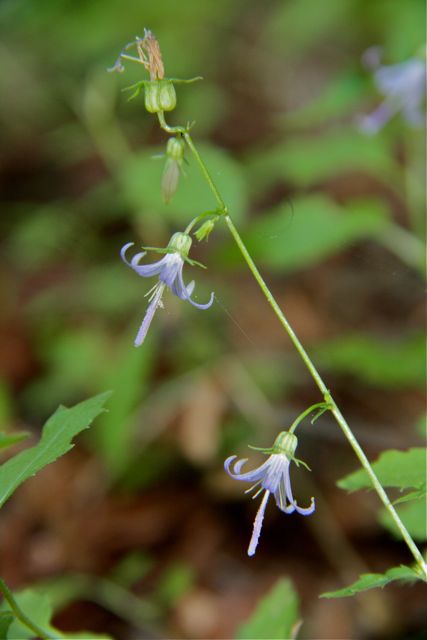
Delicate pale purple flowers grow in a low mat of green leaves on the forest floor. It’s worth stopping and getting close to check out the lovely little blooms. Five narrow, pointed petals curve backwards, away from a long slim purple-dusted pistil. As the flower matures, the pistil opens into three parts for receiving pollen.

Other names for this Asyneuma prenathoides include California harebell and slender bluebell, but I have always known it by the name found in the Peterson Guide. It once was in the Campanula genus along with the more traditional-looking bluebells but somewhere along the line it was re-assigned to a different group (something that happens a lot in botany as new features, genetic analysis, or other information comes to light).

Leave a comment

Filed under Good for gardens, Native, Plant of the day

Plant of the day: canyon gooseberry

This gooseberry is a prickly delight. From its elegant branches to its troublesome little berries, Ribes menziesii has a lot of character. The berries are edible–and yummy!–but you have to get past the spines to enjoy them. There’s no easy way to do this; you can try peeling with a pocket knife or just chewing carefully. I’ve also tried popping them with my teeth first, before chomping down. This seems to work the best, but you’re still bound to get prickled a few times.

This slideshow requires JavaScript.

Overall this plant is better for looking at than for eating, especially in spring and summer. The thorny branches sport scalloped green leaves on gracefully arching branches, and in the spring it puts out masses of small lantern-shaped flowers that bees love.

Gooseberries are a type of currant, and some of the local wild species (spreading gooseberry, flowering currant) are spineless–as are their store-bought cousins. In addition to the canyon gooseberry featured here, there are some other spiny species around as well (California gooseberry and Victor’s gooseberry). You can tell them apart because the first has smooth, hairless leaves and the second has shorter spines on the fruit that are all about the same length.

Leave a comment

Filed under Edible, Good for gardens, Native, Plant of the day

Plant of the day: western rasperry

A sprawling pale-stemmed bush is decked with dark purple raspberries. Warmed in the sun, they have a mild, rich sweetness. These tasty fruits are smaller, leaner, and much darker than their plump commercial cousins. I’ve always preferred the wild version!

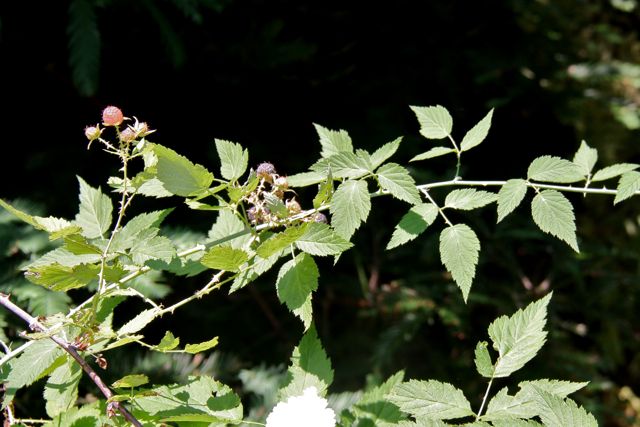
There are many listed names for Rubus leucodermis  (western raspberry, white stemmed raspberry and whitebark raspberry) but I’ve always just called this “wild raspberry” since it’s the only native one around. It’s in the same genus as Himalayan blackberry, but though the plants are similar they are easy to tell apart even when not in fruit. Western raspberry is a delicate shrub with slim branches that have a glaucous coating which you can rub off with a finger. The leaves of both species are three parted, but blackberries’ are much thicker and darker.

Western raspberry is one of my very favorite California berries, but you won’t see it growing in Marin. Sonoma County? Yep. Santa Cruz? Yep. Even down to San Diego and up into Alaska. But for some reason it doesn’t like the San Francisco bay – there’s no record of it  in SF, Marin, the East Bay, or the Peninsula.

Leave a comment

Filed under Edible, Good for gardens, Native, Plant of the day

Plant of the day: slender tarweed

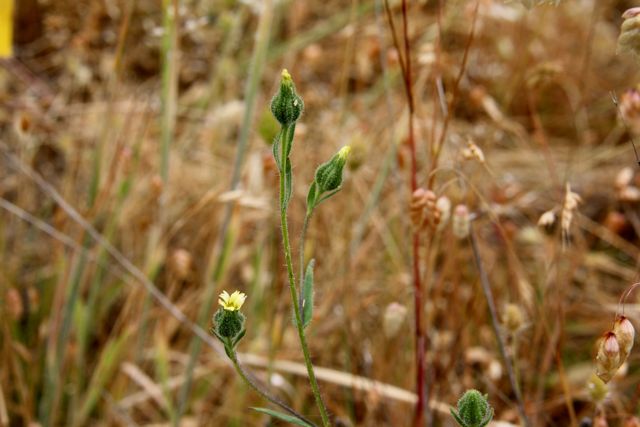
Here is a common little tarweed with small unobtrusive flowers. Madia gracilis has the strong odor and sticky stem that’s common to the tarweeds (or gumweeds, which is another one of this little guy’s common names). The flowers are often dwarfed by the bulbous green cup of sepals below. If you look close you’ll see that the entire plant is covered with little glandular hairs, with tiny black dots atop stubby white bristles.

Leave a comment

Filed under Native, Plant of the day