Category Archives: Non-native

Plant of the day: calla lily

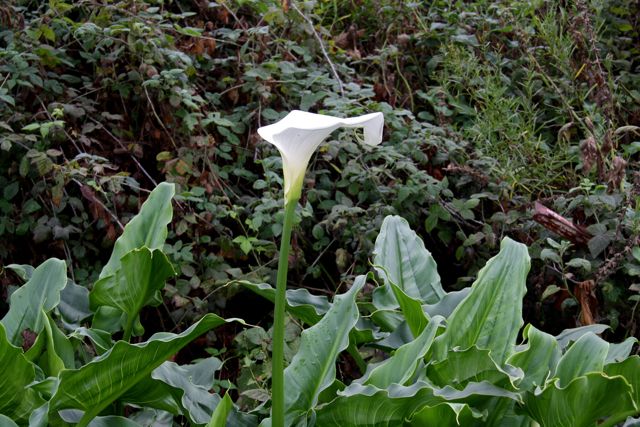
Here is another pretty out-of-season bloom. Calla lilies are a gorgeous sight with large cream-colored blossoms rising from clusters of dark green leaves. They usually flower from May through June, but recently there has been a pretty cluster of them growing near the neighborhood farm stand in Bolinas–is it climate change? Or just the variable microclimates in the Indian summer of California?

The stark white “flower” of the calla lily is actually a spathe, or bract–a leafy appendage below the flower that is usually green. The actual flowers are clustered on a yellow nub that rises from the center of the creamy white sheath. Each spathe is nearly 10 inches across.

This plant is native to east Africa, and grows in scattered locations here in California–usually near places that are (or were historically) inhabited.

Calla lily (Zantedeschia aethicopia) is mildly toxic to eat. It is also called Arum lily and (according to Wikipedia) “varkoor”, which aptly means “pig’s ear” in Africaans.
Leave a comment

Filed under Non-native, Plant of the day, Poisonous

Plant of the day: cape weed

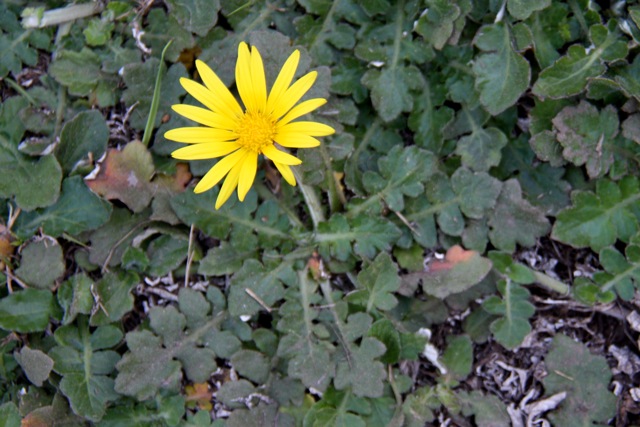
A coastal bluff is carpeted with a mat of yellow daisies. The leaves are grayish green, woolly, and shaped like deeply lobed arrowheads. The flowers are bright yellow, blooming a few inches above the rosette of leaves.

This is cape weed, or Arctotheca calendula, an invasive species introduced from South Africa. It spreads via underground stems called stolons, as well as by seed. It has often been planted as an ornamental because of its flashy flower and long blooming period, but ecologists discourage this because of its tendency to invade delicate coastal prairies.

Traditionally, cape weed was considered to be one species but it is now actually identified as two separate species–the fertile Arctotheca calendula and infertile (or, rarely fertile) Arctotheca prostrata which can only reproduce via stolon and not by seed. The leaves of the infertile species, prostrate cape weed, are either entirely yellow on their underside–or they are tinted a reddish to brownish hue on the outer half of the leaf. The petals of the fertile, “standard” cape weed are a steely blue color underneath.

Leave a comment

Filed under Invasive, Non-native, Plant of the day

Plant of the day: forget me not

I try to keep these posts seasonal, and write about flowers that people are likely to see right now. But this sight was strange enough that I’m going to break this rule.

This slideshow requires JavaScript.

Forget me nots (Myosotis latifolia) are common little weeds in the springtime. Cheerful blue flowers tend to grow in dense patches along moist stream banks and woodland clearings. Though not native to California, the plant has naturalized here and now is ubiquitous. Luckily it doesn’t cause too much ecological damage–as far as I know!

A few days ago hiking along the Arroyo Hondo in Bolinas, I saw several forget-me-nots in bloom. True, it’s shady there, along a canyon with a deep canopy of pepperwood and other trees. But still–I haven’t seen any of these plants for months, and they aren’t due to start blooming again until february. It’s a good reminder that even though there are general patterns to when things blossom, in the end each individual still marches to its own drummer. And there are always outliers…

1 Comment

Filed under Non-native, Plant of the day

Plant of the day: sheep sorrel

Almost all the year round you can see low green stalks studded with small red flower buds–a splash of color usually growing intermixed with grasses. This is common sheep sorrel, or Rumex acetosella, an invasive species that was introduced from Europe. It usually grows in weedy areas, and has a long bloom period from March all the way through November.

The tart leaves are edible, and taste like redwood sorrel or lemongrass. Try it in salad or steep the leaves for a tea. The acidy-lemon flavor comes from oxalic acid–small doses are fine, but eating a lot of it can lock up calcium and other nutrients in your body.

The root can be dried, ground and made into noodles but this seems like a lot of work and I’ve never heard of anyone actually doing it. The seeds are also edible, but they are so tiny that they also aren’t practical as anything other than a novelty.

Leave a comment

Filed under Edible, Invasive, Non-native, Plant of the day

Plant of the day: German ivy

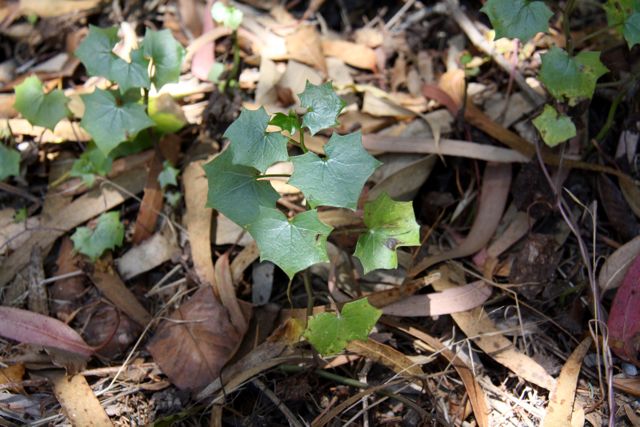
Vines with shiny green leaves–roundish yet spiked with points–grow on a forested bank. This is German ivy, or Delairea odorata, a South African native that is a problematic invasive here in California. It can smother trunks, shrubs and ground cover with its vigorous stems.

It is also known as cape ivy, and is unrelated to the vaguely similar-looking English ivy.

Leave a comment

Filed under Invasive, Non-native, Plant of the day

Plant of the day: mattress vine

Occasionally you’ll see a tree or a fence drenched by a mound of greenery. The small round leaves are delicately suspended on twining, wire-like vines that are dark purplish-brown. This is mattress vine, or Muehlenbeckia complexa. Its other names are wire vine (because of the wiry stems?) and maidenhair vine (because the leaves are similar to those of maidenhair fern?).

This slideshow requires JavaScript.

Mattress vine is a native to New Zealand that occasionally can be seen growing wild here in California. It’s often grown as an ornamental for walls or topiaries, but is considered a problematic invasive in certain places–such as the Golden Gate National Recreation Area. You can see it growing in large mounds at the bunkers on Fort Cronkhite, as well as at Land’s End and the Presidio

Leave a comment

Filed under Non-native, Plant of the day

Plant of the day: dallisgrass

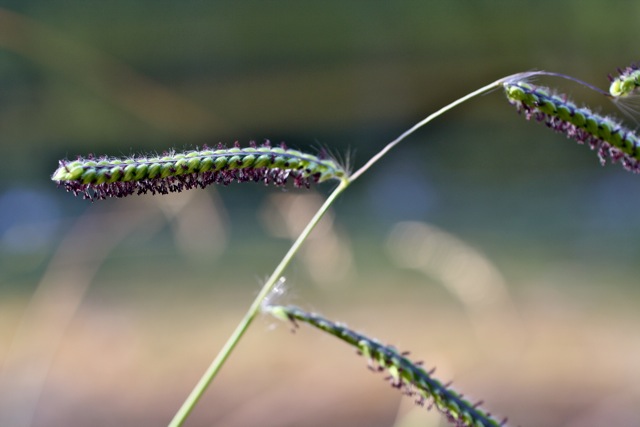
Dallisgrasslooks rather like a centipede when in bloom–except much more lovely. Each drooping raceme of resembles a segmented body, and the dark purple threadlike flowers that dangle beneath could look like the insect’s tiny feet.

This showy grass was introduced from Brazil and Argentina, and is found growing throughout much of California–often in weedy places along roads and trails. The photos here were taken alongside the Bon Tempe reservoir. Though widespread throughout Marin, it isn’t considered an invasive. But it has naturalized throughout much of the US, and elsewhere it is considered a problematic weed. Dallisgrass (Papsalum dilatatum) looks a lot like its native cousin knotgrass, which is used as forage for cattle. But dallisgrass is less palatable since it hosts a fungus that is toxic to livestock. Despite its attractive flowers, its habit of showing up as stiff clumps in lawns and golf courses also has made it unpopular. Look for 3-5 centipedes of flowers to distinguish dallisgrass from knotgrass (which generally only has 2 flowers per stalk).

Incidentally, while researching this plant is the first time I’ve heard the term “cultural control” used to define the alternative to “herbicide control”. Basically it means digging the plant out or using other manual, non-chemical means to get rid of it. But for a minute I daydreamed that cultural control might mean eating hors d’oevers or playing Pavarotti really loud on a stereo to make any nearby weeds shrivel up…

Leave a comment

Filed under Non-native, Plant of the day

Plant of the day: umbrella sedge

Long ribbons of leaves dangle off a central stalk like the naked ribs of an umbrella that has had the fabric torn off.

This is the aptly named umbrella sedge, or Cyperus involucratus. It’s often grown as a garden plant but occasionally seeds from this east-African native escape the yard and grow in the wild. This plant is said to be a close relative of Egyptian papyrus. It generally likes to grow in boggy areas and wetlands.

You can tell this plant from the other triangle-stemmed sedges around because of the many leaves, which grow beneath delicate clusters of flower spikes. But FYI, the leaves are technically bracts, with the actual leaves existing only as tiny nubs around the base of the stem.

Leave a comment

Filed under Non-native, Plant of the day

Plant of the day: curly dock

Dock is a striking roadside sight, especially now as it is in fruit or beginning to die. The tall stalks of red or dark brown stand out in bold contrast to the dry grasses they often grow in. Curly dock likes to grow in damp areas that have standing water in the winter.

I had a lot of trouble telling curly dock (Rumex crispus) from Western dock (Rumex occidentalis) using my key. But I am now pretty sure that I’ve figured out a good seat-of-the-pants way to tell them apart: look at the tiny fan-like fruit. Curly dock, shown here, has a little nub at the center of every one–sort of like a baseball lodged in a mitt (see the photo above). Western dock looks more like a reddish leaf with a thickened vein at the center.

Young leaves are edible in small quantities, and have high levels of oxalic acid which give it a lemony flavor (like redwood sorrel). Eating it may aggravate people with rheumatism, arthritis, gout, or kidney stones so be careful! It also can be used as a gentle laxative.

Leave a comment

Filed under Edible, Invasive, Medicinal, Non-native, Plant of the day

Plant of the day: Queen Anne’s lace

A delicate parasol of tiny white flowers is punctuated at the center with one that is dark purple. This is Queen Anne’s lace, or Daucus carota.

Though the plant looks a lot like poison hemlock, Queen Anne’s lace is actually edible–its other name is wild carrot. The roots are eaten cooked, or roasted for a coffee substitute, while the seeds are used as a flavoring. I personally have been too squeamish to try it, though the subtle details of the two plants are very different. First there is the central purple bloom. Second, wild carrot has a green stem stippled with hairs (while poison hemlock has a mottled and whitish stem).

This non-native plant is native to Europe and Asia.

Leave a comment

Filed under Non-native, Plant of the day