Category Archives: Plant of the day

Plant of the day: coastal sagebrush

The haunting smell of sagebrush is iconic for anyone who has spent time outdoors in the west. There are many different species, and though they go by different names (sagebrush, sagewort, wormwood) the smells are all similar. It’s a pungent, spicy fragrance that speaks of campfires and starry nights and open spaces.

This slideshow requires JavaScript.

Coastal sagebrush (Artemisia californica) is the only shrubby sagebrush in Marin; the species grows only in California and Baja. You can usually find it along the coast or in chaparral communities. It has narrow, linear leaves that sometimes branch like the tines of a pitchfork. The flowers are unobtrusive–small yellowish-green or reddish-green discs. The smell is classic sagebrush.

Historically, some tribes used a tea made from Coastal sagebrush as a female tonic. It was used to induce menstruation, as well as to ease and recover from childbirth. Women drank the tea at the start of their cycle, and it was fed to one-day-old newborns to cleanse their system. It was also used to treat colds, headaches, and to desensitize those suffering from hay fever. Dried leaves were smoked in a mix with tobacco, and used in sweathouses. Bundles of sagebrush branches were hung along trails leading to shrines. The wood was also used for arrows, fire sticks and windbreaks.

Dusky-footed woodrats love to eat it.
Leave a comment

Filed under Medicinal, Native, Plant of the day

Plant of the day: woolly mullein

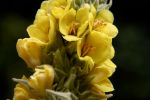
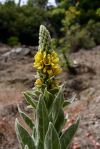
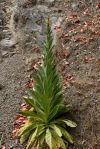
A tall spire of wooly leaves is topped with many bright yellow flowers. Each five-petaled bloom has two lower, straightened stamens and the remaining three are smaller and hairy. This is woolly mullein, or Verbascum thapsus, an invasive species that is now found throughout much of California and the rest of the country.

This plant prefers to grow in dry places, and can grow to more than six feet tall. The leaves are furry like lamb’s ears, and taper progressively smaller towards the top of the stem–giving the whole plant the shape of a narrow christmas tree. In addition to being an invasive, woolly mullein is also a host to insect species that can damage crops. It’s a persistent plant, with seeds that can survive up to 35 years in the soil.

Leave a comment

Filed under Invasive, Non-native, Plant of the day

Plant of the day: California rose

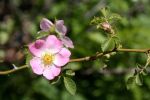
This wild rose is a favorite sight in spring and summer, as pink blossoms give way to ripe red fruit. This is the California rose (or as it is conversely known in Latin, Rosa californica), which grows in nearly every county in California, as well as in parts of Oregon.

This hardy shrub can look scraggly, but also can be groomed into a good garden plant, with pale green leaves and colorful fruit and flowers. It grows to 8 feet tall but is usually smaller. The tangle of thorny branches make excellent shelter for birds, and I’ve spotted many a nest by peering into a wild rose bush.

Rose hips are a renowned source of Vitamin C, and you can make an immune-boosting tea just by pouring boiling water over the red fruit. The hips can also be eaten fresh, though the inner bit is unappetizing, filled with seeds and strange stiff hairs. But the thin outer layer of flesh is tasty–I usually eat it by splitting the fruit open with a fingernail and scraping out the seeds. But this is labor intensive, and rose hips were never a significant food source for Native Americans. There was some medicinal use, though. A tea of wild rose hips was used to treat fever, sore throats and stomach aches–as well as to wash sores and sooth the pain of babies.

There are several different kinds of wild roses in California, and they all look fairly similar. The California rose (according to the Marin Flora) has the brown remains of its sepals at the tip of its ripe hips, and also tiny hairs visible on the stems of its leaves. It grows in full sun and partial shade, and in both wet and dry areas.

Leave a comment

Filed under Edible, Good for gardens, Medicinal, Plant of the day

Plant of the day: redwood sorrel

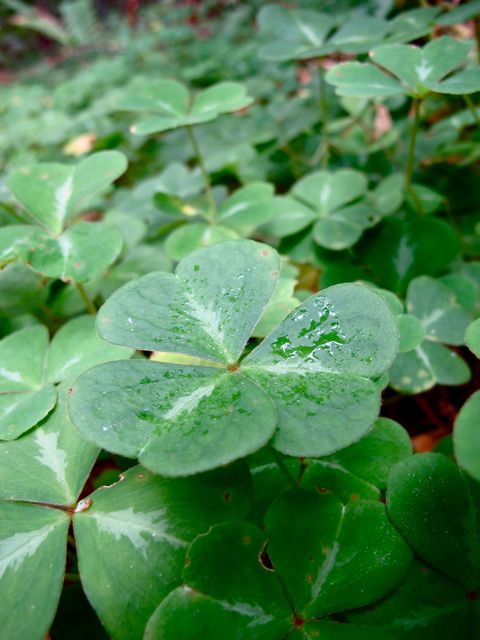
Deep under the shade of the redwood trees is a brilliant swathe of green. A field of tiny three-leaved plants carpet the forest floor. This is redwood sorrel, or Oxalis oregana. Each heart-shaped leaf has a pale splotch along its midrib, as though it had been folded around a dab of light green paint in a kindergarten art class.

When I was a kid, this little plant was a favorite treat. It’s edible and easy to spot, so I would eat it all the time. The leaves have a fresh, lightly bitter flavor like a mild lemon. You can add them to salad or other foods, and since they love to grow in shade they are a nice addition to a garden that doesn’t get full sunlight. In late spring they sprout an attractive, pale-pink flower.

An interesting list of historical uses is described on the Native American Ethnobotany Database: chewed redwood sorrel roots were applied to sore eyes. It was given to anyone who didn’t feel like eating, and used as a wash to treat rheumatism. Poultices were applied to boils, sores and infections. Leaves were eaten raw, cooked with grease, or with dried fish. One source says the stems could also be used to make a rhubarb-like pie–but wow, that would need a LOT of stems.Oxalis_oregana

Leave a comment

Filed under Edible, Good for gardens, Native, Plant of the day

Plant of the day: toyon

Heteromeles arbutifolia

Small, dark green trees with clusters of white flowers are scattered here and there across the hillsides. This is toyon (Heteromeles arbutifolia). It will truly come into its own in a few months, when clusters of brilliant red berries begin to ripen. Toyon is also called “christmas berry” for these cheerful December fruit, which once were sold as a local substitute for similarly colored holly sprigs.

Don’t get any ideas about collecting your own–it’s now illegal to harvest wild toyon. This species is often a part of the scrubby chaparral community, but you can also see it in oak woodlands and other forests and shrublands across the state. The berries are described as having a “sweet and spicy” flavor, and a tea made from the leaves was used for irregular menses, aches, pains, stomachaches, and to wash wounds. Californians once ate the fruit regularly–roasted, toasted and fresh. Spanish settlers made a drink from the bark, and Channel Island fishermen used it to tan their fishing lines.

Leave a comment

Filed under Edible, Medicinal, Native, Plant of the day

Plant of the day: leather oak

Oaks are generally thought of as tall, graceful trees. But you can also find them in the sea of waist-high bushes known as chaparral. Leather oak (Quercus durata var. durata) is a common sight on serpentine soils in this area.

This slideshow requires JavaScript.

Leather oak can grow to around nine feet tall, but I have mainly noticed them growing much closer to the ground. Look close to spot acorns or clusters of catkin-like flowers among the small, grayish green leaves. The leaves of this species are dull, dusted with a pale fuzz (paler on the top than on the bottom). They also are concavely curled towards the ground–you could flip one over and use it for a little spoon, if they didn’t have a tendency to be spiny.

As with all acorns, the nut of the leather oak is edible once its bitter tannins have been leached out. Acorns were historically a major food source for local Native American tribes, and still are a major part of the food chain for wildlife. People generally remove tannins by soaking the nut in water (or a running stream). But some tribes would plant the acorn in a bog and wait until it sprouted in the spring–a system which apparently got rid of most tannins but preserved more nutrients than the water method.

Acorns can be eaten whole, or ground into a floury powder for cooking. Roasted acorns can be used as a coffee substitute.

Leave a comment

Filed under Edible, Native, Plant of the day

Plant of the day: coyote brush

Small white flowers are beginning to bud and bloom on a sweet-smelling bush of the chaparral. This is coyote brush, or Baccharis pilularis. For some reason that I can’t put my finger on, I find this a particularly charming plant. Its small leaves are scalloped at the edges and rough (and sometimes sticky) to the touch. On hot days, you can tell it’s nearby just from the resinous, pleasant smell.

This slideshow requires JavaScript.

Coyote brush blooms in late summer and early fall, and bears its male and female flowers on separate plants (the botanical word for this is “dioecious”, as opposed to most plants which are “monoecious” and have their male and female parts on the same plant, usually in the same flower).

You can find coyote brush growing from Baja California to Tillamook County, Oregon; from coastal scrub to foothill forests. Generally its an upright shrub, but along the coast it can also grow in a prostrate form that once was (but no longer is) considered a different species.

1 Comment

Filed under Native, Plant of the day

Plant of the day: pampas grass

Cortaderia jubata

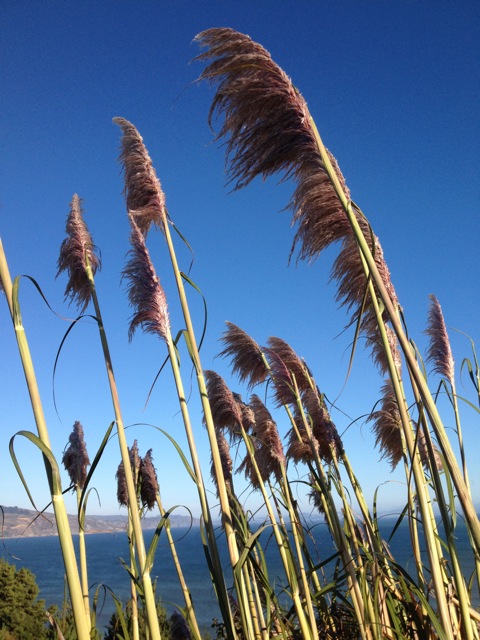
People who don’t know better think that pampas grass is beautiful–and in most ways, it is. The flowers of this gigantic grass are showy plumes that wave in the wind like horses’ manes or pennants. The leaves are long and trailing, and as wide as a large man’s finger. The whole plant, including the lofty bloom, can be up to 20 feet tall.

But this striking plant is also a noxious invasive, imported from Argentina and the Andes. It grows quickly in disturbed areas like cliff faces and road cuts, and forms large patches that crowd out smaller or slower growing native species.

There are actually two species that are commonly called pampas grass–Cortaderia jubata and C. selloana. Both thrive along the coast, but jubata (sometimes also called jubata grass) is restricted to coastal areas, while selloana also grows farther inland. Jubata plumes are purple or lilac, tending towards white as they age. This species can also be distinguished from its cousin because it holds its plumes quite high above the mound of leaves.

Both species of pampas grass bear their male and female flowers on separate plants (the botanical word for this is “dioecious,” as opposed to most plants which are “monoecious” and have their male and female parts on the same plant, often in the same flower). But while C. jubata reproduces asexually and lives for ten years or more, C. selloana can only reproduce if another plant of the opposite sex is nearby.

3 Comments

Filed under Invasive, Non-native, Plant of the day

Plant of the day: wax myrtle

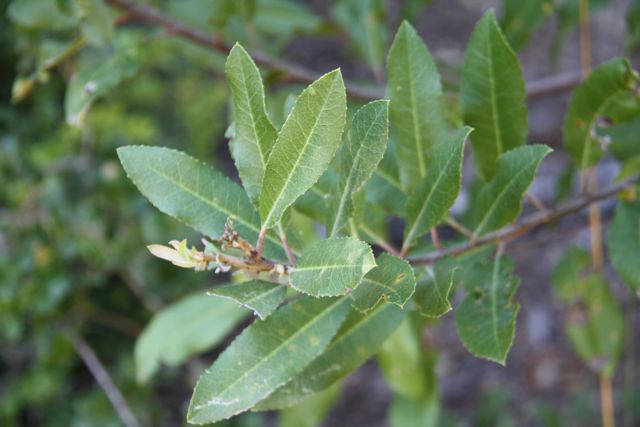
The berries of the California wax myrtle look like they are made from grains of purple wax, all pressed together into a ball. You can see them now, growing close to the stem in the Bishop pine forests of Point Reyes (and elsewhere). This small tree (Morella californica) has long, narrow leaves with pointy tips.

This slideshow requires JavaScript.

Both the coating and the pulp of the berries contain wax, which can be gleaned by boiling them. The wax is said to make a pleasant-smelling candle if enough is collected. The berries, while not toxic, are not said to be tasty either (I admit I’ve never tried them). They also can be used to make a purple dye.

Leave a comment

Filed under Native, Plant of the day

Plant of the day: salal

Gaultheria shallon

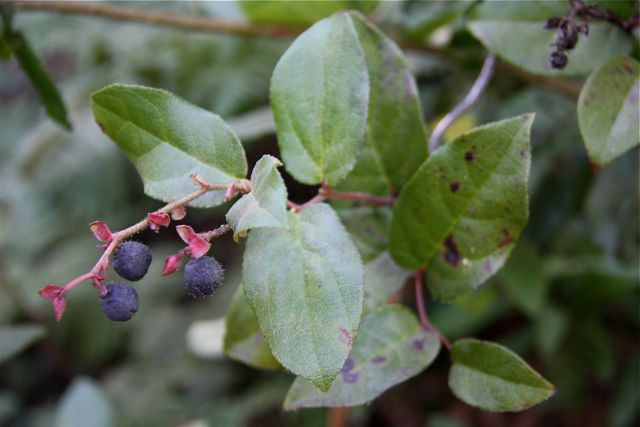
Salal is a familiar companion of the forest underbrush from Alaska to Santa Barbara. It is unadorned for most of the year, a simple shrub with largish (~4 inch) leathery leaves that dance up alternate sides of a slightly zig-zagged stem. In between the large veins, the leaves are traced with an intricate lacey pattern somewhat like the crease on the palm of a hand.

Small bell-shaped flowers of pinkish white appear at the tips of the stems in the early summer, and by now the dark purple fruit has ripened. Each berry is lightly hairy, and they are fairly sparse on the plant. Though edible, I have found them to be bland the few times I’ve tasted them. The leaves can be made into “a pleasant tea“, and poultices made of the leaves were traditionally applied to cuts, burns and sores. The fruit or leaves were also used to make dyes (of purple or yellow).

Leave a comment

Filed under Edible, Native, Plant of the day