Category Archives: Plant of the day

Plant of the day: American speedwell

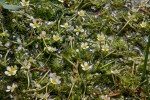
A little spring-fed stream is densely filled with the abundant deep green leaves of a low-growing plant. Petite blue-purple flowers bloom here and there in the foliage. This is American speedwell, or Veronica americana. A splayed pair of stamens surrounded by four small petals (the bottom one sometimes slightly smaller than the other three) are characteristic of the many species of speedwells.

American speedwell (also called brooklime) is native to temperate parts of North America and Asia. This plant loves to grow in slow-moving water, where its fleshy stems grow into a sprawling tangle. It is tart but edible, and high in Vitamin C.

Leave a comment

Filed under Edible, Native, Plant of the day

Plant of the day: water buttercup

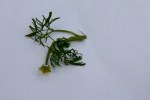
Petite cream-colored flowers peek above the still surface of a pond. Small white petals are banded with yellow at the center, surrounding a buttery cluster of yellow stamens. The flower has a glossy shine, akin to that of its land-locked buttercup cousins. Look close and you’ll see the flowers are rising from a mat of yellowish-green leaves just below the surface. Water buttercup (Ranunculus aquatilis) is also called whitewater crowfoot, likely because the narrow twiggy leaves look like the bony feet of a bird.

You can see this plant all over California and throughout much of the west. The photos shown here were taken in the high Sierra, where a spring had made a small pond in an otherwise very dry landscape of sagebrush and juniper; the seeds must have been deposited by a bird that stopped there for water.

Leave a comment

Filed under Botany basics, Native, Plant of the day

Plant of the day: chamise

Adenostoma fasciculatum

Chamise is a needle-leaved shrub of the chaparral. Right now it’s spikes of small white flowers are fading to brown, but the dried flowers will stay on the bush for most of the summer. A close look at those that are still blooming will show five little petals and the long splayed stamens. The flowers are so small that even when a bush is in full bloom it looks understated, not showy.

The small, leathery leaves of chamise (Adenostoma fasciculatum) are about a quarter of an inch long and grow in bunches off the stem. This is one of the most common chaparral plants, and its leaves secretes an oil that burns easily. Native tribes used the oil to treat skin infections (they also used an infusion of bark and leaves to treat syphilis, and collected scale insects from the plant to make a glue for arrows and baskets).

2 Comments

Filed under Native, Plant of the day

Plant of the day: golden chinquapin

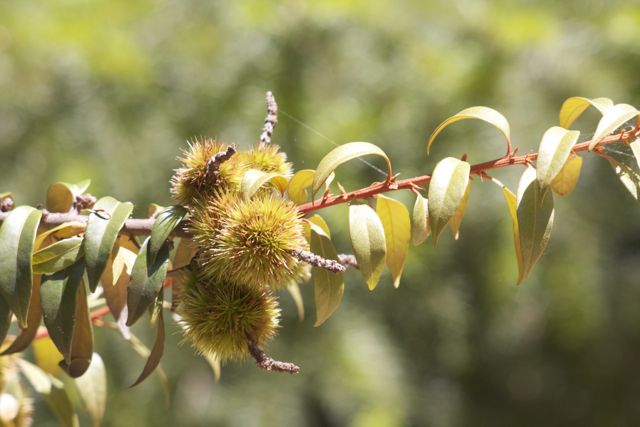
Golden chinquapin with nut

In the scrubby underbrush of dry hillsides is a shrub with velvety golden down on the underside of its shiny green leaves. This is the aptly named golden chinquapin (Chrysolepsis chrysophylla), which is a member of the oak family. It’s nuts, which are covered with a spiky golden husk, ripen in the summer time. The nuts are sweet-tasting and can be eaten raw or cooked; they were a common food for local tribes. If you plan to collect them, I recommend taking thick gardening gloves though–the spines are SHARP!!

Golden chinquapin is mostly found in coastal counties in California, but it does grow in scattered inland locations as well. It’s native to California, Oregon and southern Washington, where its range moves inland (and the plant gets larger). In our area it usually appears as a shrub, but don’t be fooled if you see a tree that fits the same description. The more widespread variety of this species is a tree that can grow up to 60 feet tall!

Leave a comment

Filed under Edible, Good for gardens, Native, Plant of the day

Plant of the day: coffeeberry

Frangula californica

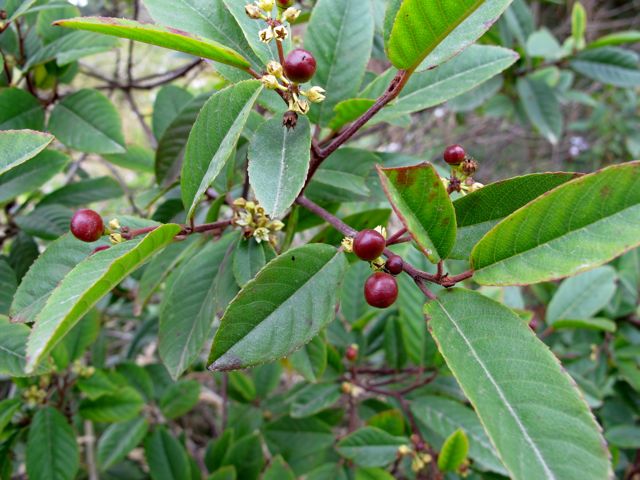
Reddish berries are nestled among the dusky green leaves of coffeeberry (Frangula californica), a tremendously attractive shrub of dry hillsides, canyons and chaparral. Its stems are often reddish also, and the slightly shiny leaves dance up the twigs on alternating sides. In places it can look like a small tree, but more often I have seen it as a medium-sized shrub.

Coffeeberry is an important food for wildlife–mainly birds, but deer will eat it when tastier stuff isn’t around. Critters from pigeons to black bears (and deer too) enjoy the berries, and woodrats will eat limited amounts of the coffee-bean-like seeds inside. I’ve never tried the fruits, but apparently they are sweet and tasty, and were eaten by Native Americans. The bark has a laxative effect, and once was exported for medicinal use.

Unfortunately this pretty little native is vulnerable to Sudden Oak Death…

Leave a comment

Filed under Edible, Native, Plant of the day

Plant of the day: red elderberry

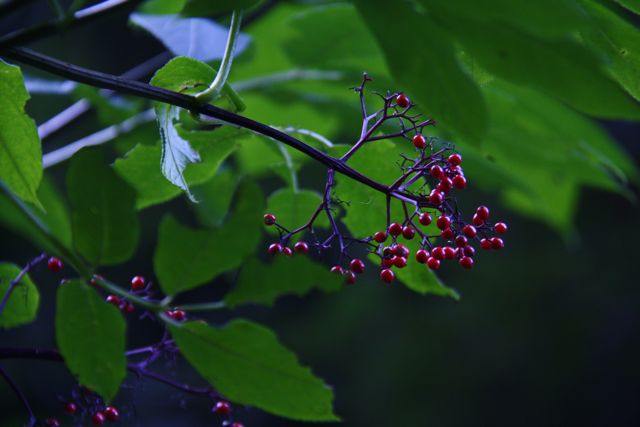
In the shade of the forest, clusters of brilliant red berries seem to glow with color. This is red elderberry (Sambucus racemosa), the cousin of blue elderberry which I wrote about yesterday. There is a lot less written about this beautiful plant–some sources say the berries are edible, some say they are not. My guess is that even if you can safely eat them they aren’t nearly as tasty as their blue cousins or more info would be available.

Despite their names, the Jepson database says that red elderberry can also be a blueish-black color; the way to tell it isn’t blue elderberry is that the dark form of the berries lack the glaucous white coating on their surface.

Leave a comment

Filed under Native, Plant of the day

Plant of the day: blue elderberry

Clusters of grayish-blue fruits hang from the branches of a small tree. Blue elderberry (Sambucus nigra) is a beautiful plant with arching branches. Its shaggy bark is wrapped around with furrows in older plants. The leaves are a fresh green and paired; each pinnate leaf actually looks like several leaves, since it is composed of 3–9 little leaflets.

Elderberry has a rich history of being used in cuisine, crafts, and medicine–but it must be approached with caution since the green parts of the plant and the unripe berries are quite toxic. The roots are the most toxic of all. But ripe berries make a delicious syrup, jam or wine, and the plant has long been cherished by traditional cultures. Petals can be eaten raw, made into a tea, or used to flavor pancakes. Some have even dipped the entire flower head in batter and fried it! Elderberry syrup is said to be an effective treatment for the flu; you can buy bottles of it at most health food stores. Native Americans used the branches for baskets, flutes and arrow shafts, and the fruit was a main food source.

Before the fruit is ripe, you can tell blue elderberry from its cousin, red elderberry, by the shape of the flower head. Blue elderberry has a flat-topped cluster, whereas red elderberry flowers are arranged in a pyramidal or roundish shape.

Notice the flower head is flat, not cone-shaped

Leave a comment

Filed under Edible, Good for gardens, Medicinal, Native, Plant of the day, Poisonous

Plant of the day: narrow leaf cattail

This tall reed rustles its leaves above a small pond. Long cylindrical flower heads look like two plump brown sausages on a spit. The sausages are actually flower heads, with the female flowers clustered in the lower, plumper segment while the male flowers are clustered together above.

These are narrow leaf cat-tails, a common sight in wetlands or roadside ditches. There are actually three species here in the Bay Area that hybridize with one another; the main way to tell them apart is by the flower heads (if the skinnier flower head is stacked immediately above the fatter one with no gap of stem visible in between, you’re looking at common cattail, or Typha latifolia). The two species of narrowleaf cattail (T. domingensis and T. angustifolia) are harder to tell apart–look for orange or yellow flowers, and dark dots on the inside of the lower leaf, to ID T. domingensis.

Leave a comment

Filed under Native, Plant of the day

Plant of the day: salty Susan

Jaumea carnosa

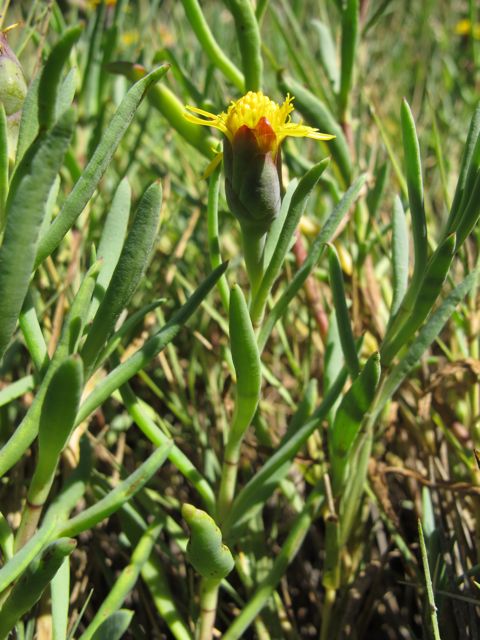
Nestled among the pickleweed are patches of grayish-green plants with bright yellow flowers. This fleshy-leaved little aster is Jaumea carnosa  (also known as marsh jaumea or salty Susan), and the patchiness is because it spreads by rhizome, or underground stem. Jaumea is common in the upper reaches of salt marshes along the Pacific coast from California to Canada. It’s affinity to the sea is a strong one: you won’t find it growing above 16 feet in elevation!

Even though Jaumea stands out as one of the comparatively few plants that grow in salt marshes, there’s not much information on this little plant. As far as I can tell, it’s not edible and hasn’t got any significant cultural or historical uses. It’s just an upstanding citizen that likes to grow at the upper edge of the tide, quietly going about its business of flowering and photosynthesizing.

Leave a comment

Filed under Native, Plant of the day

Plant of the day: showy St. John’s wort

Yellow flowers and myriad long, wild stamens deck this creekside bush. Here is a St. John’s wort–Hypericum grandifolium. It looks out of place along a not-very-remote trail, and upon looking it up later I realize that impression was spot on. There are several species in the Hypericum genus dubbed St. John’s wort, of both native and non-native varieties. I happen to have stumbled across what is really a slightly misguided garden plant. The CalFlora database only lists two observations in the state!

There are several other species of Hypericum that are much more common that you can keep an eye out for. All will have similar flamboyant yellow flowers. Possibly the most common is Hypericum perforatum, a low-growing shrubby plant that naturalized from Europe. It has long been used as a medicine in homeopathy, naturopathy and traditional remedies. It is acclaimed for having antibiotic and antidepressant properties, and for soothing nerve pain. The plant’s compound hypericin is said to inhibit HIV.


Leave a comment

Filed under Non-native, Plant of the day