Category Archives: Plant of the day

Plant of the day: pickleweed

The pickleweed is in bloom, but you probably won’t notice.

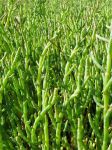
First, you would have to notice the plant itself. Sarcocornia pacifica is a fleshy, low-growing plant of the salt marshes. It is named for its leafless, segmented succulent stems, which resemble tiny pickles. Or, little green fingers. I think it’s an adorable plant, but it is undeniably unobtrusive. Often people just see it as something to step on while they are getting to the water, the beach or the view…
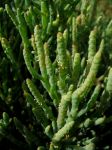
To see the flowers, you have to look even closer. The blooms themselves are simply tiny white threads emerging from the green wall of the plant; you can barely see them with the naked eye (click on the middle picture to get an idea).

I’ve never nibbled on it, but pickleweed (also called Virginia glasswort) is edible, with a mild salty flavor. Not surprising, since it often grows in a dense mat along the wet edges of marshes. Regularly drenched by the tide,  it has the ability to absorb large amounts of saltwater.

1 Comment

Filed under Edible, Native, Plant of the day

Plant of the day: alkali heath

Along the edge of a lagoon is a small purple flower perched atop dusky green leaves. This is alkali heath, or Frankenia salinaIt’s mainly found in California, though it also can be found occasionally in other parts of the US.

This plant often grows in dense clumps, but it is not very tall. I have only seen it growing to about a foot tall, and that is when it was using other plants for support.

Because it grows in areas that are often submerged by the tides, alkalai heath has the ability to withstand large amounts of salty water–unlike most plants. The technical description for this talent is “halophytic”, and the community of plants that shares this trait is comparatively small. With its five purple petals, comparatively long stamens, pale green leaves and ability to live in salty marshes, alkalai heath is fairly unique to identify.

Leave a comment

Filed under Native, Plant of the day

Plant of the day: stinging nettle

Urtica dioica

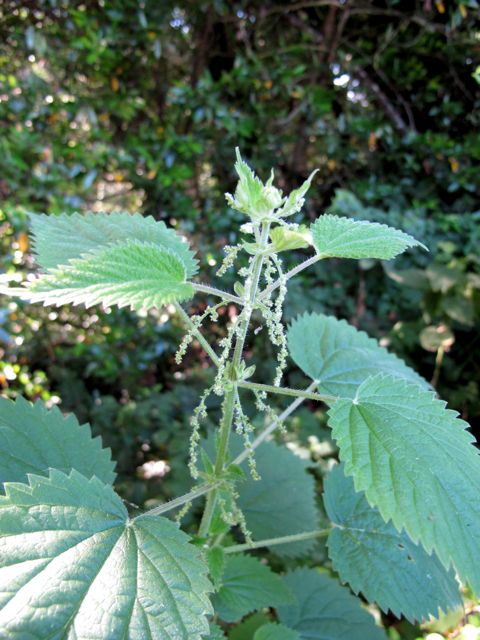
Stinging nettles are a common denizen of the shady forest. These tall plants have heart-shaped leaves with jagged edges like the edge of a bread knife. Though seemingly delicate, Urtica dioica packs a hidden weapon: stinging hairs that give a painful bite to the bare skin of any unwary passersby.

But these plants are friend as well as foe. They are tasty as a tea, in soup, and also as an addition to one of my favorite fancy cheeses. Nettle wine is still being made. Even brief exposure to heat destroys the sting, but some actually seek it out–a British nettle eating competition is a vivid example. One winning contender ate the leaves off 48 feet of stalks! I don’t recommend trying this. But I can vouch that a tea made from the fresh leaves is delicious. Collect them using a plastic bag or gloves, and simply pour boiling water over them in a cup. The water turns a dark green with a rich flavor, and when you drain your cup the leaves can be eaten as well. The plant contains large amounts of chlorophyll, and is a natural source of magnesium, iron, and calcium. Plus it’s delicious!

Nettles have had many uses besides food over the centuries as well. The fibrous plants are great for textiles–they have been made into shrouds, sailcloth, rope, silk-like fabric, and military uniforms.

Stinging nettles are native to Europe, Asia and also North America. There is another, less common type of nettle as well. Dwarf nettle is low growing, less than 1.5 feet tall as opposed to stinging nettle which grows 3 to 10 feet tall. Also, it isn’t native to California.

1 Comment

Filed under Non-native, Plant of the day

Plant of the day: tall flatsedge

Cyperus eragrostis

It sort of looks like a grass, but not quite. The leaves are thicker than your typical grass, and the stem is triangular in cross-section. The leaves are in threes, not in pairs as in grasses. And the big, robust seeds are nestled among long splayed leaves at the end of the stalk.

This is tall flatsedge, or Cyperus eragrostis–one of the most common sedges in Marin. Though partial to wet meadows, seeps, springs and stream banks, it can be found in in dry areas as well. Sedges (and grasses, and rushes) are particularly hard to ID since they have tiny flowers and require a lot of specialized terminology. For more information on how to key these plants, check here and here.

Leave a comment

Filed under Native, Plant of the day

Plant of the day: Indian teasel

Dipsacus sativus

The distinctive silhouette of teasel (Dipsacus sativus) is a familiar sight in the coastal parts of California. Thick, pointed bracts jut out, like splayed arms beneath the cone-shaped flower head. This structure stays standing long after the small white flowers have faded; people collect the dried stems for decoration. The spiny flower heads are so stiff they were used to card wool before metal carding combs were created!

Sadly this odd-looking plant is also a fairly nasty invasive. It can form dense chest-high thickets that are impassable to both people and animals. This European invasive likes to grow in disturbed areas: along roadways, in ditches and on grasslands. Another species, wild teasel (Dipsacus fullonum) is less common locally but more widespread throughout North America. It has pink-to-purple flowers and sharply upcurved bracts. Just to confuse things, both species also go by the common name of  Fuller’s teasel.

Leave a comment

Filed under Invasive, Non-native, Plant of the day

Plant of the day: snowberry

Clusters of stark white berries dangle from leafy stems in the forested understory. Snowberry (Symphoricarpos albus) is perfectly named for its color.

This pretty bush is in the same family as honeysuckle, and is native to Canada and much of the US (except for the southernmost states). Some sources say that the berries are NOT edible, with symptoms listed as vomiting, dizziness and mild sedation in children. However, west coast tribes ate the fruit both fresh and dry (though they apparently didn’t prefer it). It was also used as a shampoo, a poultice, and a treatment for STDs. The wood was used as arrow shafts and pipe stems.

There are two species of snowberry in Marin, and several others are found throughout California. In Marin, you can tell common snowberry from its cousin, creeping snowberry, because it is taller and doesn’t have hairs on the top of its leaves.

Leave a comment

Filed under Plant of the day, Poisonous

Plant of the day: Pacific blackberry

So you thought a blackberry was always a blackberry, huh? Well, no. Or rather, there are a few different kinds of blackberry, so you have to look close.

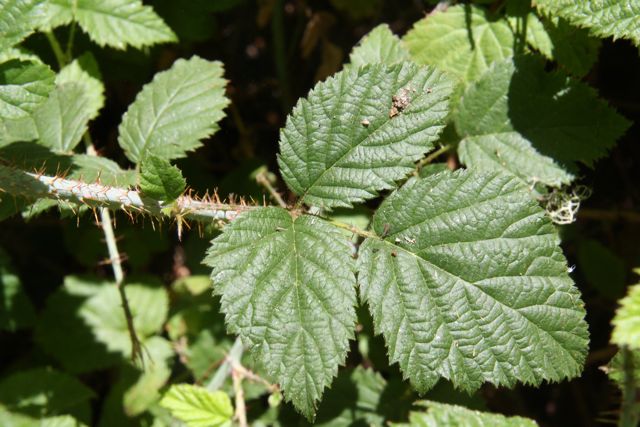
I wrote about the invasive Himalayan blackberry a few weeks ago–but now the native Pacific blackberries (Rubus ursinus) are beginning to ripen, so keep your eyes out for them as well. Superficially, these look similar to their invasive cousins. Both grow in prickly mounds of briars. Both have leaves that generally are in groups of three, and many-segmented berries. But Pacific blackberries are all-around more delicate: their berries and their thorns are both more delicate, and their leaves are a lighter green and a thinner texture. Flip one over, and the Pacific’s leaf will be green below while the Himalayan’s leaf will be white.

If you get a look at the flowers, the distinction gets even easier. Pacific blackberry is the only local member of the Rubus genus to have gender-segregated flowers. What this means is that instead of male stamens and female pistils being in the same bloom, some flowers only pack pistils while others only sport stamens.

And that is why botany is awesome.

Leave a comment

Filed under Edible, Good for gardens, Native, Plant of the day

Plant of the day: scarlet monkey flower

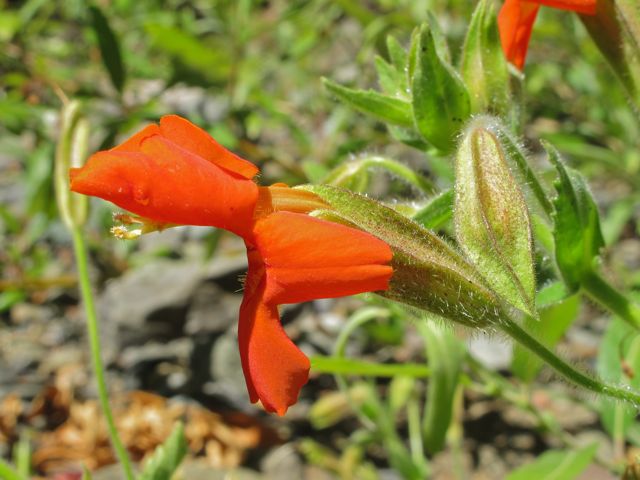
Orange-red flowers grow in the dappled shade of a dry stream bed. This is the scarlet monkey flower, or Mimulus cardinalis–one of the most lovely of this group. With bright green leaves and flashy flowers it is a treat in gardens and wild places alike.

Hummingbirds, butterflies and other insects also love this plant, but deer do not. Native plant gardeners rave about the monkey flowers in general for this reason.

Scarlet monkey flower is usually found near water, and so when you see it you have a strong clue that you’re in a wetland or near a stream (and below 8,000 feet, which is the upper limit of its range). You can see them growing in most parts of California from the northern Sierra to San Diego. Outside of the state, it grows north into Washington state and east as far as New Mexico.

Leave a comment

Filed under Good for gardens, Native, Plant of the day

Plant of the day: California poppy

If you learn only one plant as a Californian, it should probably be this one. Our state flower is simply stunning. Rich orange flowers bloom lushly atop feathery foliage. The cup-shaped blossoms were originally pollinated by beetles, but they have also become a favorite of the introduced European honeybee.

This slideshow requires JavaScript.

California poppy (Eschscholzia californica) is one of the most beautiful flowers of the spring, and it blooms well into the summer with good showings still going on. In this area they usually grow in scattered patches, but in places you will see them blanketing hillsides or valleys in a carpet of orange (eg Santa Barbara’s Figueroa Mountain). In harsh places the flowers can be on the small side, but in good conditions each of the four petals can be over two inches long. This poppy is native to the west coast of North America, but because it is a beautiful and hardy garden flower it has been introduced to many other parts of the country and the world.

Native Americans are said to have used the pollen as a cosmetic. They also ate the leaves, and used the plant as a mild pain-killer to treat insomnia and toothache. Extract of poppy is still sold today, and was touted as an alternative to Oxycodone by television personality Dr. Oz.


Leave a comment

Filed under Good for gardens, Medicinal, Native, Plant of the day

Plant of the day: farewell to spring

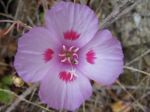
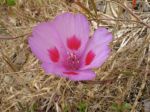
Pink, poppy-sized flowers show up with a flamboyant burst of color on the browning hillsides. Each of the four delicate petals are dotted with a dark red splotch. This is farewell to spring, or Clarkia amoena.

There are several species of Clarkia in Marin that differ slightly from one another; this species can be either white or pink. You can distinguish it from the other similar species because it has red splotches instead of a red ring on the petals, and the buds don’t droop. These flowers seem to thrive on dry road cuts – I’ve seen them growing along Highway One in several different places (these photos were taken just south of Tomales).

1 Comment

Filed under Native, Plant of the day