Category Archives: Plant of the day

Plant of the day: bull thistle

One of the most common thistles around is bull thistle, an invasive species from Europe. Its showy purple flowers are beloved by bumble bees and other insects, but its spiny leaves are a bane to ranchers.

Bull thistle (Cirsium vulgare) grows most abundantly in coastal grasslands, along the edge of marshes, and in sunny openings in forests, according to the California Invasive Plant Council – but it is found in every state in the country. You can recognize this species because the leaves don’t stop when they meet the stem; instead they run down along it like little spiny wings.

This plant thrives on disturbance; it grows most readily when the soil is disrupted by plowing, logging, digging and so on. Even gopher activity can give it a boost!
Leave a comment

Filed under Invasive, Non-native, Plant of the day

Plant of the day: creeping buttercup

In low wet places, a mat of green leaves and yellow flowers grows. The flowers have five glossy, spreading petals and many stamens. Pale green splotches dot the leaves, which are three-parted and ragged at their ends.

This slideshow requires JavaScript.

This is creeping buttercup, or Ranunculus repens. It’s a mildly invasive plant that is becoming common along trails and roadsides where it can form large patches. Its stem can sprout roots where it touches the ground, enabling it to spread easily.

This flower is a relative of the taller, leggy California buttercup (a native).

Leave a comment

Filed under Invasive, Non-native, Plant of the day

Plant of the day: cobweb thistle

On an open hillside is a graceful thistle with whitish stems and leaves. Look close and you’ll see a cobweb-like webbing stretched between the spines. This is cobweb thistle (Cirsium occidentale), one of the most beautiful of the native thistles. A busy community of bees, ants and other insects also find it attractive! You’ll see them buzzing and crawling around the plant and (apparently) sometimes dozing in the flowers.

There are a LOT of thistles in the area; CalFlora lists eighteen different species, most of which are invasive. But unlike these non-native species, cobweb thistle tends to grow singly or in sparse groups. And plus, it’s cobwebby. There are other native species with this feature (the technical term for cobwebby is “arachnoid”) but they have leaves right beneath the flower head, and a very different growth form.

Leave a comment

Filed under Native, Plant of the day

Plant of the day: pennyroyal

As I walk down the marshy trail there is a strong minty smell in the air. This is coming from small purple-flowered plants: pennyroyal, or Mentha pulegium is in the mint family and almost always grows in wetlands. Even if the ground appears dry, it’s a strong indicator that a low summer-dried fields or valleys was wet in the spring, according to the Flora of Marin. Pennyroyal is another weedy non-native species native to Ireland and other parts of Europe.

This slideshow requires JavaScript.

There are a lot of other members of the mint family that have tuft-like purple flowers, but pennyroyal is the only one in the area that has discrete whorls of leafless (or small-leaved) flowers in stacks along the stem.

Leave a comment

Filed under Invasive, Non-native, Plant of the day

Plant of the day: fennel

It tastes great in salads, but fennel (Foeniculum vulgare) is an unfortunate weed in California. It grows avidly along roadsides and in other disturbed places. This plant grows up to ten feet tall, with feathery leaves and yellow umbrella-shaped umbels of flowers.

This slideshow requires JavaScript.

The leaves and the seeds have a distinctive licorice flavor, which is likely why the plant came to the Americas in the first place. It’s been used as a spice and a medicinal plant for centuries, and is thought to have escaped into the wild time after time.

Fennel is an invasive species, and takes over areas by forming dense stands where nothing else can grow. This isn’t just because the plants are so numerous that there is no room for any others. They also exude chemicals that actually prevent their competitors from growing!


Check out the above video for an musical animated interpretation of why fennel is a problem…
 

Leave a comment

Filed under Edible, Invasive, Non-native, Plant of the day

Plant of the day: yellow star-thistle

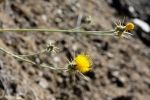
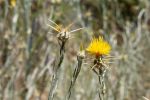
A wash of prickly, pale green stems is scattered across a dry field. Yellow flowers are surrounded by a mean halo of long narrow thorns. Here is yellow star-thistle (Centaurea solistalis) one of the nastiest invasive plants around. It’s a big problem on farmland and in wild places along the west coast. It interferes with grazing, and eventually leads to permanent brain damage in horses that eat it.

Introduced in the 1850s, this thistle is now the most widespread invasive plant in California, infesting between 10 and 15 million acres in the state. A native to southern Europe, it probably first came to the US indirectly, along with alfalfa seed imported from Chile. By the early 1900s it was a serious weed in the Sacramento Valley and was spreading quickly along roads, railways, trails and streams, according to the CalIPC. “It is a thousand times as common as ten years ago, and perhaps even six years ago,” observed Willis Jepson in 1919.

Things have only gone downhill from there! And it’s not surprising why. This deeply taprooted annual invades summer-dry grasslands across most of the US. A single large plant can produce nearly 75,000 seeds, and blooms from late spring through fall. It’s largely pollinated by honeybees but doesn’t have much in the way of predators, and so it continues to spread.


Leave a comment

Filed under Invasive, Non-native, Plant of the day

Plant of the day: California bluebell

Asyneuma prenathoides

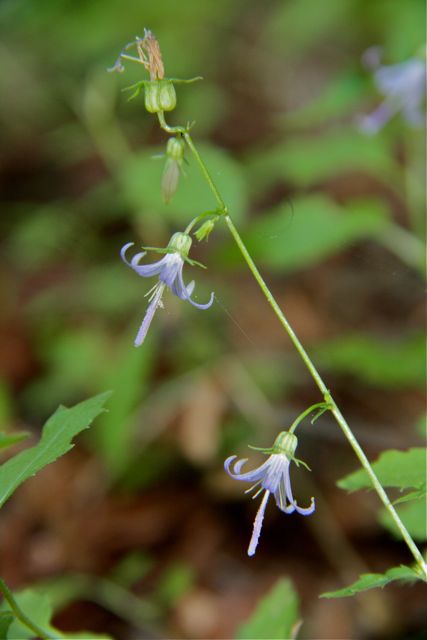
Delicate pale purple flowers grow in a low mat of green leaves on the forest floor. It’s worth stopping and getting close to check out the lovely little blooms. Five narrow, pointed petals curve backwards, away from a long slim purple-dusted pistil. As the flower matures, the pistil opens into three parts for receiving pollen.

Other names for this Asyneuma prenathoides include California harebell and slender bluebell, but I have always known it by the name found in the Peterson Guide. It once was in the Campanula genus along with the more traditional-looking bluebells but somewhere along the line it was re-assigned to a different group (something that happens a lot in botany as new features, genetic analysis, or other information comes to light).

Leave a comment

Filed under Good for gardens, Native, Plant of the day

Plant of the day: moth mullein

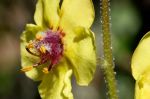
A flash of pale yellow underneath a coyote bush. Growing up under the gray branches of the shrub is a stalk holding several pretty, broad-faced flowers. The five petals surround a hairy, reddish-pink cluster of stamens. The stamens and pistil are flamboyant: the three upper stamens are clustered together, while the lower ones–and the pistil–scoop outward, presumably an invitation to insects.

This unusually striking flower is moth mullein (Verbascum blattaria), and unfortunately it’s not a native to California. It was introduced from Eurasia and has spread across much of the United States. Other species of mullein share the distinctive hairy-ness and the unusual stamen-and-pistil pattern, but otherwise look quite different.

Leave a comment

Filed under Non-native, Plant of the day

Plant of the day: canyon gooseberry

This gooseberry is a prickly delight. From its elegant branches to its troublesome little berries, Ribes menziesii has a lot of character. The berries are edible–and yummy!–but you have to get past the spines to enjoy them. There’s no easy way to do this; you can try peeling with a pocket knife or just chewing carefully. I’ve also tried popping them with my teeth first, before chomping down. This seems to work the best, but you’re still bound to get prickled a few times.

This slideshow requires JavaScript.

Overall this plant is better for looking at than for eating, especially in spring and summer. The thorny branches sport scalloped green leaves on gracefully arching branches, and in the spring it puts out masses of small lantern-shaped flowers that bees love.

Gooseberries are a type of currant, and some of the local wild species (spreading gooseberry, flowering currant) are spineless–as are their store-bought cousins. In addition to the canyon gooseberry featured here, there are some other spiny species around as well (California gooseberry and Victor’s gooseberry). You can tell them apart because the first has smooth, hairless leaves and the second has shorter spines on the fruit that are all about the same length.

Leave a comment

Filed under Edible, Good for gardens, Native, Plant of the day

Plant of the day: western rasperry

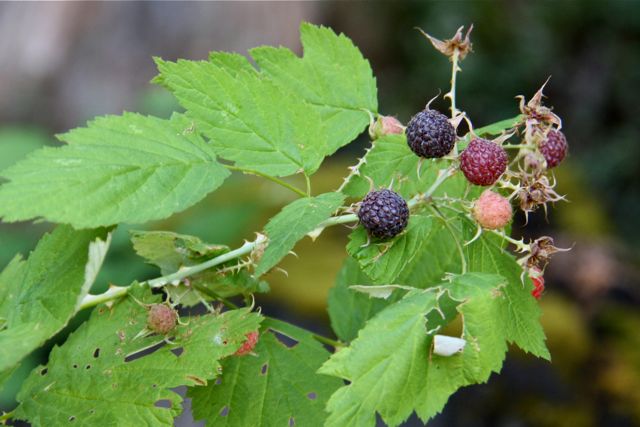
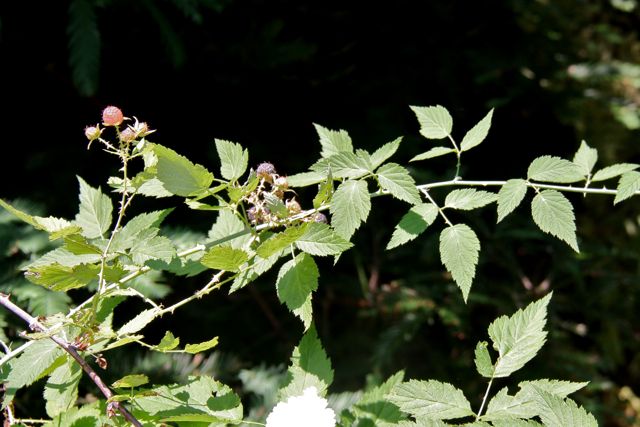
A sprawling pale-stemmed bush is decked with dark purple raspberries. Warmed in the sun, they have a mild, rich sweetness. These tasty fruits are smaller, leaner, and much darker than their plump commercial cousins. I’ve always preferred the wild version!

There are many listed names for Rubus leucodermis  (western raspberry, white stemmed raspberry and whitebark raspberry) but I’ve always just called this “wild raspberry” since it’s the only native one around. It’s in the same genus as Himalayan blackberry, but though the plants are similar they are easy to tell apart even when not in fruit. Western raspberry is a delicate shrub with slim branches that have a glaucous coating which you can rub off with a finger. The leaves of both species are three parted, but blackberries’ are much thicker and darker.

Western raspberry is one of my very favorite California berries, but you won’t see it growing in Marin. Sonoma County? Yep. Santa Cruz? Yep. Even down to San Diego and up into Alaska. But for some reason it doesn’t like the San Francisco bay – there’s no record of it  in SF, Marin, the East Bay, or the Peninsula.

Leave a comment

Filed under Edible, Good for gardens, Native, Plant of the day