Plant of the day: serpentine springbeauty

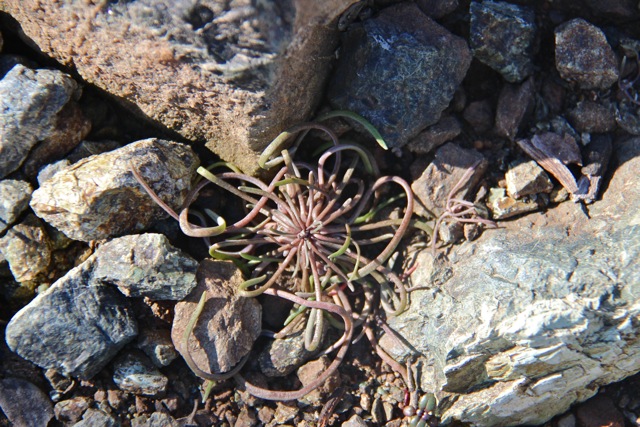
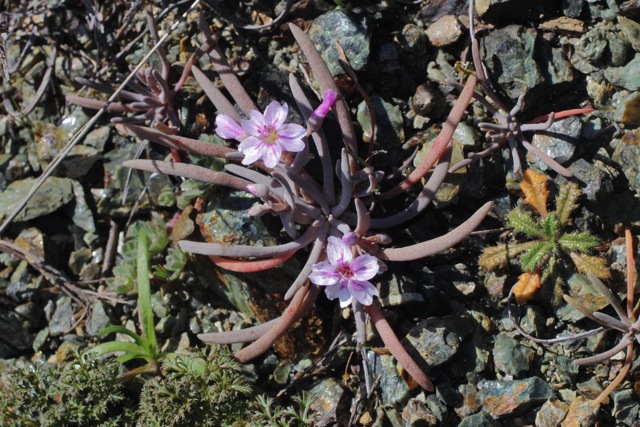
Claytonia_exigua1Clusters of tiny pink flowers grow on the bare rock and dirt beside the trail. If you don’t look close you might not see it at all–it is that small, and blends in with the reddish hue of the rocks. The flowers rise from a nest of long, strap-like leaves. Where found flowerless, the leaves look rather like a sea anemone with lean, purple-tinged arms.

This is serpentine springbeauty (Claytonia exigua), a diminutive plant that is adapted to survive in the harsh chemistry generated by this type of soil. It can be found on rocky slopes of serpentine, shale and sandstone.

Serpentine springbeauty is actually a cousin of the common (and tasty) miner’s lettuceClaytonia_exigua2

Leave a comment

Filed under Native, Plant of the day

Botany challenge!!

OK, my dear plant-loving eco-geeks of the world: here is a special challenge for you. How many different species can you tell are present where this picture was taken, based on this photo?

What clues do you see?

???

(Hints: The picture was taken in Marin, and all the species are native. I’ve written about at least four of them in this blog, but–despite the title of botany challenge–they are not necessarily all plants).

3 Comments

Filed under Plant of the day

Plant of the day: deer fern

This shy little fern isn’t very common in Marin, but it’s a lovely one to get to know–and where it does grow it’s often abundant. It looks sort of like a small, lean, blunted sword fern–though when you look close it’s really quite different. Deer fern (Blechnum spicant) is interesting because each plant has two different types of fronds–a handful that are fertile, with spores underneath, and the rest which are sporeless and sterile.

The fertile fronds have much narrower leaflets, pared down like the skeleton of a fish. Two rows of deep brown spores coat the underside of the leaflets. Each plant throws up several of these fertile fronds, rising upright above the drooping mound of sterile fronds. These leaves have thick, rounded leaflets that are a bright, darker green above and a paler, duller green beneath.

Leave a comment

Filed under Native, Plant of the day

Carson Ridge hike with CNPS

There are some of us who love meandering along trails, looking closely at flowers and foliage, debating taxonomy. We are a small but enthusiastic subset, it’s true–but what fun to be with folks of similar mind!

This slideshow requires JavaScript.

Last weekend I tagged along with the Marin chapter of the California Native Plant Society. Our hike rambled out through the serpentine chaparral of Carson Ridge, then down into a peaceful valley to admire Carson Falls.

This hike showcases the wealth of nature in Marin–there are undeveloped hills and valleys spreading as far as the eye can see, in all directions but south-east, where the Bay and its surrounding cities shine like gems. It’s amazing to think that the vast landscape we were hiking into is protected–mainly, where we were, by the Marin Municipal Water District. But MMWD land abuts County open space, State Park land, and National Parks as well, forming a great swath of public land, free for both wildlife and people.

CNPS16It was not a fast hike–but that is how I like it. There was plenty of time for photos, and I learned a lot, both from my highly knowledgeable fellow hikers and from our adept leader Amelia Ryan (who, in full disclosure, I’ve been friends with since I was six). The sun was shining, scenery was beautiful, the falls were lovely, and the company was good. What a treat.

Leave a comment

Filed under TRAIL NOTES

Plant of the day: western leatherwood

It’s easy to walk right past one of the rarest shrubs in California. Especially at this time of year, western leatherwood (Dirca occidentalis) is little more than a bundle of slim branches hidden in the dappled shade of the forest.

This slideshow requires JavaScript.

But despite being understated, this is a lovely plant. It produces its leaves and flowers from the same bud. First fuzzy, pussy-willow-type buds pop out all over the multiple, reddish-brown stems that rise from the ground. Then small but intricate yellow flowers emerge–first the long pistil, and then the many drooping stamens. As the flowers fade, the fuzzy young leaves begin to appear. In my limited experience with dirca, as it is often called, these things happen at different times on a single plant so you can see buds, flowers and young leaves all at the same time.

Dirca grows only in the San Francisco Bay Area–and even here it is a very rare sight. It tends to grow on moist hillsides, in partial shade. In the place where I saw one, it was under oaks and alongside hazelnut. The older stems were mottled, splotched with patches of white and gray.

Leave a comment

Filed under Native, Plant of the day, Rare

Plant of the day: green wattle

Acacia_decurrens1Swaths of yellow seem spray-painted on the landscape as I drive across Mt. Tam on Pantoll Road. This is green wattle, or Acacia decurrens, yet ANOTHER naturalized acacia.

As I keep writing about this genus, the more it seems like a game of mix-and-match. All the species look superficially similar, yet all have distinct combinations of leaf shape and flower type that make it easy to tell one from another.

The pom-pom-like flowers of green wattle remind me of those fiber optic table lamps that were popular back in the 80s: the ones where shafts of light dance up a spray of delicate filaments. There is something space-agey about these little blooms. They make a lovely sight, especially when they are fresh and surrounded by the tree’s dusky-green, feathery leaves. Each leaf is bipinnately compound, meaning the blade is divided then divided again into myriad tiny leaflets. This also is the only local acacia to have true leaves, not simply overblown, leaf-like petioles called phyllodes.

Green wattle is not native, but not listed as invasive by CalFlora. As with the other acacias, it is native to Australia. It also goes by the names wattle and black wattle–a wacky Aussie name if I’ve ever heard one!Acacia_decurrens2

Leave a comment

Filed under Non-native, Plant of the day

Plant of the day: everblooming acacia

Acacia_retinoides1I never knew there were so many different types of acacia! But there are, and it seems like they are all in bloom at once. Today’s plant is everblooming acacia (Acacia retinoides). This is in the pom-pom tribe–whereas the others that I’ve written about so far are in the bottle brush tribe. The flowers of everblooming acacia are tiny yellow balls of fluff. But be warned–it has cousins with very similar-looking flowers, so you need to look at the leaves to be sure which species you are seeing. Everblooming acacia has blade-shaped leaves with one prominent central vein. Except, just to confuse you, the “leaves” of almost all acacia trees are actually phyllodes–modified petioles (usually just the leaf stem) that have morphed to look like full-blown leaves. For this reason, in the key the central vein is actually called a “nerve”, which is its technically correct name.

Like the other acacias, this species is native to Australia and has naturalized into the semi-wild places near town. Unlike some species, it isn’t highly invasive and doesn’t spread far from where a parent plant once was planted–but it can be weedy on a local scale.

Leave a comment

Filed under Non-native, Plant of the day

Plant of the day: golden wattle

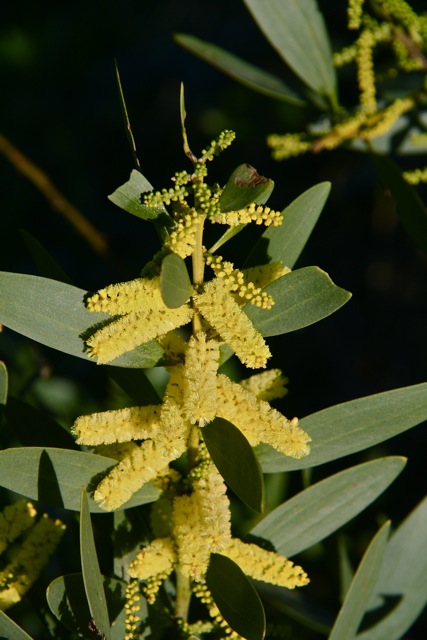
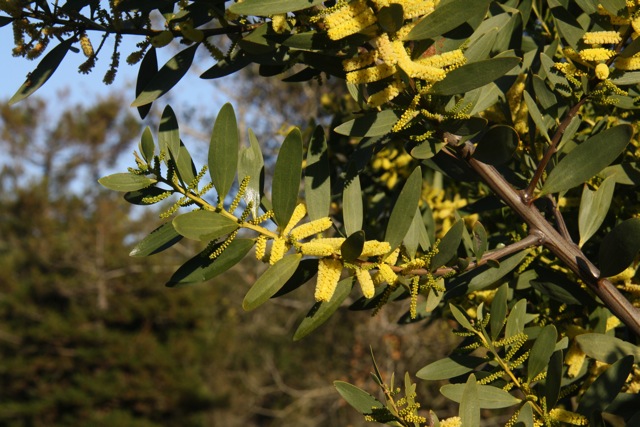
Acacia_longifolia21This small tree boasts little yellow bottle-brush flowers scattered among long, blade-shaped leaves. Sydney golden wattle (Acacia longifolia) is native to Australia, but has naturalized here in southern and central California. It is distinguished from many of the Acacias by having leaves that aren’t feathery or divided, and also by having long rod-shaped spikes of flowers, instead of puffy pom-pom-shaped balls.

The golden wattle is a fast growing plant, and is used in Australia and other countries to stop erosion. This member of the Fabaceae family can fix nitrogen through a symbiotic relationship with bacteria that live in nodules in its roots. The flowers, seed and seed pot are all edible. The cooked flowers have a light fragrance and are used in fritters. Flowers also can be used to make a yellow dye, and the seed pods make a green dye.

None of the Acacias are native, and many are invasive here in California.Acacia_longifolia1

Leave a comment

Filed under Non-native, Plant of the day

Plant of the day: beach strawberry

Fragaria_chiloensis1A rugged little beachgoer, this wild strawberry spreads across the sand via long stems called runners. Where these stems touch down and root, a new little plant will start up–spreading its small scalloped leaflets toward the sun.

Beach strawberry (Fragaria chiloensis) is a common sight in sandy seaside spots. Its cousin, wood strawberry, looks similar but has leaves that are thin and slightly hairy on the top. By contrast, beach strawberry has thicker, hairy, and distinctly glossy leaves. As their names suggest, the two also grow in different habitats. Both are edible.

Leave a comment

Filed under Plant of the day

Plant of the day: sand verbena

Abronia_latifolia1Heads of little yellow flowers decorate the dunes. This is sand verbena, or Abronia latifolia. Its prostrate stems are sprawled like sunbathers across the sand, raising their leaves and blossoms like a lazy wave. The flowers are some of the showier native dune blooms, and have a lemon-verbena scent. The succulent, scalloped leaves are pretty in their own right–especially when lightly dusted with sand.

You can find this little flower on the dunes and strand, and in coastal scrub, from Santa Barbara to Washington State. Its long, stout roots are edible and somewhat sweet. They were usually harvested in the fall by coastal tribes.

I saw spotted this verbena on the white sands of Asilomar during EcoFarm–a great conference, and a lovely state park and beach to visit at any time! Asilomar1

Leave a comment

Filed under Edible, Native, Plant of the day