Plant of the day: rattlesnake grass

The brown hills of California are far from monochromatic. Look closely and you’ll see a complex tapestry of colors, textures, shapes, sizes–and sounds! Do you hear that rustling rattle as you brush through the grass? Look close and you’ll see graceful stalks of rattle-shaped grass heads.

This is rattlesnake grass, or Briza maximaone of my favorite plants of the summer. Sadly this nice-looking plant is also fairly invasive (introduced from Europe, and occasionally planted as an ornamental). It’s now become naturalized in the Coast Range and in scattered other parts of California, which is why you see it almost everywhere.

Leave a comment

Filed under Invasive, Non-native, Plant of the day

Spectacular Steep Ravine/Dipsea loop

Ramble downhill through a wonderland of ferns and old-growth redwoods. Huge old trunks tower over your head, and beams of sunlight filter down along with birdsong and the sweet smell of the branches. This is the Steep Ravine trail, and it’s aptly named. The ravine that it follows is steep, with towering canyon walls rising up on both sides from a narrow boulder-strewn creek below. In places, giant redwoods have fallen and wedged between the banks, like rustic bridges or a giant game of pick-up sticks. The trail itself is also steep, dropping precipitously down the flanks of Mt. Tam. A little over half-way from the Pantoll Parking Lot, there’s a sturdy 10-foot wooden ladder to help hikers down a particularly steep spot.

This slideshow requires JavaScript.

The uphill leg of the loop is a chunk of the Dipsea trail, which Steep Ravine merges in to after nearly two miles. At this junction you can either keep heading downhill to Stinson Beach, or you can turn left to head up the Dipsea (I like to do the loop hike in this direction since this part of the Dipsea has a LOT of steep stairs, which can get slippery when it’s wet. But in any weather I’d rather go up these stairs than down them).

The Dipsea leg is as beautiful as the Steep Ravine leg – the first section of the climb is so steep that it feels like you’re in a tree fort. The crowns of big old Doug firs are at eye level when you look out over the canyon. Later in the hike you pass through huckleberry stands, dense groves of skinny (young?) redwoods, gnarled oaks and bays, and then out into the high Tamalpais grassland with sweeping views of the Pacific ocean. The trail heads south for a ways before meeting up with the Coastal Fire Road that leads you back to Pantoll.

This loop is a great spot to see a lot of different kinds of plants. The microclimate changes sharply as you move up and down the mountain, from the narrow moist ravine into the open high-elevation grassland. There are many species of shade-loving ferns and lots of wildflowers. At this time of year, a lot of plants were in fruit but I still saw lots of blooms as well.

If you’re coming from Stinson Beach, you can also start this hike at the bottom end of the loop instead of at Pantoll. Park in the large turnout near a metal access gate, right before the big metal “Mt. Tamalpais State Park” sign. Then you can head uphill on the Dipsea for half a mile, until you come to the Steep Ravine junction. Veer left across a aged wooden footbridge to do the uphill leg of the loop on the Dipsea. 

Leave a comment

Filed under TRAIL NOTES

Plant of the day: rosin weed

Growing across a rocky bed of serpentine is a field of low white flowers. Look close, and you see that the leaves and stems are sticky and thick with white hairs. Nestled among the hairs are little dark dots that are actually glands. This is what makes it sticky – and also the source of the name, Calycadenia multiglandulosa.

You’ll usually see this little plant on serpentine, and only in California.

Leave a comment

Filed under Native, Plant of the day

Plant of the day: Mt. Tamalpais jewelflower

Mt. Tamalpais jewelflower

On a bare serpentine outcrop high above the Pacific ocean is a low leafless stalk with a few small purple flowers. This is the Mt. Tamalpais jewelflower, a sub-species of Streptanthus glandulosus which is found only in Marin County. Though the plant is unassuming, when you look close the flowers have earned their name. Narrow, crinkled petals flare out above a colorful pouch that is faceted and luminous like a gem.

The jewelflower is in the same family as radish and milkmaid. The long, narrow, fleshy seed pods that are pictured below are typical of the family, though the unusual flowers are not! I saw this beauty, S. glandulosus ssppulchellus, near Rock Springs on Mt. Tam during the MMWD/Cal Academy Bioblitz last weekend, and owe thanks for the ID to Terry Gosliner. I wrote about secund jewelflower back in May – which is also a sub-species of S. glandulosus, and the only jewelflower in Marin that isn’t listed as either rare or endangered.

Leave a comment

Filed under Native, Plant of the day, Rare

Plant of the day: California everlasting

Like dried flowers in a storebought display, California everlasting has crispy, white, straw-like petals. But actually these petals are bracts – you have to look close, and at the right time, to see the real (yellow) petals peeking through from the flower inside. When done flowering, the bracts open wide around a dandelion-like puff of seeds.

Pseudognaphalium californicum is a native that’s found in most parts of North America. It’s in the Asteraceae family, along with dandelion, chamomile, burdock and daisy. It dries out as nicely as its name suggests!

There are several similar-looking species to this one, including others in the Pseudognaphalium family.  But I first mistook this plant for the very similar lookalike: pearly everlasting (Anaphalis margaritaceae – thanks to Doreen for setting me straight!). I’m still trying to figure out a good way to tell the two apart – in the key, the main difference is that California everlasting has a taproot while the roots of pearly everlasting are fibrous. I think that the flowers of the first are either bisexual (a typical flower, with both male and female parts) or only female, while the latter has separate male and female flowers. But since they are in the aster family, with little teeny tiny flowers, this is a hard difference to spot.

Just from looking at the photos, it seems that California everlasting has a much sleeker, smoother look to the shape of the bracts, while pearly everlasting seems to have a spiky look to each flower head, with the many pointy tips of the bracts bent backwards a little bit.

I’ll offer more tips on how to tell these two apart, as I come up with them!

6 Comments

Filed under Native, Plant of the day

Plant of the day: sweet pea

These flashy pink flowers are everywhere right now. Like the Tangier pea that I wrote about a few weeks ago, the sweet pea (Lathyrus latifolius) is an escaped garden plant. It has many sweet-smelling pink or purple flowers growing at the end of climbing stalks. The stem is dramatically flared, or winged, with a flat leaflike shelf projecting out from either side. The leaves are narrow and paired, like bunny ears.

As I mentioned in the last pea post, there are several different kinds of sweet peas growing in the area – I had always thought there was only one! Today’s post is about the true “sweet pea”, which is distinguished by the broad stem wings and by the fact that it’s a perennial, not an annual. You can tell the non-native sweet peas from the native species by looking at the leaves. All the non-natives have the paired “bunny ear” type of leaf, while the native species have many (more than five) leaflets on a stalk.

Leave a comment

Filed under Non-native, Plant of the day

Plant of the day: marsh zigadene (death camas)

Growing alongside a meadow stream are many spikes of pale flowers. This is marsh zigadene, or Toxicoscordion micranthus. A few long, linear leaves sit unobtrusively at the base of the plant, which is decked with several dozen creamy white blossoms. The six-petalled flowers have a small yellow spot at the base of each grooved petal, and a short tight cluster of stamens with oversized anthers.

Marsh zigadene is a native that is usually found growing in damp places, often near serpentine, according to the Flora of Marin. It’s common in this county but is rare elsewhere.

The common name for the several similar-looking species in the Toxicoscordion genus is “death camas.” These species are another example of highly toxic beauty. I have always known these plants as Zigadenus species, but they were recently moved to a different group (something that is always happening in the botany world – it can be hard to keep track!). They are still listed in most floras under the old name, but are in online databases under the new name.

Leave a comment

Filed under Native, Plant of the day, Poisonous, Rare

Plant of the day: chaparral pea

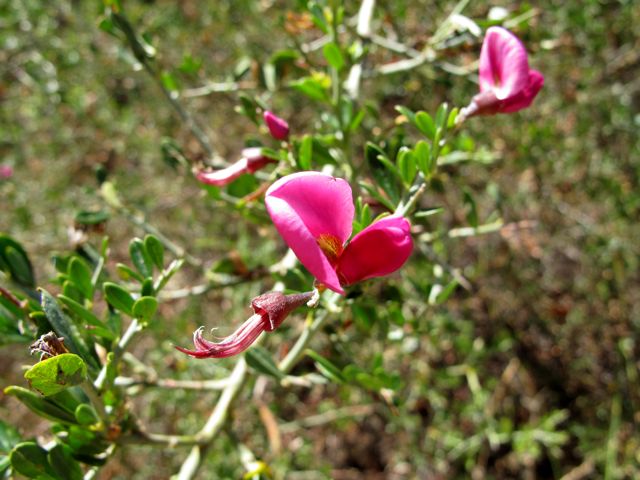
At first glance, the chaparral pea looks like a French broom… with bright pinkish-purple flowers. But this pretty bush is a California native. Pickeringia montana has medium-sized flowers and three-leaftleted leaves that are a shiny, vivid green. It can grow to more than six feet tall, and sprawls a little – just like broom does. But if the color and the shiny leaves weren’t enough to convince you that this isn’t a broom, then the thorns might do the trick! So watch out for it when you’re hiking.

It’s often found (as the name suggest) in the chaparral. Black-tailed deer love to browse on it, delicately nibbling their way around the thorns. This pretty shrub doesn’t reproduce well by seed in this area, but it does spread by rhizomes (spreading underground stems) or from its own roots. It comes back strongly after a fire has burned through.

Leave a comment

Filed under Native, Plant of the day

Plant of the day: yellow mariposa

A constellation of yellow lilies blooms on a serpentine ridge atop Mt. Tam. The yellow mariposa lilies (Calochortus luteus) are little works of art: delicate patterns of red and orange decorate the inside of the petals. No two are alike. Some are plain, some are complex. All are lovely. Beetles seem to think so too; I’ve often seen them hanging out inside. When I saw the ones pictured here, some still held water from the previous night’s rain in their cup-shaped blossoms.

This slideshow requires JavaScript.

This mariposa lily is a California endemic that can be found as far north as Humboldt and as far south as LA.

Leave a comment

Filed under Native, Plant of the day

Plant of the day: poison hemlock

With lacy leaves and delicate flowers, this plant doesn’t look like a deadly killer. But it is. This is the same plant that is fabled to have poisoned Socrates, and is the bane of ranchers since it can kill undiscriminating cows (it’s also responsible for “crooked calf disease“). There’s no antidote. So – admire this one from a distance, but don’t eat it, crush it, or take any other liberties. The root is the most poisonous part (unnerving, since it’s part of the inviting-looking carrot family!)

This slideshow requires JavaScript.

Conium maculatum isn’t native to California, but it is found throughout most of the state, often in open or disturbed places. Plants can grow to more than six feet tall, and have many flat umbels of lacy white flowers. Its similar-looking cousins, water hemlock, are also poisonous. But when I saw some on the open space above Mill Valley the other day, the lady bugs were having a wonderful time hanging out on the hemlock flowers!

Leave a comment

Filed under Invasive, Non-native, Plant of the day, Poisonous