Plant of the day: selfheal

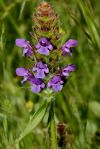
These small sturdy towers of purple flowers are usually found in meadows and wet places. Though it only grows to be about five inches tall, it’s a hardy and versatile little plant – Prunella vulgaris is found in every state in the continental US as well as in Europe, Asia and many parts of Canada.

As the name suggests, this is also a traditional medicinal plant that has been used in teas, in stews and for compresses.The square stem and two-lipped flower reveals this flower as a member of the mint family.

Leave a comment

Filed under Edible, Medicinal, Native, Plant of the day

Alamere Falls hike

For one of the best hikes in Marin, take the trek past Bass Lake to Alamere Falls. All through the spring this trail offers a wildflower bonanza–but it’s a treat at any time of year. The views are any over-the-top word you’d like to use: spectacular, breath-taking, awesome. But my favorite thing is that you pass through such a diversity of landscapes. Beginning from the eucalyptus forest at the Palomarin trailhead, you follow the Coast Trail along the bluffs high above the ocean. The wide and well-maintained trail bends inland in places, so when you aren’t walking along windswept and view-ridden hillsides, you dip down into lush and sheltered gullies filled with greenery and the trickling sound of small creeks. The gentle ups and downs of the trail give you a workout but nothing particularly daunting.

This slideshow requires JavaScript.

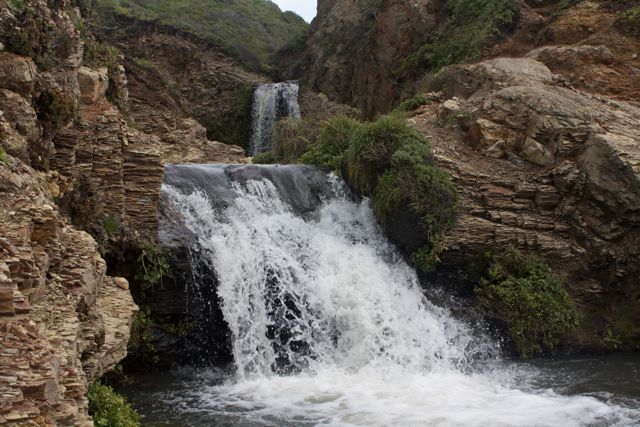
After (very approximately) two miles of this, you reach the only climb of any steepness on the trail, which dog-legs away from the water and heads up a smallish ridge. You then hike in and out of a forest of Douglas fir and alder until the views give way unexpectedly to Bass Lake, a placid tree-skirted spot. Not long after this, you begin to drop down out off of the ridge, passing another little lake (Pelican) on your left and once again heading into the treeless coastal scrub. The trail down to Alamere Falls is unmaintained, but used often enough that it’s not too overgrown. The trail is somewhat eroded though, and it’s a tiny bit of a scramble to reach the falls. But very well worth it. What unusual falls these are!

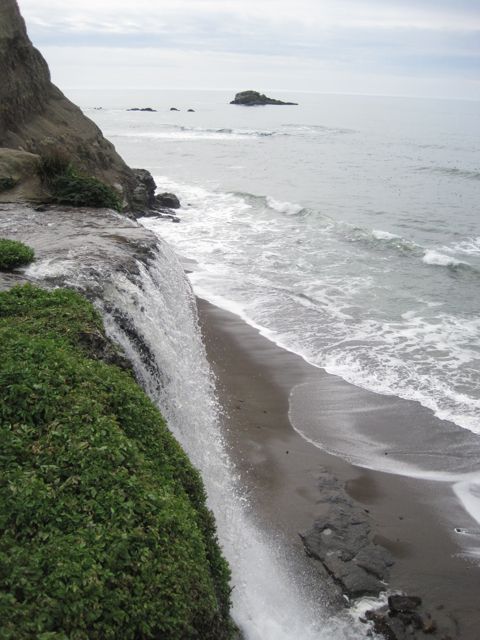
As you approach them, you’re not even sure what you’re seeing. You’re walking toward the ocean but high above it on a bluff, headed the same direction as the stream. As you get closer, you realize that the creek stair-steps down low crumbled cliffs, streams across the level surface of the bluff, and then disappears over the cliff to crash onto the beach about 50 feet below.

Pack a lunch if you go since the total distance is just over eight miles, round trip. And if you’re not a people-person, be warned that this trail can be jam-packed by midmorning on weekends. It’s on the popular Coast Trail, which links up with many other trails on the Point Reyes Peninsula, and also connects to various campgrounds. Check here for more info, directions and so on.

Leave a comment

Filed under TRAIL NOTES

Plant of the day: dwarf brodiaea

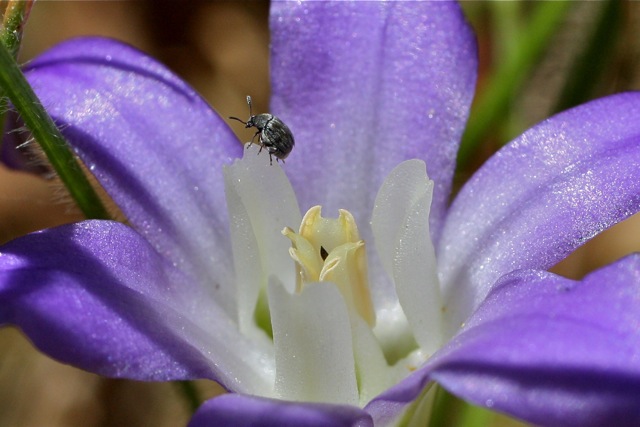
In grassy meadows and along open hillsides, these low-growing flowers open their purple petals to the sun. Each plant has one or two medium-sized flowers that have the classic lily family form. Six gracefully pointed petals fade to white towards the center. Three flat, white, tongue-like spurs (which are actually sterile stamen called staminodia) sit at the base of alternating petals. These staminodia in turn alternate with an interior cluster of flat, fertile stamen dusted with yellow pollen, which at first look like a stout, three-sided pistil.  To see the actual pistil, you have to gently tug on the petals to draw the stamens apart.

The easiest way to tell this from similar species is that it is so low to the ground, with the flower only rising a few inches off the ground. It truly is Brodiaea terrestris.

Leave a comment

Filed under Native, Plant of the day

Plant of the day: rose clover

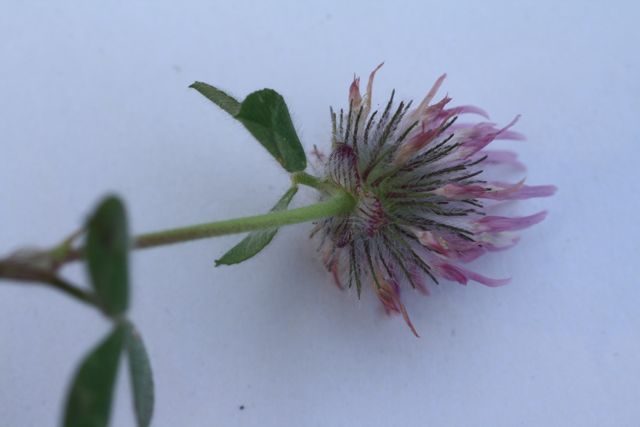
There are so many clovers around that they can be daunting to identify. But this little one has long caught my eye—partly because of the pretty pink color of its petals, combined with the many long green teeth of the calyx. But mostly I just like how it invariably has one little leaf coming directly off the flower. It may be strange but I find that adorable. Of course it turns out that botanically speaking the leaf isn’t actually part of the flower, it just appears to be so. In science-speak, the “heads are sessile above the uppermost leaves and stipules”. But that is good enough for me.

Rose clover (Trifolium hirtum) is native to Europe, not California. But it is now so ubiquitous as to be described by the authorities as “one of the most common” of the European species that have naturalized here.

You can pretty much tell rose clover from other species of clover because it has all of the following features: (a) It is hairy but doesn’t get cottony when it goes to seed; (b) Its showy, rosy flowers; (c) It’s an annual not a perennial; (e) That cute little leaf.

Leave a comment

Filed under Invasive, Non-native, Plant of the day

Plant of the day: wild hyacinth

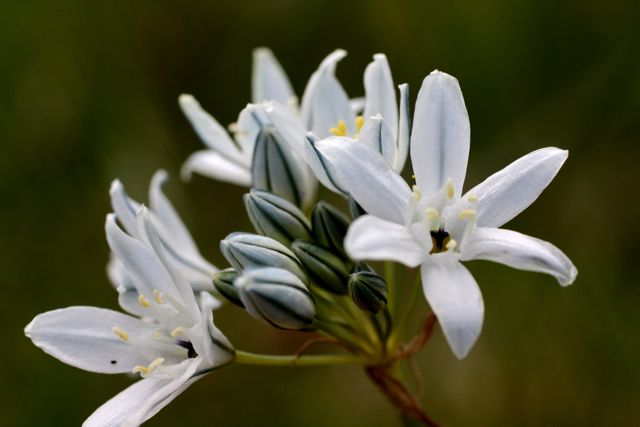
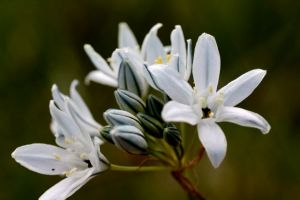
A flash of white against the frog-colored palette of a wet meadow. A loose cluster of white flowers atop a long, smooth stem. Each flower is an open bowl with the petals fused at the base, then tapering into six delicate points. This is wild hyacinth, or Triteleia hyacinthina. It grows in wetlands and along creeksides, as well as in grasslands and forests throughout much of the state.

The six stamens alternate in height, and flatten out so their bases nearly meet, making what looks like a crown set inside the bowl of petals. Green ribs run up the middle of each fleshy white petal.

There is another pale-colored Triteleia in the area (marsh triteleia, which can be whitish but is purple tinged – at least at the midrib if not elsewhere). You can tell the two apart because the wild hyacinth is bowl-shaped when seen from the side, while the marsh triteleia is narrower, shaped more like a funnel or a horn and the stamens are harder to see, hidden deep inside this vessel.

Leave a comment

Filed under Native, Plant of the day

Brodiaeas, wally baskets and blue dicks

Triteleia has standard stamens

Triteleia

There are a bunch of beautiful flowers in bloom right now, with clusters of white or purple blossoms atop long leafless stems. These are the brodiaeas, blue dicks and wally baskets, and even though they are quite distinct it can be oddly difficult to remember which is which. So I’m going to give an overview of their similarities and differences here, and then focus on some specific species in these groups throughout the week.

This group of cousins all belong to the Liliaceae family, which you can tell because their petals and stamens come in multiples of three.

Dichelostemma has short pedicels and a twisty stalk

Dichelostemma

Because they are all so similar, botanists once thought they were all in the same genus as well, but now genetic and other work has determined they are actually different genera (but if you have an old guidebook, you’ll find them all under Brodiaea). All three have flowers that appear in a umbel at the top of the (usually long) leafless stalk.  The flower petals are united at the base, and are always purple or white.

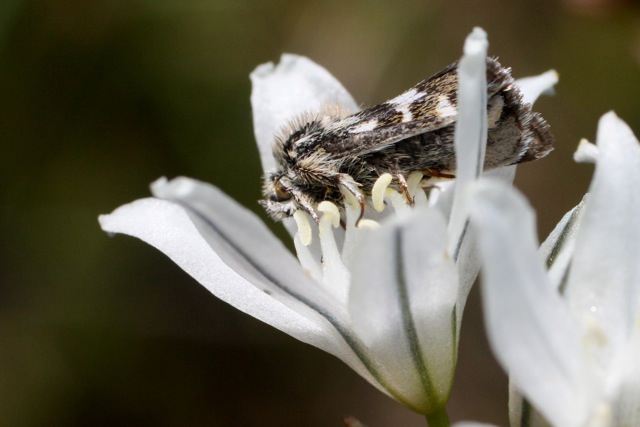
But their differences are not hard to see. You can easily tell a wally basket (Triteleia, shown at top and below) because it has six stamens that alternate in heights so three are distinctly taller than the others. The stamens are fairly typical looking, with a stalk (“filament”) topped by a pollen-dusted anther.

Both blue dicks (Dichelostemma) and brodiaeas (you guessed it: Brodiaea) have three stamens, and they are less typical looking – flat and tongue-like, arranged equally so they face each other like the three sides of a triangle; see the photo at the bottom of the page for a close-up.

brodiaea_elegans-02

Brodiaea has a long pedicel

Within this group, you can tell the two apart because blue dicks have short flower stalks (“pedicels”), so the head of flowers appears dense and crowded together. Also their stalk is twisted, whereas the brodiaea stalk is straight. Brodieas also have longer pedicels, so the head of flowers looks more like a loose bouquet (though this example only has two flowers, you can still see how the two pedicels between the flowers and the stem is quite long).

Et voila! Enjoy your botanizing!
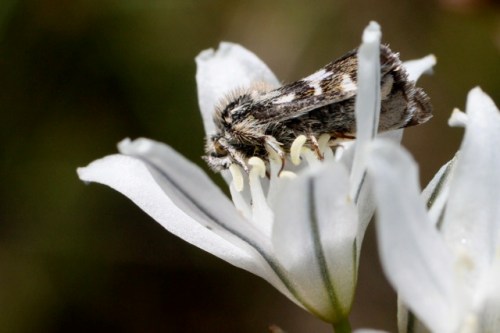
Triteleia

Close-up of the “standard” stamens of Tritileia (being enjoyed here by a moth)

Brodiaea

Notice the flat, tongue-like stamens (found in both Brodiaea, shown here, and Dichelostemma)

1 Comment

Filed under Botany basics

Plant of the day: wild radish

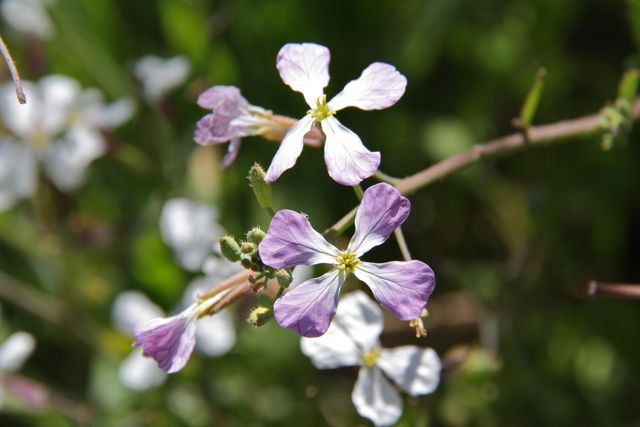
Masses of delicate easter-colored flowers fill fields and hillsides, standing as tall as your waist or even shoulder. These pale yellow, purple, and white flowers are wild radish, or Raphanus sativus. You can see a fantastic showing of them along the first part of the Pierce Point trail on the Point Reyes Penninsula.

These flowers also taste good—take a trailside nibble or add flowers and pods to a salad for a spicy radish taste. And there are those four simple petals again! That’s right, the wild radish is in the Brassicaceae, or mustard, family that I wrote about last week.

According to the Marin Flora, the local wild radish is actually a hybrid between R. sativus and its cousin, R. raphanistrum.

Leave a comment

Filed under Edible, Invasive, Non-native, Plant of the day

Plant of the day: buckeye

It’s buckeye season – one of my favorite stages of spring. These spreading trees with their tall, pinkish-white spires of flowers can be seen along roadsides, streamsides, in mixed woodlands and even at the edge of pebbly beaches on Tomales Bay. I’ve seen Aesculus californica growing so close to the water that the lower branches were draped with streamers of dried eelgrass.

This slideshow requires JavaScript.

This lovely tree is unique to California, and can be found across much of the state. It has loads of character, with knobby, gnarled trunks and wide palmately compound leaves. It leafs out during the winter, offering cool shade on hot days into the early summer, and then it goes dormant. In the fall it drops beautiful shiny chestnut-colored nuts (ok, actually they are “capsules” since the hard exterior contains several seeds). I like to gather them and use them for decoration. But don’t eat any! They are toxic, known to depress the nervous system, cause abortions in cattle and be toxic to bees. Native Americans would use extract of the seed topically (for hermerrhoids?!). In tough times the seeds were sometimes eaten (after careful preparation to leach the poison out). Buckeye also provided food in a different way: pouring a ground-up powder of the seed into a stream would stupify fish for easier catching!

Leave a comment

Filed under Good for gardens, Medicinal, Native, Plant of the day, Poisonous

Plant of the day: fairy lantern

This is one of the most beautiful flowers of the Bay Area. It’s aptly named, with its complex blossom looking like a delicately wrought lantern nodding on a slender stem. The three upper sepals curve upward like a pagoda roof, while the fringed petals below curl inwards as if to protect a flame. It’s not hard to imagine them as fixtures in a tiny magical kingdom. Keep your eye out for these little plants, and when you find one, look close!

The fairy lantern (Calochortus amabalis) is endemic to northern California, and is pretty much restricted to the coast range north of San Francisco bay. As such, Marin County is toward the southern-most end of the species’ range, and it is a rare sight here. These photos were taken in Sonoma county, where it is much more common.

Because all the parts are in threes, you can tell it is in the lily family, like the irises and blue-eyed grass.

Leave a comment

Filed under Native, Plant of the day

Plant of the day: rough hedge nettle

Rough hedge nettle is widespread in the area, and hedge nettles in general are easy to recognize. Though they don’t have the typical smell, hedge nettles are in the mint family! Mints are often hairy and smelly (like some rugged botanist-types that I know?!) and they have a tubular flower that usually is distinctly two-lipped. For the hedge nettles this is certainly the case. But the real giveaway for this family is that they have a square stem. Just roll it between your fingers to see what this means – all mint stems are distinctly four-sided (see the stem close-up below). There are other families that have square stems, but the many local species in the mint family (Lamiaceae) are by far the most common.

Stachys rigida is usually found in dry places—woods, shrublands, or grasslands. There are other hedge nettles (such as S. chamissonis, with its showy purple flowers) that prefer wetlands but our S. rigida is almost always on slopes, in gravel, clay or rocky soil. And, if you want to get technical, you should know that the Marin Flora lists Stachys rigida var. quercitorum as the local variety.

Leave a comment

Filed under Native, Plant of the day