Plant of the day: star-flowered false Solomon’s seal

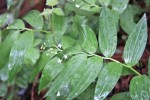
Deep in the shaded understory, small star-shaped flowers gleam. Each spray of white blooms is arranged above symmetrical rows of corn-like leaves. This is star-flowered false Solomon’s seal (Maianthemum stellatum).

This pretty little flower is found across much of North America, and goes by a whole boatload of names including false lily of the valley, starry false Solomon’s-seal, star-flowered Solomon’s-seal, starry Solomon plume, starry smilac, and spikenard. The Nuxalk Indians of British Columbia, and many other tribes, collected the ripe berries for food; the root was often used medicinally. The most-cited use was for stomach ailments but it was also used for earache, cough, arthritis, boils, menstrual troubles, venereal disease, and to stupefy fish. It is a very versatile plant.

Leave a comment

Filed under Edible, Medicinal, Native, Plant of the day

Plant of the day: canyon larkspur

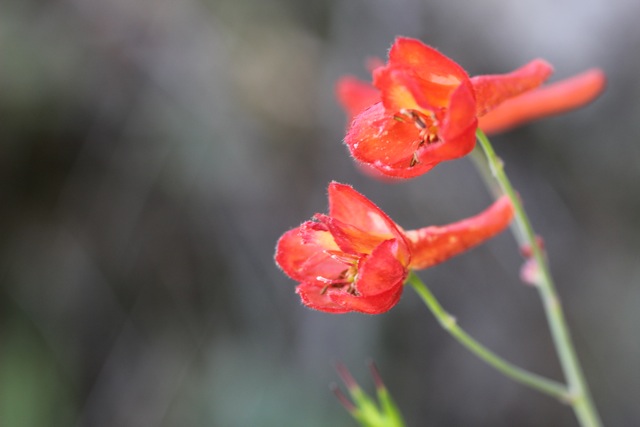
Delphinium_nudicaule1The brilliant red of canyon larkspur seems to glow in the shade of a rocky hillside. Also known as red larkspur, the color of Delphinium nudicaule flowers is so intense that it nearly vibrates. Each little flower tapers to a point in the back; an artists’ rendering of a gnome’s cap or the cowl of Little Red Riding Hood’s cape.

Red larkspur tends to grow most prolifically on shaded, rocky slopes. It is found across much of Northern California, and is not to be confused with scarlet larkspur–which grows farther south and has plants with more densely clustered flowers. It’s the only red larkspur in the area (though there is one yellow-flowered species, and several that are blue, white, or purple). According to the Marin Flora, this species has been found to hybridise with the blue-flowered coastal larkspur, creating offspring that are coral, lavender or purple.

All parts of the plant are highly poisonous–don’t eat it!Delphinium_nudicaule2

Leave a comment

Filed under Native, Poisonous

Plant of the day: goldfields

A puddle of rich gold fills a dip in a meadow; a blanket of gold covers a hillside. Hundreds upon hundreds of little yellow daisies crowd out all other color. This is California goldfields (Lasthenia californica), an aptly named and spectacular spring bloom.

This slideshow requires JavaScript.

According the Jepson database, the plants can grow over a foot tall, but usually they are much smaller–generally just a few inches high. They look like minute sunflowers, with spreading rays around a mounded central disc of tiny flowers. Indigenous tribes would make a flour of the diminutive seeds, or eat them dried.

There are several other species of goldfields–which tend to look quite similar, and frankly are tough for beginners to key out. In Marin, one tip for a quick & easy way to narrow down what species you might be looking at is to check and see if CNPS has a plant list for the area (Rock Springs, in this case).

Leave a comment

Filed under Native, Plant of the day

Plant of the day: few-flowered collinsia

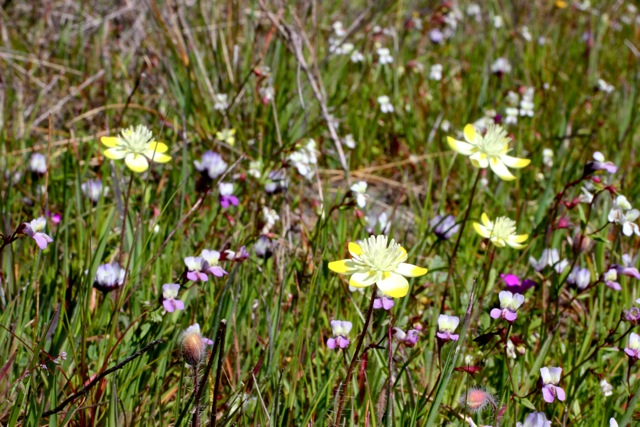
A sea of pale, snapdragon-like flowers seems to float above the ground, hovering on thin wiry stems. The white, yellow, or lavendar blossoms are so small you can almost miss them–and so dense you have to tread carefully so as not to step on them. Look close: they are lovely. The arched back of the corolla swoops toward an open maw of petals splotched and dotted with color.

This slideshow requires JavaScript.

This is few-flowered collinsia (Collinsia sparsiflora), a diminutive cousin of the more robust Chinese houses. And yes, they are in the same family as snapdragons. As with other recent species, few-flowered collinsia is tolerant of serpentine.

It is also known as spinster’s blue-eyed Mary.

Leave a comment

Filed under Native

Plant of the day: cream cups

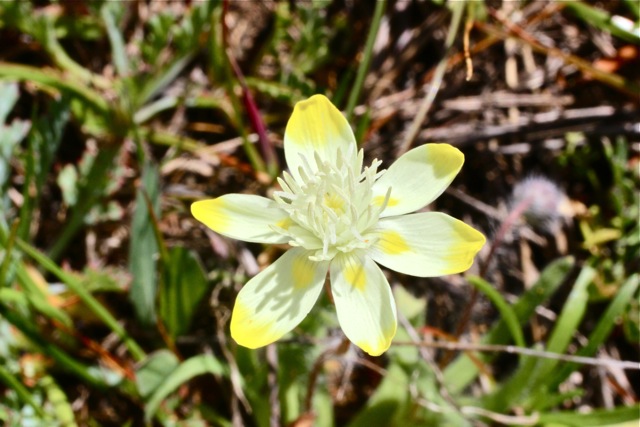
Platystemon_californica1This is another lovely flower of the open hillsides. Cream cups (Platystemon californica) have buttery yellow splotches on their tips and toward the middle of each pale yellow petal. Each blossom is perched atop a reddish, wiry stem that is covered with sparse but stout hairs. A mound of hairy, silvery-green leaves provides a base for this pretty showing.

Cream cups were once much more common in open fields, particularly following fire–but today they have been crowded out by more aggressive non-native grasses and weeds. Cream cups tolerate serpentine soils, which is one place you can find them growing in large numbers–because their invasive competitors can’t survive there.

There are some suggestions that the hirsute leaves are edible, but I would do more research before noshing on them. In fact, I might not eat them anyway–they don’t look very appetizing (but then, I don’t like peach fuzz, either).

Cream cups are in the Papaveraceae, the same family as poppies and bleeding hearts.

Platystemon_californica2 Platystemon_californica3Platystemon_californica4

Leave a comment

Filed under Native, Plant of the day

Plant of the day: baby blue eyes

Broad-faced, freckled little flowers are scattered across the grassland. These are baby blue eyes (Nemophila menziesii), a sweet sight of spring. Each showy blossom can be up to 4 cm across, and when they grow en masse they are even more striking. In Marin, these flowers usually are a pale blue, but they can also be white–or a dark blue that fades toward white at the center.

Nemophila_menziesii

Nemophila menziesii var. menziesii

Baby blue eyes are in the waterleaf family, along with Phacelia and yerba santa, but unlike both those species it has only one showy flower per stalk. They can grow scattered or in dense clusters, with the long-stalked blooms rising above pinnately compound leaves. Look for this bloom from southern Oregon to northern California.

Gardeners love this little annual because it can self-sow, seeding a new batch each year.

Leave a comment

Filed under Good for gardens, Native, Plant of the day

Serpentine in bloom

A stony hillside is awash in a sea of color. Swatches of yellow, purple, and pink nearly obscure the barren slope, which (other than the flowers) is striking because of how little grows there. This is a serpentine outcrop, and the harsh chemistry of this rock prevents all but a few hardy and specially adapted species from growing.

This slideshow requires JavaScript.

One lovely serpentine-dominated outcrop is perched atop Mt. Tamalpais near the Rock Springs parking area, and is in full and glorious bloom right now. I’ll write about each of the different species over the next few days–but the above slideshow celebrates the panorama.

Amazingly, there are even more surprises waiting on the stony hillside. Later in the season other flowers, including buckwheat, Mt. Tamalpais jewelflower and yellow mariposa lily, will appear. But for now there is no sign of them.


Leave a comment

Filed under TRAIL NOTES

Flowers on vacation!

Flowers of Marin is going camping–we’ll be back with more blog posts for you next week. Meanwhile here are some photos of the gorgeous Monvero Dunes and the surrounding area for your enjoyment. The Monvero Dunes are a rare inland dune system, perched atop the hills of the western San Joaquin valley. The floral assemblage there (and in much of the San Joaquin) has more in common with the Mojave than with the Bay Area.

This slideshow requires JavaScript.

This land is owned by the Bureau of Land Management, but because it is surrounded by private property it isn’t generally open to the public. I was lucky enough to visit it on a field trip the BLM hosted because it was a great wildflower year for the dunes (though not a great wildflower year in general). Enjoy!

1 Comment

Filed under Plant of the day

Tiny firecrackers? Or hazlenut in bloom…

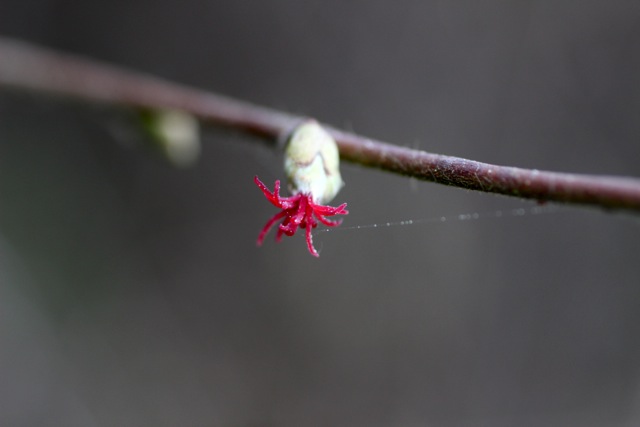
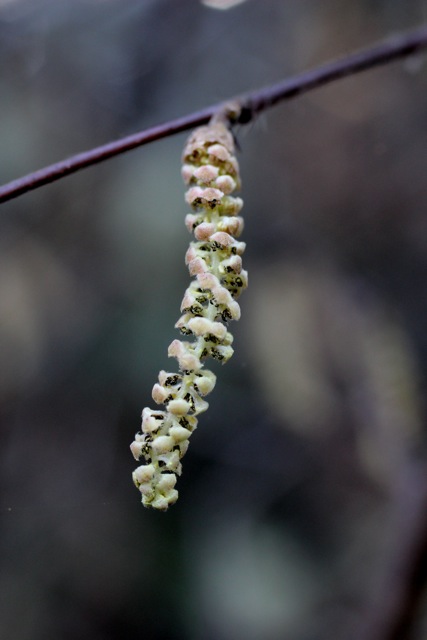
Hazlenut is in bloom with subtle yet stunning flowers right now. It’s worth a pause next time you pass one of these leggy, twiggy little shrubs. Right now the  leaves  are just beginning to bud out, but the branches seem mostly naked but for long dangling caterpillars of the male catkins. But hiding, almost invisible from a distance, are the tiny red female flowers.

Pistillate (female) flower

Pistillate (female) flower

This minute explosion of showy red stigmas emerges from a simple-looking bud; the whole thing is less than a centimeter long. But I think they are a special & lovely sight to behold.

Check out my full post on hazlenut (Corylus cornuta) here.

The staminate (male) flower is a catkin

The staminate (male) flower is a catkin

Leave a comment

Filed under Native

Plant of the day: California saxifrage

A dainty spray of picture-perfect white flowers grows on a shady slope. Five smooth white petals surround ten rust-tipped stamens. This is California saxifrage, or Micranthes californica.

This saxifrage is mostly a Californian species–it’s range extends from southern Oregon to Baja. The pretty blooms grow on a long reddish stalk that rises from a handful of hairy, tongue-shaped leaves growing close to the ground. The flowers often are on only one side of the stalk.

Leave a comment

Filed under Native, Plant of the day