Tag Archives: Botany

Plant of the day: seaside daisy

This pretty purple daisy prefers excellent views. It grows along the coast, often clinging to rocky cliffs or sunbathing on sandy beaches. I photographed the ones shown here on the Point Reyes Peninsula, growing on the top of Arch Rock–a lovely vantage point looking down on the long stretch of coast to the north and south.

Seaside daisy (Erigeron glaucus) has rounded, grayish green leaves that are soft to the touch. The flowers heads are purple, ranging towards white or pink, with a yellow center. It’s native to California and Oregon, and it’s often seen in rock gardens as well as in the wild. Other names include beach daisy and seaside fleabane.

3 Comments

Filed under Good for gardens, Native, Plant of the day

Plant of the day: California rose

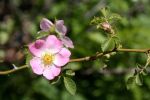
This wild rose is a favorite sight in spring and summer, as pink blossoms give way to ripe red fruit. This is the California rose (or as it is conversely known in Latin, Rosa californica), which grows in nearly every county in California, as well as in parts of Oregon.

This hardy shrub can look scraggly, but also can be groomed into a good garden plant, with pale green leaves and colorful fruit and flowers. It grows to 8 feet tall but is usually smaller. The tangle of thorny branches make excellent shelter for birds, and I’ve spotted many a nest by peering into a wild rose bush.

Rose hips are a renowned source of Vitamin C, and you can make an immune-boosting tea just by pouring boiling water over the red fruit. The hips can also be eaten fresh, though the inner bit is unappetizing, filled with seeds and strange stiff hairs. But the thin outer layer of flesh is tasty–I usually eat it by splitting the fruit open with a fingernail and scraping out the seeds. But this is labor intensive, and rose hips were never a significant food source for Native Americans. There was some medicinal use, though. A tea of wild rose hips was used to treat fever, sore throats and stomach aches–as well as to wash sores and sooth the pain of babies.

There are several different kinds of wild roses in California, and they all look fairly similar. The California rose (according to the Marin Flora) has the brown remains of its sepals at the tip of its ripe hips, and also tiny hairs visible on the stems of its leaves. It grows in full sun and partial shade, and in both wet and dry areas.

Leave a comment

Filed under Edible, Good for gardens, Medicinal, Plant of the day

Plant of the day: leather oak

Oaks are generally thought of as tall, graceful trees. But you can also find them in the sea of waist-high bushes known as chaparral. Leather oak (Quercus durata var. durata) is a common sight on serpentine soils in this area.

This slideshow requires JavaScript.

Leather oak can grow to around nine feet tall, but I have mainly noticed them growing much closer to the ground. Look close to spot acorns or clusters of catkin-like flowers among the small, grayish green leaves. The leaves of this species are dull, dusted with a pale fuzz (paler on the top than on the bottom). They also are concavely curled towards the ground–you could flip one over and use it for a little spoon, if they didn’t have a tendency to be spiny.

As with all acorns, the nut of the leather oak is edible once its bitter tannins have been leached out. Acorns were historically a major food source for local Native American tribes, and still are a major part of the food chain for wildlife. People generally remove tannins by soaking the nut in water (or a running stream). But some tribes would plant the acorn in a bog and wait until it sprouted in the spring–a system which apparently got rid of most tannins but preserved more nutrients than the water method.

Acorns can be eaten whole, or ground into a floury powder for cooking. Roasted acorns can be used as a coffee substitute.

Leave a comment

Filed under Edible, Native, Plant of the day

Plant of the day: salal

Gaultheria shallon

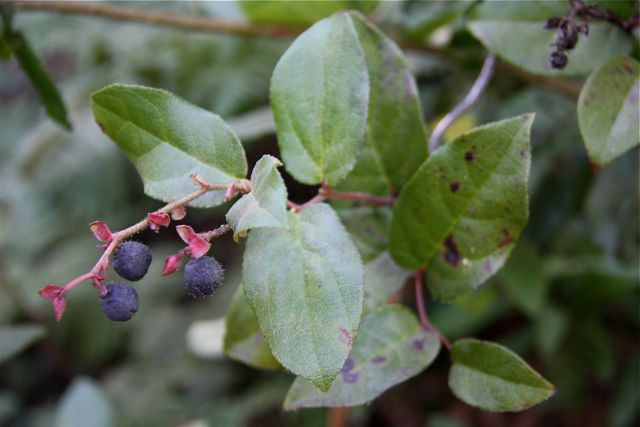
Salal is a familiar companion of the forest underbrush from Alaska to Santa Barbara. It is unadorned for most of the year, a simple shrub with largish (~4 inch) leathery leaves that dance up alternate sides of a slightly zig-zagged stem. In between the large veins, the leaves are traced with an intricate lacey pattern somewhat like the crease on the palm of a hand.

Small bell-shaped flowers of pinkish white appear at the tips of the stems in the early summer, and by now the dark purple fruit has ripened. Each berry is lightly hairy, and they are fairly sparse on the plant. Though edible, I have found them to be bland the few times I’ve tasted them. The leaves can be made into “a pleasant tea“, and poultices made of the leaves were traditionally applied to cuts, burns and sores. The fruit or leaves were also used to make dyes (of purple or yellow).

Leave a comment

Filed under Edible, Native, Plant of the day

Plant of the day: primrose monkeyflower

Mimulus primuloides

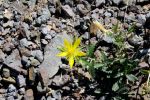
On a mossy lake shore, a small yellow flower gapes its red-spotted tongue towards passing insects. It stands only a few inches tall, balancing a single bloom on a thread-thin, leafless stalk. A rosette of green leaves surrounds it at the base. This is primrose monkeyflower (Mimulus primuloides), which only likes to grow above 2,000 feet in elevation.

At first glance, this little yellow monkeyflowers of the alpine country look a lot like those of the lowlands–but look close! Even though we are used to seeing Mimulus guttatis around here, there are many other species with bright yellow blossoms that are dotted with red… But this is the only one (that I know of) to bear a single flower on a leafless stem.

1 Comment

Filed under Native, Plant of the day

Plant of the day: explorer’s gentian

Beautiful deep-blue flowers top tufts of green on an alpine slope. The vase-shaped blossom spreads into five gracefully rounded petals at the mouth; each petal is dotted with pale yellow spots that fade into green deeper in the throat of the flower.

This is explorer’s gentian, or Gentiana calycosaanother high-elevation beauty (also called the Ranier gentian, or the Ranier pleated gentian). It likes cold climates and wet soil near streams or in low meadows (although I saw it outside this typical range, growing on an exposed and rocky slope, so this can happen as well). Bees and other insects love to rummage in it’s deep flowers, and it has been cultivated as an ornamental. In the Bay Area, you can keep your eye out for the similar-looking pleated gentian (Gentiana affinis), a cousin that prefers low elevation.

Leave a comment

Filed under Native, Plant of the day

Plant of the day: ranger’s button

Woolly beige tufts rest on umbels of stout stalks. This is ranger’s button (Sphenosciadium capitellatum), a common mountain plant with flowers are clustered into dense and symmetrical heads. Each round and wooly heads is then clustered into an umbel, at the end of a branching stalk. The umbel stalks also are woolly, and the overall effect is highly stylized and geometric.

Ranger’s button likes to grow in the wet soil of meadows, or near lakes and streams. It grows at 3,000 to 10,400 feet in elevation. This plant is in the celery family (Apiaceae) along with poison hemlock and angelica, which it somewhat resembles. It’s toxic to livestock, and an infusion made from the root was used by the Paiute tribe to treat lice… and venereal sores.

Leave a comment

Filed under Native, Plant of the day

Plant of the day: giant blazing star

This yellow-flowered plant grows everywhere on the east side of the Sierras, like a weed. But how can any weed be this beautiful? The pale yellow blossom is as big as my palm, with long delicate petals, and a spreading bouquet of yellow stamens rises from the center. Five skinny “petals” that alternate with the wider ones are actually modified stamens that don’t produce any pollen. This extravagant bloom is surrounded by long green sepals  that peek out from between the petals. With a pale stem and scalloped green leaves, the entire package looks like a carefully wrought floral display. Yet nature did all of the arranging.

Giant blazing star (Mentzelia laevicaulis) can be found across much of California and across all of western North America. Despite its delicate looks, this beauty loves high heat and rocky habitats. It was also used by many native tribes for everything from skin wash to gravy. Roots were used to treat arthritis, earaches, bruises and fever. An infusion made from the leaves was used for stomachaches and skin disease. The gravy was made from fried seeds and water.

Leave a comment

Filed under Native, Plant of the day

Plant of the day: prickly poppy

Flamboyant white flowers are scattered across a sagebrush plain. Prickly poppy, or Argemone munita, has the large papery-thin petals–stark white around a brilliant yellow center. Insects flock and feed among the many yellow stamens. The whole plant has abundant gray-green leaves that are prickly to the touch, and stands as tall as my knee. It is truly a beauty! But you won’t see it in the Bay Area; it grows across the west but only between 4,000 and 8,500 feet. If you see a similar flower at low elevation, you’re probably looking at one of this bloom’s lovely cousins, such as the Matilja poppy.

Leave a comment

Filed under Native, Plant of the day

Plant of the day: white clover

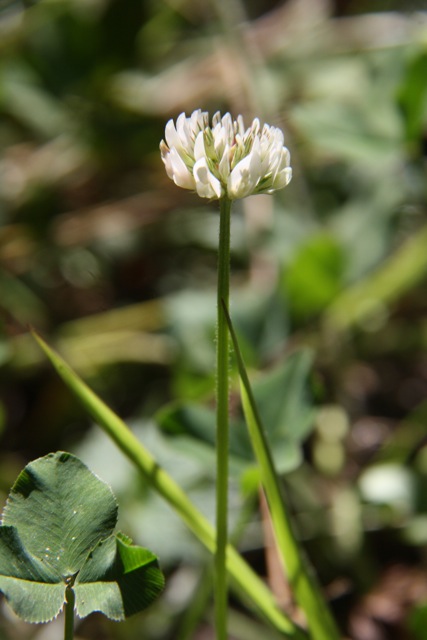
White heads of flowers dot the unmowed ball field like cotton balls scattered freely. But look close and the blooms are not at all cottony; this is a clover, each head a cluster of dozens of small pea-type flowers. The leaves are distinctively bisected with a faint crescent line that looks like a watermark, or the pattern left behind on paper that was soaked and then dried.

Everpresent in lawns and weedy berms, white (Trifolium repens) clover is one of the most common (and dare I say overlooked) plants around. Rare, shy, or temperamental flowers are a treat to find and behold–but I also like to take the time to get to know the species that are so common that they are easy to ignore. This little European invader is certainly one of those. But it turns out that not only is it a favorite snack for livestock, but humans can eat it too! Young leaves can be used in salads or soups, or it can be cooked like spinach. Dried flowers and seed pods have been ground into a high-protein flour that can be used on its own or as a garnish. The plant can be boiled for a tea, either just because its tasty or as a traditional Cherokee treatment for fever. Roots can be cooked and eaten, and evidently the leaves give baked goods a vanilla-like flavor. Who knew.

Trifolium repens

Leave a comment

Filed under Edible, Medicinal, Non-native, Plant of the day