Tag Archives: Botany

Plant of the day: rose clover

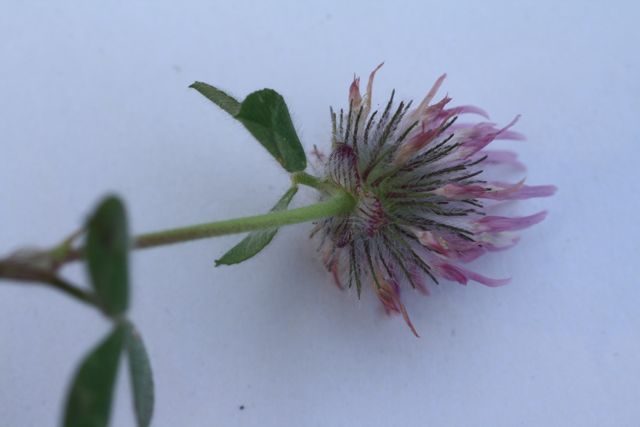
There are so many clovers around that they can be daunting to identify. But this little one has long caught my eye—partly because of the pretty pink color of its petals, combined with the many long green teeth of the calyx. But mostly I just like how it invariably has one little leaf coming directly off the flower. It may be strange but I find that adorable. Of course it turns out that botanically speaking the leaf isn’t actually part of the flower, it just appears to be so. In science-speak, the “heads are sessile above the uppermost leaves and stipules”. But that is good enough for me.

Rose clover (Trifolium hirtum) is native to Europe, not California. But it is now so ubiquitous as to be described by the authorities as “one of the most common” of the European species that have naturalized here.

You can pretty much tell rose clover from other species of clover because it has all of the following features: (a) It is hairy but doesn’t get cottony when it goes to seed; (b) Its showy, rosy flowers; (c) It’s an annual not a perennial; (e) That cute little leaf.
Leave a comment

Filed under Invasive, Non-native, Plant of the day

Plant of the day: wild hyacinth

A flash of white against the frog-colored palette of a wet meadow. A loose cluster of white flowers atop a long, smooth stem. Each flower is an open bowl with the petals fused at the base, then tapering into six delicate points. This is wild hyacinth, or Triteleia hyacinthina. It grows in wetlands and along creeksides, as well as in grasslands and forests throughout much of the state.

The six stamens alternate in height, and flatten out so their bases nearly meet, making what looks like a crown set inside the bowl of petals. Green ribs run up the middle of each fleshy white petal.

There is another pale-colored Triteleia in the area (marsh triteleia, which can be whitish but is purple tinged – at least at the midrib if not elsewhere). You can tell the two apart because the wild hyacinth is bowl-shaped when seen from the side, while the marsh triteleia is narrower, shaped more like a funnel or a horn and the stamens are harder to see, hidden deep inside this vessel.

Leave a comment

Filed under Native, Plant of the day

Plant of the day: wild radish

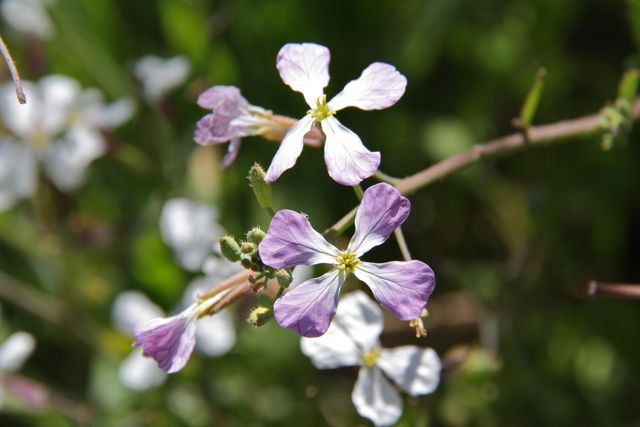
Masses of delicate easter-colored flowers fill fields and hillsides, standing as tall as your waist or even shoulder. These pale yellow, purple, and white flowers are wild radish, or Raphanus sativus. You can see a fantastic showing of them along the first part of the Pierce Point trail on the Point Reyes Penninsula.

These flowers also taste good—take a trailside nibble or add flowers and pods to a salad for a spicy radish taste. And there are those four simple petals again! That’s right, the wild radish is in the Brassicaceae, or mustard, family that I wrote about last week.

According to the Marin Flora, the local wild radish is actually a hybrid between R. sativus and its cousin, R. raphanistrum.

Leave a comment

Filed under Edible, Invasive, Non-native, Plant of the day

Plant of the day: silverweed cinquefoil

Silver weed cinquefoil

Potentilla anserina

This is sunny little flower almost always grows in wetlands or creeksides, though it can be found elsewhere. The photo shown here was taken on a seemingly-dry trailside, but because it was on a hill I wouldn’t be surprised if it is wetter than it appeared. Potentilla anserina is the most common cinquefoil in the area. In general, cinquefoils have a very distinctive “look,” with five spreading petals and surrounding a central mound of many stamens. The leaves are composed of crinkly, jagged-edged leaflets. Often the leaflets are arranged in many pairs along the stem (as with this silverweed here), but sometimes they are in threes or in a fan shape. Once you’ve seen a few different species the similarities start to jump out at you!

Leave a comment

Filed under Native, Plant of the day

Plant of the day: long beaked stork’s bill

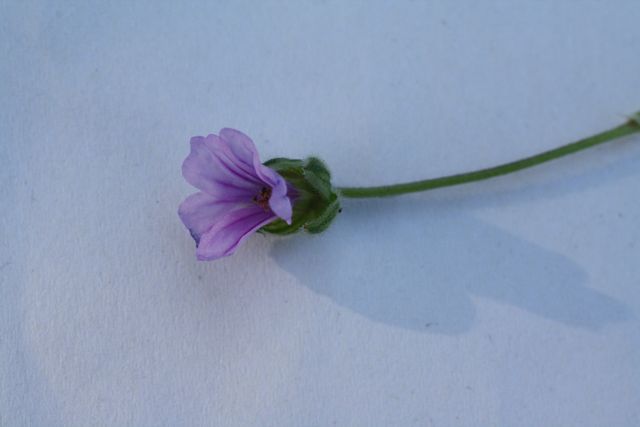
Long beaked stork’s bill is a ubiquitous sight in the fields of the bay area. This invasive little weed and its cousins, other types of stork’s bills, have naturalized across most of California. The long beaked stork’s bill (Erodium botrys) is distinctive because of the particularly long, beak-like seed pod, but also because of its leaf – it is the only one with a long narrow leaf that isn’t actually dissected into separate leaflets.

There are several species of wild geraniums with flowers that look quite a bit like those of stork’s bills – small, pinkish-purple. Again, look to the leaf to know what plant it is. The geraniums (sometimes called crane’s bills) have deeply dissected leaves that are overall roundish in shape. In other words, if you drew a line around the outside of the leaf, ignoring the details, you’d come up with a circle as opposed to the overall tongue-shaped leaves of the stork’s bills. The wild geranium petals are usually notched at the end, giving them a toothed look. Almost all of the wild geraniums are also invasive, with a few exceptions.

Leave a comment

Filed under Invasive, Non-native, Plant of the day

Plant of the day: mule ears

Like stubby sunflowers, these cheerful yellow blossoms have large, open faces. They can be seen ornamenting grassy hillsides as well as woods and brushy areas. Mule ears (Wyethia glabra) is a California endemic that is widespread throughout much of the western part of the state. Each yellow flower head is backed by a large collection of leaves that can be seen peeking out from behind the inflorescence. Narrow-leaved mule ears (Wyethia angustifolia, not endemic) are also common in Marin, but are easy to tell from regular mule ears because they lack these backing “broad and foliacious” bracts.

This is the first member of the Ateraceae family – also known as a “composite” – to appear on this blog, so a note on this type of plant. What looks like a single flower is actually hundreds of smaller flowers grouped together. This amalgamation is easier to mistake for a single bloom than other headlike arrangements because often the outer flowers look like petals, while the inner flowers are smaller and less showy and can look a lot like pistils or stamens. The outer, petal-like flowers are the “ray” flowers and the inner ones are the “disc” flowers. Each is truly an independent flower in and  of itself, each with its own petals and reproductive parts. The entire arrangement is called a “pseudanthia.”

Leave a comment

Filed under Botany basics, Native, Plant of the day

Plant of the day: milk maids

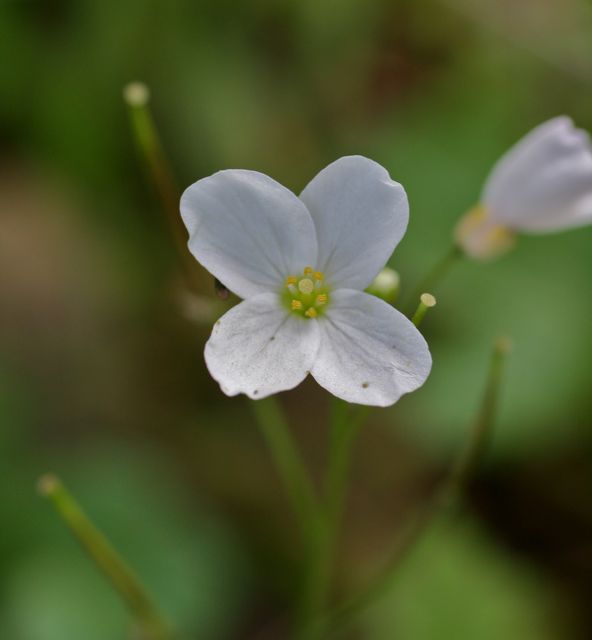
Milk maids are a ubiquitous sight in the spring, with their flowers of four simple white petals alternating sparsely up a stalk. They are one of the first of the year to start blooming, and they can last through May. Wikipedia says the name derives from a hat often worn by milkmaids, but that seems like a stretch since there is nothing bonnet-like about these blooms. Cardamine californica has flowers that are about half an inch across, and grow in most habitat types in the county except the driest. The four petals mark it as a brassica, the same family that houses wild mustard and radish. Many cultivated edibles, like broccoli and kale, are also in the Brassicaceae. Because of the “cross shaped” petals, this family once was called the cruciferae.

This pretty little flower is one of the earliest to bloom, and all parts of the plant (leaves, flowers, and roots) are edible, with a peppery radishlike flavor–they are tastiest before the flowers bloom, according to Judith Larner Lowry’s wonderful book, California Foraging (I admit I haven’t done a careful comparison myself).

Leave a comment

Filed under Native, Plant of the day

Plant of the day: Douglas iris

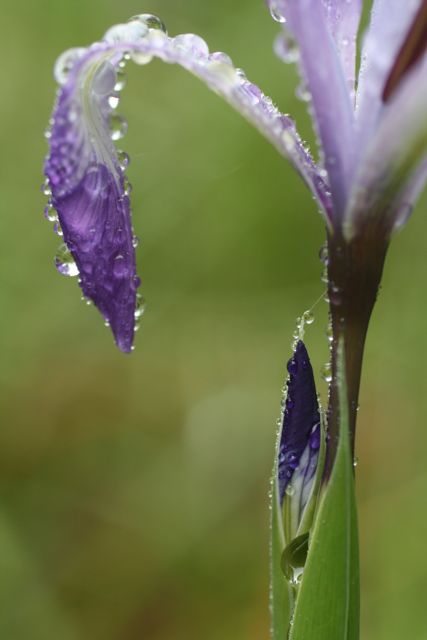
The wild irises of California are a spring delight. You can see them in forest clearings and meadows, sometimes in great green and purple masses. Other times one plant will appear singly, a burst of color against the browns of an understory. With their many variations in color and decoration they are a never-ending visual treat ranging from dark purple to pale yellow.

This slideshow requires JavaScript.

The three largest, lower petals can look like a cross between a watercolor and a stained-glass window, with dark veins blocking out yellows, whites and purples – but with the color fading gently towards the edge of the petal. Above it is what appears to be a paler, less gaudy petal (it’s actually part of the pistil). Sandwiched between the two is the dark purple tongue of the stamen, dusted underneath with pollen, and invisible unless you pry the flower open or look very close. Often you’ll see bees rummaging around and coming out with their legs laden with pollen.

Douglas iris (Iris douglasiana) is the most common wild iris species, but coast iris (Iris longipetala) and ground iris (Iris macrosiphon) are also somewhat common. And keying them is a trick!! Every book or expert gives different suggestions about how to distinguish one from another. The Marin Flora says you can identify a Douglas iris if the pollen is yellow and the surface of the leaf is shinier than the underside and the long purple tube below the flower (the perianth tube) is about 2 centimeters long. But the Flora of Sonoma County suggests two ways to ID the Douglas. First  is if the leaf bases (but not the entire plant!) is reddish. Second is if the perianth tube is less than 3 centimeters long. So take your pick! Once I get a confident ID on another species I’ll post about those as well.

1 Comment

Filed under Good for gardens, Native, Plant of the day

Plant of the day: yerba santa

Beside a rocky trail, a tall spike of leathery green leaves topped by a cluster of white flowers peeks up through the chaparral. This is yerba santa, or Eriodictyon californicum. It is known as a medicinal plant (tea now available at Amazon as well as in the great outdoors), though personally I haven’t been attracted by the descriptions of a bitter, menthol-like taste. Traditionally, the tea was used for colds and other respiratory troubles, though it also has been used to treat maladies as diverse as stomach aches, headaches, bruises, eye troubles, and gonnorhea.

The leaves are often dusted with an unappealing black mold, but without this yerba santa is a handsome plant. The white flowers cluster loosely at the top of the spike of leaves. Each blossom is tubular and flared at the mouth, with petals that taper off into points. If you look close, you’ll see that each flower has two styles (and no, that isn’t sweats and slacks. The style is the shaft of the female reproductive parts).

You commonly find yerba santa on rocky slopes or in chaparral, among the dense scrub of manzanita or ceanothus. It can reproduce by seed, but only does so after a fire or other disturbance of the soil surface. Since fires aren’t common in today’s era of fire suppression, it usually reproduced vegetatively. They can grow a rhizome (rootlike structure) up to eight feet long in a single summer! That rhizome will put up new plants every 8 to 10 inches — an effective way to raise a family indeed.

Leave a comment

Filed under Edible, Native, Plant of the day

Plant of the day: Pacific blacksnakeroot

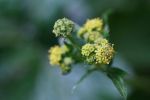
This plant most often presents itself as shiny, three-lobed leaves that grow close to the ground. What is that plant? It is unobtrusive yet distinctive. In the spring it sends up a tall spindly stalk, which splits into branches, each topped with a small head of greenish-yellow flowers. It is Sanicula crassicaulis, also known as Pacific blacksnakeroot, Pacific sanicle, or gamble weed.

A similar species, Coast blacksnakeroot is also common in Marin, but it has yellower flowers and some subtle differences in the fruit.

Leave a comment

Filed under Native, Plant of the day