Tag Archives: California

Plant of the day: Ithuriel’s spear

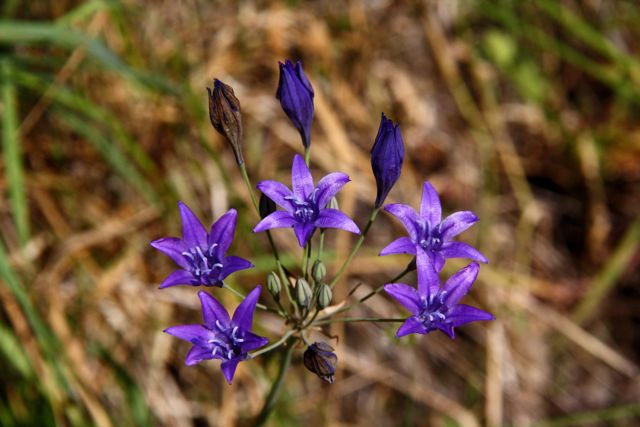
Triteleia laxa

Here is another one of the lovely leggy lilies that I wrote about last week. Triteleia laxa sports a loose umbel of trumpet-shaped purple flowers. The color is usually the rich royal purple shown here, but it can be paler as well. The way to tell this beauty from the similar species is to look inside and see that it has six classic-looking stamens.

The young plant is spear-shaped when it first emerges from the earth. Evidently the name is (for you literary types!) a reference to Milton’s Paradise Lost, in which the angel Ithuriel finds Satan has approached Eve in the shape of a toad. Ithuriel touched him with her spear and revealed his true form. I think toads are beautiful and charismatic critters, and for me this is the best part of the fable – that a toad is what was chosen to infiltrate the ranks of goodness!

See the six distinct stamens

Leave a comment

Filed under Native, Plant of the day

Plant of the day: cow parsnip

This is a fearsome plant. It’s rough, tough leaves are larger than my head: pointed and creased like thick green origami. Its stem is hollow and thick as a hose, and it can heft its dense umbel of flowers as much as seven feet in the air. I prefer the scientific name—Heracleum maximumto the common name “cow parsnip”. That is far too pedestrian for this beast. Cows are placid, parsnips are passive underground things. This is a vigorous creature of light and growth. The implied size is appropriate, but that’s about all.

Right now it is out in abundance and it’s hard to hike (or drive) near the ocean without seeing it. It clusters along stream-banks and hangs over the curves on Highway One. There is nothing else that looks like this plant; it’s the only one of its genus around here. It has a vague similarity to its other cousins in the carrot family like Queen Anne’s lace or poison hemlock—but all the others have divided, lacy leaves whereas our bovine parsnip boasts solid, maple-like leaves as large as dinner platters.

2 Comments

Filed under Native, Plant of the day

Plant of the day: marsh tritileia

True to its name, this flower prefers to grow in wet places. Triteleia peduncularis is a graceful beauty, growing up to three feet tall, and is often found near serpentine. The flowers are whitish with a striking purple midvein. Six stamen are tucked away inside the trumpet- or funnel-shaped mouth of the flower.

There are two other triteleia species in the area: wild hyacinth and wally basket. They all are unique looking, as the hyacinth is white but bowl-shaped and the wally basket is purple throughout. Neither have the sleek elegance of the marsh triteleia.

Leave a comment

Filed under Native, Plant of the day

Plant of the day: rose clover

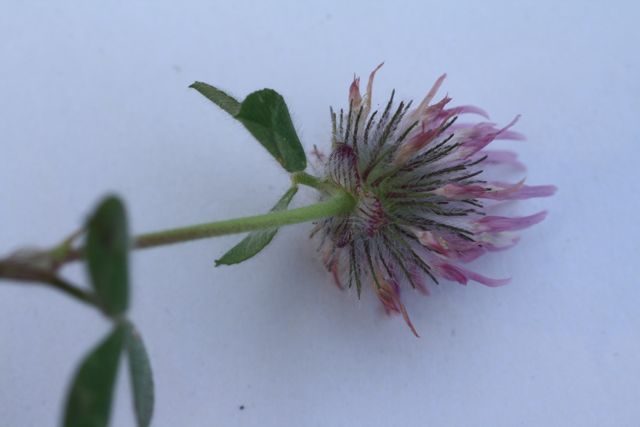
There are so many clovers around that they can be daunting to identify. But this little one has long caught my eye—partly because of the pretty pink color of its petals, combined with the many long green teeth of the calyx. But mostly I just like how it invariably has one little leaf coming directly off the flower. It may be strange but I find that adorable. Of course it turns out that botanically speaking the leaf isn’t actually part of the flower, it just appears to be so. In science-speak, the “heads are sessile above the uppermost leaves and stipules”. But that is good enough for me.

Rose clover (Trifolium hirtum) is native to Europe, not California. But it is now so ubiquitous as to be described by the authorities as “one of the most common” of the European species that have naturalized here.

You can pretty much tell rose clover from other species of clover because it has all of the following features: (a) It is hairy but doesn’t get cottony when it goes to seed; (b) Its showy, rosy flowers; (c) It’s an annual not a perennial; (e) That cute little leaf.

Leave a comment

Filed under Invasive, Non-native, Plant of the day

Plant of the day: fairy lantern

This is one of the most beautiful flowers of the Bay Area. It’s aptly named, with its complex blossom looking like a delicately wrought lantern nodding on a slender stem. The three upper sepals curve upward like a pagoda roof, while the fringed petals below curl inwards as if to protect a flame. It’s not hard to imagine them as fixtures in a tiny magical kingdom. Keep your eye out for these little plants, and when you find one, look close!

The fairy lantern (Calochortus amabalis) is endemic to northern California, and is pretty much restricted to the coast range north of San Francisco bay. As such, Marin County is toward the southern-most end of the species’ range, and it is a rare sight here. These photos were taken in Sonoma county, where it is much more common.

Because all the parts are in threes, you can tell it is in the lily family, like the irises and blue-eyed grass.

Leave a comment

Filed under Native, Plant of the day

Plant of the day: long beaked stork’s bill

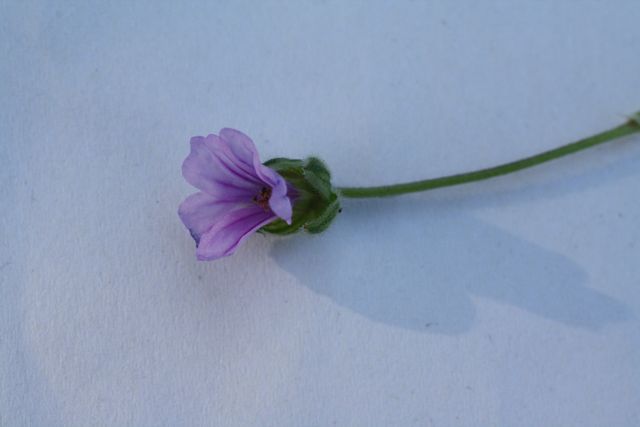
Long beaked stork’s bill is a ubiquitous sight in the fields of the bay area. This invasive little weed and its cousins, other types of stork’s bills, have naturalized across most of California. The long beaked stork’s bill (Erodium botrys) is distinctive because of the particularly long, beak-like seed pod, but also because of its leaf – it is the only one with a long narrow leaf that isn’t actually dissected into separate leaflets.

There are several species of wild geraniums with flowers that look quite a bit like those of stork’s bills – small, pinkish-purple. Again, look to the leaf to know what plant it is. The geraniums (sometimes called crane’s bills) have deeply dissected leaves that are overall roundish in shape. In other words, if you drew a line around the outside of the leaf, ignoring the details, you’d come up with a circle as opposed to the overall tongue-shaped leaves of the stork’s bills. The wild geranium petals are usually notched at the end, giving them a toothed look. Almost all of the wild geraniums are also invasive, with a few exceptions.

Leave a comment

Filed under Invasive, Non-native, Plant of the day

Plant of the day: foxglove

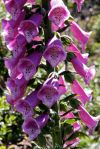
Tall spikes of white or purple flowers are bursting like flares across Marin. This is the season for foxglove, another striking-looking invasive. Native to all parts of Europe, it has now colonized much of North America, where it appears to prefer the coastal areas to the heartland. You can find it in from Alaska to Mexico, and on much of the east coast as well. Digitalis purpurea can grow to be taller than a full-grown person and is quick to colonize areas that have been disturbed such as road sides, logging or building sites.

Foxglove is also highly toxic so don’t eat it!! Small amounts have been known to be fatal. Some of its other names give you a clue that this is a bad idea: Witches’ Gloves, Dead Men’s Bells, Bloody Fingers, and Fairy’s Glove just name a few. Yet in its noteworthy history, Digitalis was also used as a medicinal plant by herbalists. They were on to something: extracts from the plant are now used pharmaceutically to treat congestive heart failure. As much as I appreciate folk remedies, this is one I’m glad the scientific establishment has gotten involved with; messing around with a plant that supposedly killed some kids who drank the water from a vase containing foxgloves seems like a bad idea!

Leave a comment

Filed under Invasive, Non-native, Plant of the day, Poisonous

Plant of the day: mule ears

Like stubby sunflowers, these cheerful yellow blossoms have large, open faces. They can be seen ornamenting grassy hillsides as well as woods and brushy areas. Mule ears (Wyethia glabra) is a California endemic that is widespread throughout much of the western part of the state. Each yellow flower head is backed by a large collection of leaves that can be seen peeking out from behind the inflorescence. Narrow-leaved mule ears (Wyethia angustifolia, not endemic) are also common in Marin, but are easy to tell from regular mule ears because they lack these backing “broad and foliacious” bracts.

This is the first member of the Ateraceae family – also known as a “composite” – to appear on this blog, so a note on this type of plant. What looks like a single flower is actually hundreds of smaller flowers grouped together. This amalgamation is easier to mistake for a single bloom than other headlike arrangements because often the outer flowers look like petals, while the inner flowers are smaller and less showy and can look a lot like pistils or stamens. The outer, petal-like flowers are the “ray” flowers and the inner ones are the “disc” flowers. Each is truly an independent flower in and  of itself, each with its own petals and reproductive parts. The entire arrangement is called a “pseudanthia.”

Leave a comment

Filed under Botany basics, Native, Plant of the day

Plant of the day: milk maids

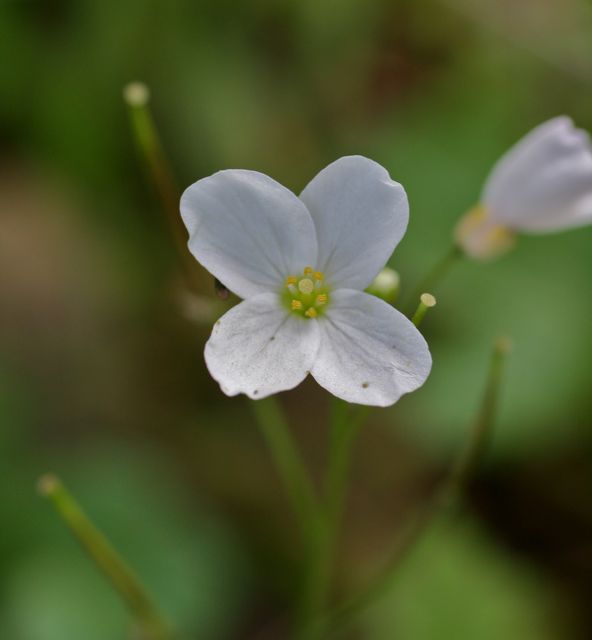
Milk maids are a ubiquitous sight in the spring, with their flowers of four simple white petals alternating sparsely up a stalk. They are one of the first of the year to start blooming, and they can last through May. Wikipedia says the name derives from a hat often worn by milkmaids, but that seems like a stretch since there is nothing bonnet-like about these blooms. Cardamine californica has flowers that are about half an inch across, and grow in most habitat types in the county except the driest. The four petals mark it as a brassica, the same family that houses wild mustard and radish. Many cultivated edibles, like broccoli and kale, are also in the Brassicaceae. Because of the “cross shaped” petals, this family once was called the cruciferae.

This pretty little flower is one of the earliest to bloom, and all parts of the plant (leaves, flowers, and roots) are edible, with a peppery radishlike flavor–they are tastiest before the flowers bloom, according to Judith Larner Lowry’s wonderful book, California Foraging (I admit I haven’t done a careful comparison myself).

Leave a comment

Filed under Native, Plant of the day

Plant of the day: Douglas iris

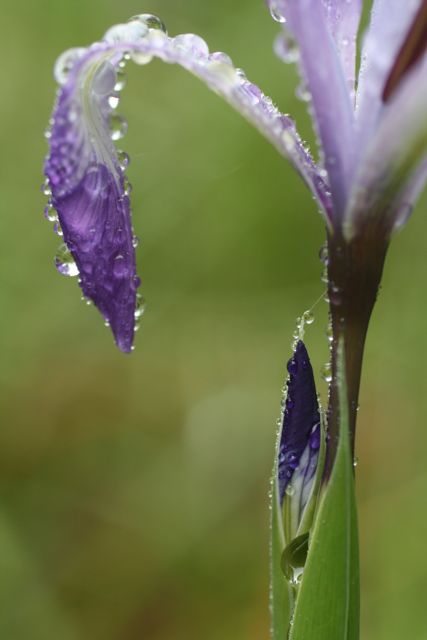
The wild irises of California are a spring delight. You can see them in forest clearings and meadows, sometimes in great green and purple masses. Other times one plant will appear singly, a burst of color against the browns of an understory. With their many variations in color and decoration they are a never-ending visual treat ranging from dark purple to pale yellow.

This slideshow requires JavaScript.

The three largest, lower petals can look like a cross between a watercolor and a stained-glass window, with dark veins blocking out yellows, whites and purples – but with the color fading gently towards the edge of the petal. Above it is what appears to be a paler, less gaudy petal (it’s actually part of the pistil). Sandwiched between the two is the dark purple tongue of the stamen, dusted underneath with pollen, and invisible unless you pry the flower open or look very close. Often you’ll see bees rummaging around and coming out with their legs laden with pollen.

Douglas iris (Iris douglasiana) is the most common wild iris species, but coast iris (Iris longipetala) and ground iris (Iris macrosiphon) are also somewhat common. And keying them is a trick!! Every book or expert gives different suggestions about how to distinguish one from another. The Marin Flora says you can identify a Douglas iris if the pollen is yellow and the surface of the leaf is shinier than the underside and the long purple tube below the flower (the perianth tube) is about 2 centimeters long. But the Flora of Sonoma County suggests two ways to ID the Douglas. First  is if the leaf bases (but not the entire plant!) is reddish. Second is if the perianth tube is less than 3 centimeters long. So take your pick! Once I get a confident ID on another species I’ll post about those as well.

1 Comment

Filed under Good for gardens, Native, Plant of the day