Tag Archives: ecology

Plant of the day: Spanish broom

With flamboyant, showy flowers, Spanish broom is probably the most beautiful of all the evil brooms. It is still evil, though. Don’t be fooled by the big yellow flowers with their many exuberant stamens and pretty wing-like petals.

This slideshow requires JavaScript.

This plant has the lean, linear look of Scotch broom but with even fewer leaves. The California Invasive Plant Council lists Spanish broom (Spartium junceum) as a species that can cause serious problems for native ecosystems. It can grow up to 15 feet tall and form dense stands that smother all other plants in the area. According the IPC, it is native to Spain, Morocco and other parts of southern Europe. It was introduced to California in 1848 as a decorative plant, and in the 1930s was planted along mountain highways in Southern California. Oops.

In Marin, it is one of the least common brooms. I saw the ones pictured here clinging to the slopes of what looks like an old rock quarry owned by the Marin Municipal Water District.

2 Comments

Filed under Invasive, Non-native, Plant of the day

Plant of the day: pride of Madeira

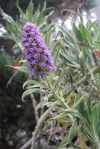
You’ll see these towering purple spikes looming from road cuts and clifftops. This is pride of Madeira, or Echium candicans. It’s a common sight – especially in more coastal areas. It grows to more than seven feet tall, and is very striking with its gray-green leaves and massive heads of flowers (easily over a foot long).

Sadly, this plant isn’t native to the US. It’s another escaped ornamental species that’s still commonly used in landscaping. Birds and butterflies love it, and deer don’t. In inland areas this isn’t a problem but in the coastal climate it spreads on its own, gradually creeping into wild areas. Because it spreads slowly it is only considered to be moderately invasive, but it’s still not recommended for local gardens.

Leave a comment

Filed under Invasive, Non-native, Plant of the day

Plant of the day: oxeye daisy

Hiking across a remote meadow, I suddenly find myself in a knee-high field of daisies. This is the invasive oxeye daisy (Leucanthemum vulgare), a striking flower with stark white petals around a yellow center.

This bloom was introduced from Europe and is now widespread throughout Marin and much of California. It has a cousin, Shasta daisy, which is less common and has (very slightly) larger flowers and leaves. Oxeye daisy is a moderately problematic invasive, growing so densely in places that it excludes other native vegetation. It also is known for giving cows’ milk an unpleasant taste if they eat it.

Leave a comment

Filed under Invasive, Non-native, Plant of the day

Plant of the day: yarrow

Achillea millefolium

Knee-high clumps of creamy flowers stand atop a narrow stalk. Each yarrow flower has a sweetly classic daisy shape to it – and like a daisy, it is actually many flowers. If you look close you’ll see the demure inner “disc” petals surrounded by the flashy outer “ray” petals.

In the southwest, yarrow is sometimes called Plumajillo, or little feather, because of its delicate plume-shaped leaves. It is listed as being mildly toxic by the California Poison Control system, but historically has been used as a tea to treat colds, nausea, cramps, hives, measles and kidney ailments. Yarrow (Achillea millefolium) also was used externally to treat cuts, stop nosebleeds, and as a hair wash to prevent baldness!

Leave a comment

Filed under Native, Plant of the day

Plant of the day: oceanspray

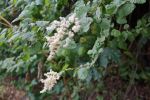
This graceful shrub has soft scalloped leaves and creamy white sprays of flowers. It is happily in bloom right now, and a fun one for drive-by botanizing since it thrives on roadside banks. Usually oceanspray (or cream bush, aka Holodiscus discolor) is a medium-sized shrub, but on exposed hills it can become a low-growing mat, according to the Marin Flora.

This is a good one for gardens since it can grow in a wide range of soils from wetlands to dry and well-drained. The beautiful flowers with their many long stamens are typical of its family, the Rosaceae or rose family. This big clan contains a wide spectrum of species from cherries and plums to roses to silverweed. It’s one of the biggest plant families there is.

Leave a comment

Filed under Good for gardens, Native, Plant of the day

Plant of the day: rattlesnake grass

The brown hills of California are far from monochromatic. Look closely and you’ll see a complex tapestry of colors, textures, shapes, sizes–and sounds! Do you hear that rustling rattle as you brush through the grass? Look close and you’ll see graceful stalks of rattle-shaped grass heads.

This is rattlesnake grass, or Briza maximaone of my favorite plants of the summer. Sadly this nice-looking plant is also fairly invasive (introduced from Europe, and occasionally planted as an ornamental). It’s now become naturalized in the Coast Range and in scattered other parts of California, which is why you see it almost everywhere.

Leave a comment

Filed under Invasive, Non-native, Plant of the day

Plant of the day: California spikenard

Here is a big, tall plant of the shadows. Smallish, round tufts of flowers are surrounded by large jagged-edged leaves. The unopened flowers are particularly beautiful – they look like a sculptor’s version of the childhood game of Jacks.

Usually this plant, which grows up to nine feet tall, is found in deep shady woods. I saw it deep in the Mt. Tam watershed, growing on a hillside among redwoods and tanoaks. California spikenard (Aralia californica) is in the ginseng family, and is used by herbalists as a tonic. The roots (and sometimes other parts of the plant) were used extensively by various Native American tribes to treat a wide variety of ailments from cancer to fainting to stopping periods. Most commonly it seems it was used to prevent skin infection, or as a tonic for colds. It has also been called elk’s clover or prairie sagewort.

Spikenard in fruit (September)

2 Comments

Filed under Medicinal, Native, Plant of the day

Plant of the day: ice plant

On a trip to the ocean, I wade through a thick reddish-green mat of rubbery plants to get to the beach. The ankle-high leaves are spiky and break off under my feet with a crunch. Large yellow flowers are scattered across this green carpet, each with hundreds of skinny petals surrounding a nest of pollen-dusted stamens. This is Carpobrotus edulis, one of several kinds of iceplant in the area. None are native.

The fruit of Carpobrotus edulis, as its name suggests, was traditionally eaten back in its original territory of South Africa. It was deliberately brought to California, planted to bind coastal soils together and help stop erosion. It does seem to be successful at that job – you can see it growing on beaches and even in colorful tapestries drooping over the edge of cliffs. However, it’s another good intention gone wrong since it has turned out to be highly invasive; an “ecological bulldozer,” along the lines of broom, that wreaks havoc on the delicate dune ecosystem. All the species of ice plant look at least somewhat similar, though not all of them are closely related (there are five species in four different genera, with the two types of Carpobrotus being the most common around here, as far as I can tell).

3 Comments

Filed under Edible, Non-native, Plant of the day

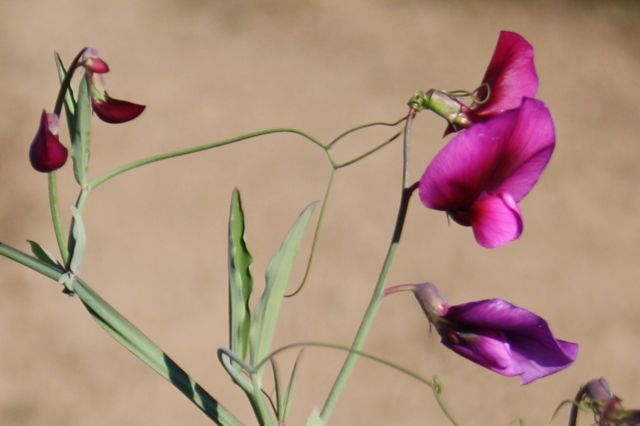
Plant of the day: Tangier pea

Lathyrus tingitanus

Showy pink blossoms, delicate fragrance and winding tendrils – it’s sweet pea season. I’ve been seeing them growing along roads and trails, in gardens, and in bouquets on people’s tables or shop counters. This is an invasive species that it’s hard not to love – a guilty botanical pleasure!

As with yesterday’s plant, this is one where I learned more than I bargained for in the identification. I had naively assumed that there was only one type of sweet pea and that every time I saw that distinctive pink blossom it was the same species. Wrong again! There are several different kinds, and also some native species with paler pink blooms, so you have to look close. Tangier pea, or Lathyrus tingitanus, has the winged stem, two-parted leaves and large, deep pink flowers that mark it as one of the non-native species. You can tell Tangier pea from sweet pea because it is an annual, and also because it only has two or three blossoms per stalk.

Leave a comment

Filed under Invasive, Non-native, Plant of the day

Plant of the day: Scotch broom

This is another badnasty invasive broom species that you’ll see frequently throughout the Bay Area. Scotch broom (Cytisus scoparius) has pretty yellow pea-like flowers and long, narrow leaves that press closely against its multi-sided stems. Though it occasionally has some rounded leaflets as well, the overall lean, linear look to its foliage makes it easy to tell from its French broom cousin that I wrote about a few weeks ago.

This slideshow requires JavaScript.

In California, French broom is a nastier problem than Scotch broom, but throughout the rest of the country the Scottish Cytisus scoparius is the worst broom around. Even worse, both were deliberately originally introduced as ornamental species!

This plant is so nasty because it is hearty and vigorous, and spreads fast because it produces a LOT of seeds. A single Scotch broom plant can live for up to 7 years, and produce over 150,000 seeds per year. It’s a mind-boggling number! The seeds stay in the ground, ready to sprout, for between 5 and 30 years. These plants grow up to 12 feet tall and smother any native plants that would otherwise have grown where they are. There’s no sharing if you’re a broom species! Scotch broom is a rampant invasive across much of the western and eastern seaboards of North America – from Alaska to Baja and from Maine to Georgia, as well as in other countries like Australia and New Zealand. It’s native to northern Africa and parts of Europe.

There is one more broom species that you might see in the area, and that’s Portuguese broom. It’s not nearly as common, but it does cover about 65 acres in the Marin Headlands where it was planted in the 1960s as part of a landscaping and slope stabilization program – another good idea gone wrong! Portuguese broom looks a lot like Scotch broom, except the seed pods are inflated instead of compressed around the seeds. Also they have 8-10 sided twigs, as opposed to the 5-sided twigs of Scotch broom.

Leave a comment

Filed under Invasive, Non-native, Plant of the day