Tag Archives: Flora

Plant of the day: moth mullein

A flash of pale yellow underneath a coyote bush. Growing up under the gray branches of the shrub is a stalk holding several pretty, broad-faced flowers. The five petals surround a hairy, reddish-pink cluster of stamens. The stamens and pistil are flamboyant: the three upper stamens are clustered together, while the lower ones–and the pistil–scoop outward, presumably an invitation to insects.
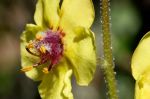
This unusually striking flower is moth mullein (Verbascum blattaria), and unfortunately it’s not a native to California. It was introduced from Eurasia and has spread across much of the United States. Other species of mullein share the distinctive hairy-ness and the unusual stamen-and-pistil pattern, but otherwise look quite different.
Leave a comment

Filed under Non-native, Plant of the day

Plant of the day: canyon gooseberry

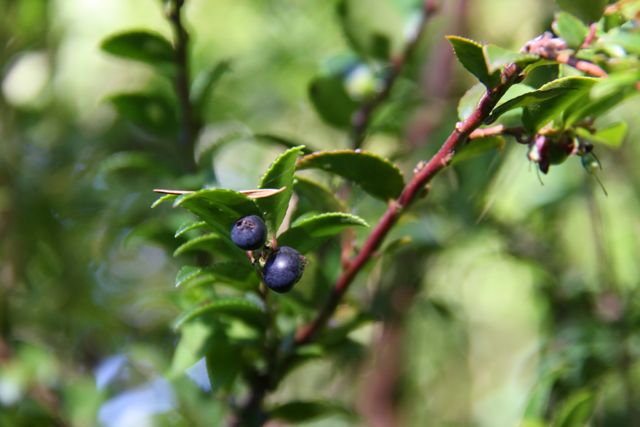
This gooseberry is a prickly delight. From its elegant branches to its troublesome little berries, Ribes menziesii has a lot of character. The berries are edible–and yummy!–but you have to get past the spines to enjoy them. There’s no easy way to do this; you can try peeling with a pocket knife or just chewing carefully. I’ve also tried popping them with my teeth first, before chomping down. This seems to work the best, but you’re still bound to get prickled a few times.

This slideshow requires JavaScript.

Overall this plant is better for looking at than for eating, especially in spring and summer. The thorny branches sport scalloped green leaves on gracefully arching branches, and in the spring it puts out masses of small lantern-shaped flowers that bees love.

Gooseberries are a type of currant, and some of the local wild species (spreading gooseberry, flowering currant) are spineless–as are their store-bought cousins. In addition to the canyon gooseberry featured here, there are some other spiny species around as well (California gooseberry and Victor’s gooseberry). You can tell them apart because the first has smooth, hairless leaves and the second has shorter spines on the fruit that are all about the same length.

Leave a comment

Filed under Edible, Good for gardens, Native, Plant of the day

Plant of the day: western rasperry

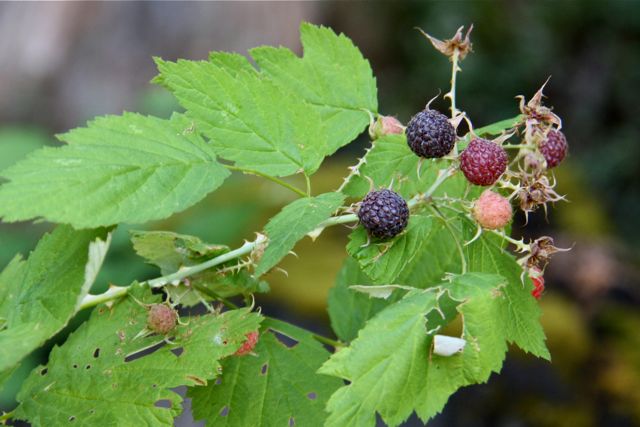
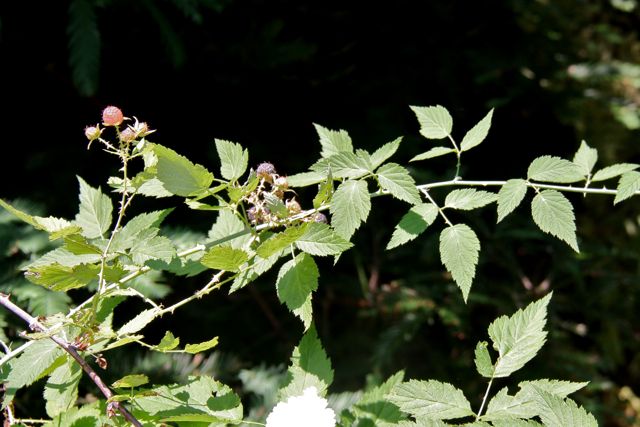
A sprawling pale-stemmed bush is decked with dark purple raspberries. Warmed in the sun, they have a mild, rich sweetness. These tasty fruits are smaller, leaner, and much darker than their plump commercial cousins. I’ve always preferred the wild version!

There are many listed names for Rubus leucodermis  (western raspberry, white stemmed raspberry and whitebark raspberry) but I’ve always just called this “wild raspberry” since it’s the only native one around. It’s in the same genus as Himalayan blackberry, but though the plants are similar they are easy to tell apart even when not in fruit. Western raspberry is a delicate shrub with slim branches that have a glaucous coating which you can rub off with a finger. The leaves of both species are three parted, but blackberries’ are much thicker and darker.

Western raspberry is one of my very favorite California berries, but you won’t see it growing in Marin. Sonoma County? Yep. Santa Cruz? Yep. Even down to San Diego and up into Alaska. But for some reason it doesn’t like the San Francisco bay – there’s no record of it  in SF, Marin, the East Bay, or the Peninsula.

Leave a comment

Filed under Edible, Good for gardens, Native, Plant of the day

Plant of the day: slender tarweed

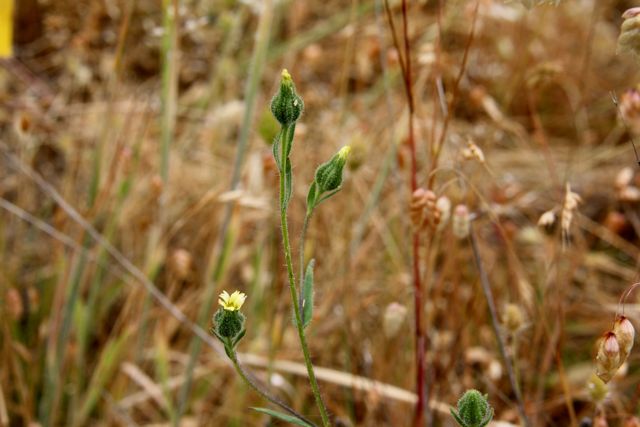
Here is a common little tarweed with small unobtrusive flowers. Madia gracilis has the strong odor and sticky stem that’s common to the tarweeds (or gumweeds, which is another one of this little guy’s common names). The flowers are often dwarfed by the bulbous green cup of sepals below. If you look close you’ll see that the entire plant is covered with little glandular hairs, with tiny black dots atop stubby white bristles.

Leave a comment

Filed under Native, Plant of the day

Plant of the day: trail plant

Adenocaulon bicolor

With distinctive arrow-shaped leaves, trail plant is a common sight while hiking. The tiny white flower is much easier to miss – I mostly notice the leaves without blooms. When it does flower, this perennial herb shoots up a long, mostly bare stalk from the low cluster of leaves.

The small flowers initially appear in a series of tiny heads, each on their own branch off the central stalk. But as the plant ages and the seed pods elongate, one flower will stay perched on the end of each seed/ovary as it matures. This gives the head an interesting multi-storied look, with some flowers still clustered in the center and some perched above them atop their green pedestals.

Adenocaulon bicolor seeds get sticky and cling to socks, pants, and fur – a handy way to disperse but a pain in the neck to walk through. Still, I’ve always been fond of this unassuming plant. The leaves are a cheerful green (with a cottony white coating underneath) and the flowers are quirky. Good enough for me!

This slideshow requires JavaScript.


Leave a comment

Filed under Native, Plant of the day

Plant of the day: yarrow

Achillea millefolium

Knee-high clumps of creamy flowers stand atop a narrow stalk. Each yarrow flower has a sweetly classic daisy shape to it – and like a daisy, it is actually many flowers. If you look close you’ll see the demure inner “disc” petals surrounded by the flashy outer “ray” petals.

In the southwest, yarrow is sometimes called Plumajillo, or little feather, because of its delicate plume-shaped leaves. It is listed as being mildly toxic by the California Poison Control system, but historically has been used as a tea to treat colds, nausea, cramps, hives, measles and kidney ailments. Yarrow (Achillea millefolium) also was used externally to treat cuts, stop nosebleeds, and as a hair wash to prevent baldness!

Leave a comment

Filed under Native, Plant of the day

Plant of the day: huckleberry

Vaccinium ovatum

One of my favorite Fourth of July memories is eating my great-aunt Martha’s huckleberry pie when I was a kid. We’d gather at the family campground by a little river, and eat California delicacies like abalone, venison, and this wonderful pie. Huckleberries are a wild-tasting fruit, tart but sweet. They taste of pine forest and long days with picking buckets. The little fruits hold their texture even when cooked, they  pop in your mouth with a satisfying burst: perfect when blended with sugar and a flaky crust.

Huckleberries (Vaccinium ovatum) grow all along the west coast – from Canada to Alaska – but not many people cook with them often since they are so small that picking enough for a pie takes a long time. Look for them  in forests and clearings, often on slopes. The shrubs are attractive, with dense shiny foliage of small oval leaves. White lantern-shaped flowers give rise to small, round, dark purple fruit that looks like a small blueberry.

2 Comments

Filed under Edible, Good for gardens, Native, Plant of the day

Plant of the day: oceanspray

This graceful shrub has soft scalloped leaves and creamy white sprays of flowers. It is happily in bloom right now, and a fun one for drive-by botanizing since it thrives on roadside banks. Usually oceanspray (or cream bush, aka Holodiscus discolor) is a medium-sized shrub, but on exposed hills it can become a low-growing mat, according to the Marin Flora.

This is a good one for gardens since it can grow in a wide range of soils from wetlands to dry and well-drained. The beautiful flowers with their many long stamens are typical of its family, the Rosaceae or rose family. This big clan contains a wide spectrum of species from cherries and plums to roses to silverweed. It’s one of the biggest plant families there is.

Leave a comment

Filed under Good for gardens, Native, Plant of the day

Plant of the day: rattlesnake grass

The brown hills of California are far from monochromatic. Look closely and you’ll see a complex tapestry of colors, textures, shapes, sizes–and sounds! Do you hear that rustling rattle as you brush through the grass? Look close and you’ll see graceful stalks of rattle-shaped grass heads.

This is rattlesnake grass, or Briza maximaone of my favorite plants of the summer. Sadly this nice-looking plant is also fairly invasive (introduced from Europe, and occasionally planted as an ornamental). It’s now become naturalized in the Coast Range and in scattered other parts of California, which is why you see it almost everywhere.

Leave a comment

Filed under Invasive, Non-native, Plant of the day

Plant of the day: rosin weed

Growing across a rocky bed of serpentine is a field of low white flowers. Look close, and you see that the leaves and stems are sticky and thick with white hairs. Nestled among the hairs are little dark dots that are actually glands. This is what makes it sticky – and also the source of the name, Calycadenia multiglandulosa.

You’ll usually see this little plant on serpentine, and only in California.

Leave a comment

Filed under Native, Plant of the day