Tag Archives: Marin

Plant of the day: sea lettuce

Sea lettuce looks exactly like its name: ruffled, brilliant green leaves that grow in tufts from shallow rocks. It’s usually found in calm waters. There are many species of sea lettuce in the Ulva genus, and as of right now I have no idea how to tell them apart–but from what I’ve read, that’s because they are all quite similar in looks and habit.

Sea lettuce is a green alga, and is edible though sometimes a little tough and bland. Some enjoy it for salads. One warning if you are planning to eat some Ulva is that it grows particularly profusely in water that’s been “enriched” by sewage or other pollution. So if you see a dense patch of the stuff, take a close & skeptical look at the nearby landscape before you harvest it…

Leave a comment

Filed under Plant of the day

Plant of the day: California fuchsia

It’s a treat to see a whole cliff-full of flowers blooming at this time of year–but that’s just what I found on Mt. Tam the other day. California fuchsia (Epilobium canum) is a late bloomer that you can see in scattered spots throughout the bay area.

Hummingbirds pollinate this flower, attracted by the scarlet, trumpet-shaped blooms. Other common names include hummingbird flower or hummingbird trumpet. It sports these flowers at the end of long stalks densely covered with small, slightly wooly leaves. This perennial plant can be woody at the base (the technical term for this is suffrutescent) but it is usually fairly low growing, with several sprawling stems that are around one foot long. California fuchsia is in the Onagraceae family along with other showy blooms like fireweed, clarkia, and evening primrose.

I saw it growing on a hot, southwest-facing road cut as Pantoll climbs up towards Rock Springs.


Leave a comment

Filed under Good for gardens, Native, Plant of the day

Plant of the day: San Francisco gum plant

Its easy to tell if you’re looking at a gum plant. All the different species have big yellow daisy-like flowers perched atop a green nub that is studded with fleshy hooks. Before the young buds bloom they ooze a white sap that looks exactly like fresh Elmer’s glue.

San Francisco gum plant (Grindelia hirsutula var. maritima) only grows near the coast, on hills and bluffs from Marin to Monterey. I spotted these specimens on a recent hike to Chimney Rock on Point Reyes. Distinguish this plant from its cousin, coastal gumplant, because it grows on the hills instead of the salt marshes–but mainly because it doesn’t have perennial woody stems. San Francisco gum plant can vary dramatically in size, from 8 inches to nearly 5 feet. The plants I saw had hairy leaves, but according to the Marin Flora the leaves are usually hairless (aka “glabrous” in botany-speak).

Surprisingly, the Elmer’s glue doesn’t seem to have had any historical uses (that I’ve been able to unearth). But the dried leaves and buds were used to treat bronchial conditions including asthma.

Though there are three different species listed in the Marin Flora, it’s worth noting that some experts think that they all are actually part of the same species, Grindelia hirsutula.

Leave a comment

Filed under Good for gardens, Medicinal, Native, Plant of the day

Plant of the day: Queen Anne’s lace

A delicate parasol of tiny white flowers is punctuated at the center with one that is dark purple. This is Queen Anne’s lace, or Daucus carota.

Though the plant looks a lot like poison hemlock, Queen Anne’s lace is actually edible–its other name is wild carrot. The roots are eaten cooked, or roasted for a coffee substitute, while the seeds are used as a flavoring. I personally have been too squeamish to try it, though the subtle details of the two plants are very different. First there is the central purple bloom. Second, wild carrot has a green stem stippled with hairs (while poison hemlock has a mottled and whitish stem).

This non-native plant is native to Europe and Asia.

Leave a comment

Filed under Non-native, Plant of the day

Plant of the day: seaside daisy

This pretty purple daisy prefers excellent views. It grows along the coast, often clinging to rocky cliffs or sunbathing on sandy beaches. I photographed the ones shown here on the Point Reyes Peninsula, growing on the top of Arch Rock–a lovely vantage point looking down on the long stretch of coast to the north and south.

Seaside daisy (Erigeron glaucus) has rounded, grayish green leaves that are soft to the touch. The flowers heads are purple, ranging towards white or pink, with a yellow center. It’s native to California and Oregon, and it’s often seen in rock gardens as well as in the wild. Other names include beach daisy and seaside fleabane.

3 Comments

Filed under Good for gardens, Native, Plant of the day

Plant of the day: California rose

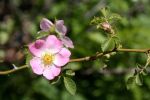
This wild rose is a favorite sight in spring and summer, as pink blossoms give way to ripe red fruit. This is the California rose (or as it is conversely known in Latin, Rosa californica), which grows in nearly every county in California, as well as in parts of Oregon.

This hardy shrub can look scraggly, but also can be groomed into a good garden plant, with pale green leaves and colorful fruit and flowers. It grows to 8 feet tall but is usually smaller. The tangle of thorny branches make excellent shelter for birds, and I’ve spotted many a nest by peering into a wild rose bush.

Rose hips are a renowned source of Vitamin C, and you can make an immune-boosting tea just by pouring boiling water over the red fruit. The hips can also be eaten fresh, though the inner bit is unappetizing, filled with seeds and strange stiff hairs. But the thin outer layer of flesh is tasty–I usually eat it by splitting the fruit open with a fingernail and scraping out the seeds. But this is labor intensive, and rose hips were never a significant food source for Native Americans. There was some medicinal use, though. A tea of wild rose hips was used to treat fever, sore throats and stomach aches–as well as to wash sores and sooth the pain of babies.

There are several different kinds of wild roses in California, and they all look fairly similar. The California rose (according to the Marin Flora) has the brown remains of its sepals at the tip of its ripe hips, and also tiny hairs visible on the stems of its leaves. It grows in full sun and partial shade, and in both wet and dry areas.

Leave a comment

Filed under Edible, Good for gardens, Medicinal, Plant of the day

Plant of the day: leather oak

Oaks are generally thought of as tall, graceful trees. But you can also find them in the sea of waist-high bushes known as chaparral. Leather oak (Quercus durata var. durata) is a common sight on serpentine soils in this area.

This slideshow requires JavaScript.

Leather oak can grow to around nine feet tall, but I have mainly noticed them growing much closer to the ground. Look close to spot acorns or clusters of catkin-like flowers among the small, grayish green leaves. The leaves of this species are dull, dusted with a pale fuzz (paler on the top than on the bottom). They also are concavely curled towards the ground–you could flip one over and use it for a little spoon, if they didn’t have a tendency to be spiny.

As with all acorns, the nut of the leather oak is edible once its bitter tannins have been leached out. Acorns were historically a major food source for local Native American tribes, and still are a major part of the food chain for wildlife. People generally remove tannins by soaking the nut in water (or a running stream). But some tribes would plant the acorn in a bog and wait until it sprouted in the spring–a system which apparently got rid of most tannins but preserved more nutrients than the water method.

Acorns can be eaten whole, or ground into a floury powder for cooking. Roasted acorns can be used as a coffee substitute.

Leave a comment

Filed under Edible, Native, Plant of the day

Plant of the day: salal

Gaultheria shallon

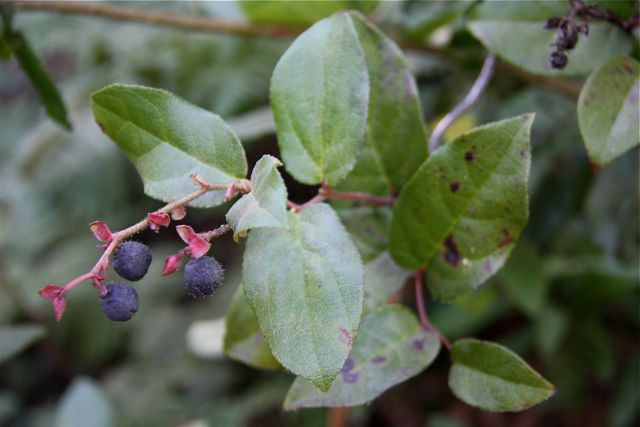
Salal is a familiar companion of the forest underbrush from Alaska to Santa Barbara. It is unadorned for most of the year, a simple shrub with largish (~4 inch) leathery leaves that dance up alternate sides of a slightly zig-zagged stem. In between the large veins, the leaves are traced with an intricate lacey pattern somewhat like the crease on the palm of a hand.

Small bell-shaped flowers of pinkish white appear at the tips of the stems in the early summer, and by now the dark purple fruit has ripened. Each berry is lightly hairy, and they are fairly sparse on the plant. Though edible, I have found them to be bland the few times I’ve tasted them. The leaves can be made into “a pleasant tea“, and poultices made of the leaves were traditionally applied to cuts, burns and sores. The fruit or leaves were also used to make dyes (of purple or yellow).

Leave a comment

Filed under Edible, Native, Plant of the day

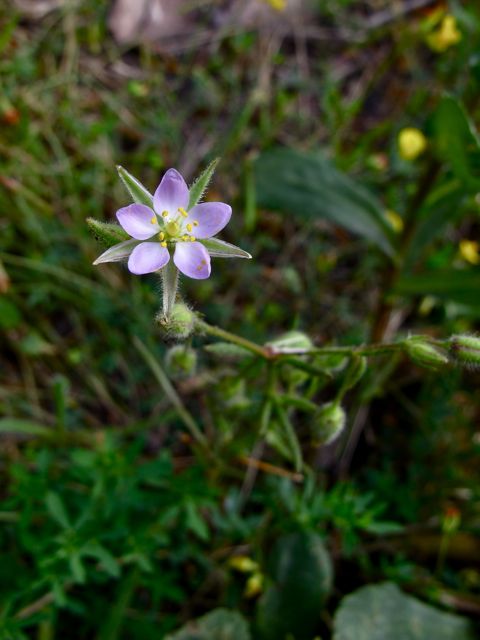
Plant of the day: sticky sandspurry

Spergularia macrotheca

On the upper edge of a salt marsh, pale purple flowers grow low to the ground. This is sticky sandspurry, or Spergularia macrotheca. There are several different species of spurrys in the area, and all are very similar. To identify S. macrotheca I had to get out my hand lens and look close at the tiny seeds. In this species, each seed is surrounded by a narrow, papery halo (or “wing”).

With its five pale petals surrounding cheery yellow stamens, sticky sandspurry can be found along the Pacific coast states up to Canada and southeast Alaska. The plant earns its name by being covered with short, sticky hairs. Clustered leaves, rising from a swollen spot in the stem, give a clue that it’s in the Caryophyllaceae family.

It prefers to grow in wet places, often near saltwater, but it also can be found by freshwater seeps, springs and vernal pools–and in non-wetlands as well.

Notice the swollen stem at the leaf nodes


1 Comment

Filed under Native, Plant of the day

Plant of the day: saltmarsh dodder

Bright orange patches dot the green swath of a salt marsh. Look close and you will see what looks like a mat of fishing line or straw. Hundreds–thousands–of narrow orange threads are wrapped tightly around bright green pickleweed stems. Copious white flowers often bloom off the threads. This is saltmarsh dodder (Cuscuta salina), a parasitic native plant that mooches nutrients off its host plant. Instead of photosynthesizing its own food, it sinks tiny root-like organs (called haustoria) into the flesh of the plant. Once it taps into the vascular system it can suck out all the water, minerals and carbohydrates that it needs.

Dodder seeds are scattered by wind, tides and animals so there is no guarantee that they will germinate near a suitable host plant. But they die if they can’t find one quickly. It sounds impossible for a  brainless, eyeless, noseless  plant to do, right? Nope–not if a host is anywhere close. They can detect the volatile compounds emitted by the host (basically, its smell) and then they grow towards it.

There are a lot of species of dodder in the US, and some of them are parasitic to some of our favorite crops like alfalfa, potatoes and petunias. Though the group is much maligned as a result, some ecologists make a case for the role that parasitic plants can play in the natural environment. Species like dodder or mistletoe don’t decimate their hosts’ population, but they do create patchiness. And in ecology, patchiness tends to lead to diversity, which is a good thing!

1 Comment

Filed under Native, Plant of the day