Tag Archives: native plant

Plant of the day: Douglas’ sandwort

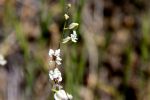
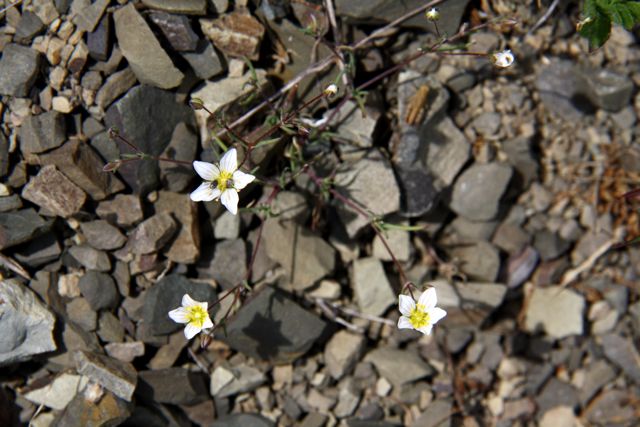
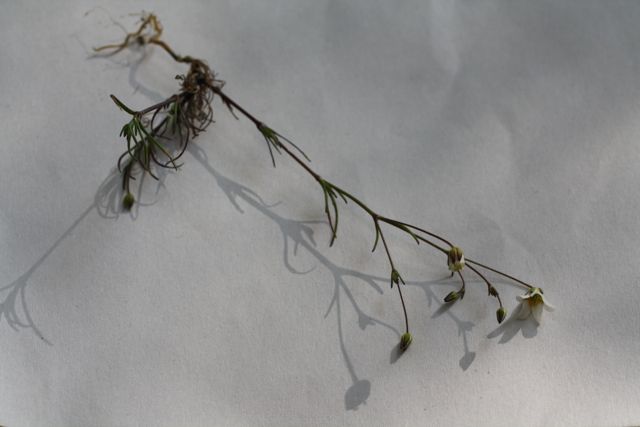
On a barren, rocky slope is a tremendously delicate little plant. Five tissue-thin petals veined with tiny lines surround a cluster of delicate yellow stamen. The reddish stems are threat-thin and sparsely decorated with green needlelike leaves.

Douglas’ sandwort (Minuartia douglasii) is fairly common, but it’s so small you might never have noticed it before. It is strongly associated with serpentine, which is where I saw it.  The paired leaves clasp around the stem, and if you look close you’ll see that this joint (or “node”) is swollen slightly—it bulges out from the rest of the stem. If you’re keying plants, this is an excellent hint that what you are looking at is in the Caryophyllaceae, or pink, family. The common store-bought carnation is a common example of this family; so is the garden flower rose campion. Look at their stems to see how they all have the swollen nodes in common!
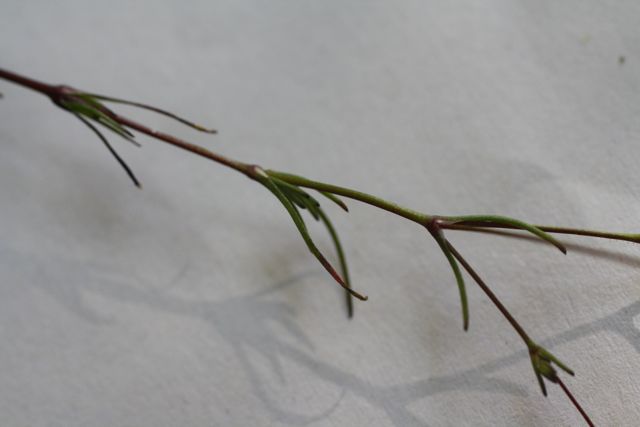
There are several other species of sandwort in the San Francisco Bay Area, but though they seem really similar in the key, they don’t look at all similar to this one in their actual growth form. At least not as far as I can tell. But I might have to wait until a while to keep looking for different growth forms – I took these photos of the sandwort about a month ago, and they are now pretty much done blooming. We might not be seeing any more until next spring.
Leave a comment

Filed under Native, Plant of the day

Plant of the day: buckeye

It’s buckeye season – one of my favorite stages of spring. These spreading trees with their tall, pinkish-white spires of flowers can be seen along roadsides, streamsides, in mixed woodlands and even at the edge of pebbly beaches on Tomales Bay. I’ve seen Aesculus californica growing so close to the water that the lower branches were draped with streamers of dried eelgrass.

This slideshow requires JavaScript.

This lovely tree is unique to California, and can be found across much of the state. It has loads of character, with knobby, gnarled trunks and wide palmately compound leaves. It leafs out during the winter, offering cool shade on hot days into the early summer, and then it goes dormant. In the fall it drops beautiful shiny chestnut-colored nuts (ok, actually they are “capsules” since the hard exterior contains several seeds). I like to gather them and use them for decoration. But don’t eat any! They are toxic, known to depress the nervous system, cause abortions in cattle and be toxic to bees. Native Americans would use extract of the seed topically (for hermerrhoids?!). In tough times the seeds were sometimes eaten (after careful preparation to leach the poison out). Buckeye also provided food in a different way: pouring a ground-up powder of the seed into a stream would stupify fish for easier catching!

Leave a comment

Filed under Good for gardens, Medicinal, Native, Plant of the day, Poisonous

Plant of the day: silverweed cinquefoil

Silver weed cinquefoil

Potentilla anserina

This is sunny little flower almost always grows in wetlands or creeksides, though it can be found elsewhere. The photo shown here was taken on a seemingly-dry trailside, but because it was on a hill I wouldn’t be surprised if it is wetter than it appeared. Potentilla anserina is the most common cinquefoil in the area. In general, cinquefoils have a very distinctive “look,” with five spreading petals and surrounding a central mound of many stamens. The leaves are composed of crinkly, jagged-edged leaflets. Often the leaflets are arranged in many pairs along the stem (as with this silverweed here), but sometimes they are in threes or in a fan shape. Once you’ve seen a few different species the similarities start to jump out at you!

Leave a comment

Filed under Native, Plant of the day

Plant of the day: secund jewelflower

Like a handful of precious jewels scattered on a rocky slope, this flower is easily missed but well worth a closer look. With single flowers spread out on a long, leafless stalk they can blend into the background. Each blossom is gathered at the base into a balloon that reminds me of the bell-shaped skirts at an old-fashioned ball. At the mouth, the four petals crinkle and flare outwards from a purple-tinged mouth. This is Streptanthus glandulosus ssp. Secundus. The ssp means “subspecies” – a lot of times this designation refers to very subtle differences within a species that a casual botanist isn’t interested in. But in this case, it means this flower is white while the others are dark purple. There are several different jewelflowers in the area, distinguished by their distinctive pouchlike shape, but this is the only white one listed in the Marin Flora.

Jewelflowers are in the same family (Brassicaceae) as the common wild mustards and radish weeds that grow all over, but their signature blossoms are different from most members of this group, which have simple four-petalled flowers. Milkmaids are a good example of a classic brassica.

Leave a comment

Filed under Native, Plant of the day

Plant of the day: mule ears

Like stubby sunflowers, these cheerful yellow blossoms have large, open faces. They can be seen ornamenting grassy hillsides as well as woods and brushy areas. Mule ears (Wyethia glabra) is a California endemic that is widespread throughout much of the western part of the state. Each yellow flower head is backed by a large collection of leaves that can be seen peeking out from behind the inflorescence. Narrow-leaved mule ears (Wyethia angustifolia, not endemic) are also common in Marin, but are easy to tell from regular mule ears because they lack these backing “broad and foliacious” bracts.

This is the first member of the Ateraceae family – also known as a “composite” – to appear on this blog, so a note on this type of plant. What looks like a single flower is actually hundreds of smaller flowers grouped together. This amalgamation is easier to mistake for a single bloom than other headlike arrangements because often the outer flowers look like petals, while the inner flowers are smaller and less showy and can look a lot like pistils or stamens. The outer, petal-like flowers are the “ray” flowers and the inner ones are the “disc” flowers. Each is truly an independent flower in and  of itself, each with its own petals and reproductive parts. The entire arrangement is called a “pseudanthia.”

Leave a comment

Filed under Botany basics, Native, Plant of the day

Plant of the day: milk maids

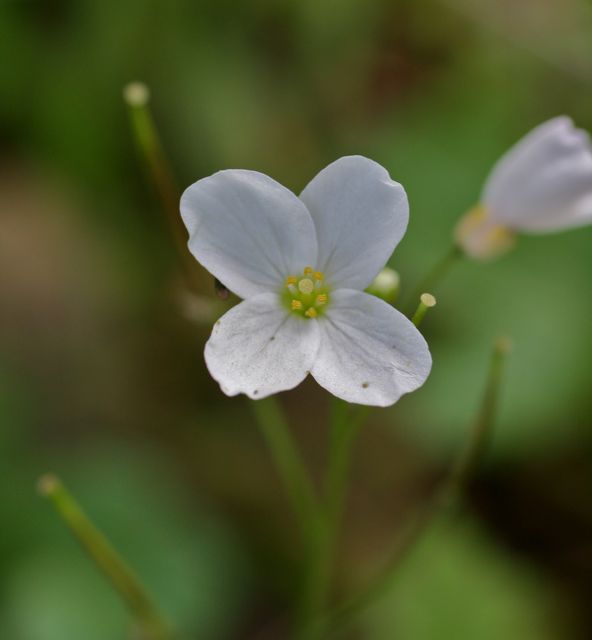
Milk maids are a ubiquitous sight in the spring, with their flowers of four simple white petals alternating sparsely up a stalk. They are one of the first of the year to start blooming, and they can last through May. Wikipedia says the name derives from a hat often worn by milkmaids, but that seems like a stretch since there is nothing bonnet-like about these blooms. Cardamine californica has flowers that are about half an inch across, and grow in most habitat types in the county except the driest. The four petals mark it as a brassica, the same family that houses wild mustard and radish. Many cultivated edibles, like broccoli and kale, are also in the Brassicaceae. Because of the “cross shaped” petals, this family once was called the cruciferae.

This pretty little flower is one of the earliest to bloom, and all parts of the plant (leaves, flowers, and roots) are edible, with a peppery radishlike flavor–they are tastiest before the flowers bloom, according to Judith Larner Lowry’s wonderful book, California Foraging (I admit I haven’t done a careful comparison myself).

Leave a comment

Filed under Native, Plant of the day

Plant of the day: Douglas iris

The wild irises of California are a spring delight. You can see them in forest clearings and meadows, sometimes in great green and purple masses. Other times one plant will appear singly, a burst of color against the browns of an understory. With their many variations in color and decoration they are a never-ending visual treat ranging from dark purple to pale yellow.

This slideshow requires JavaScript.

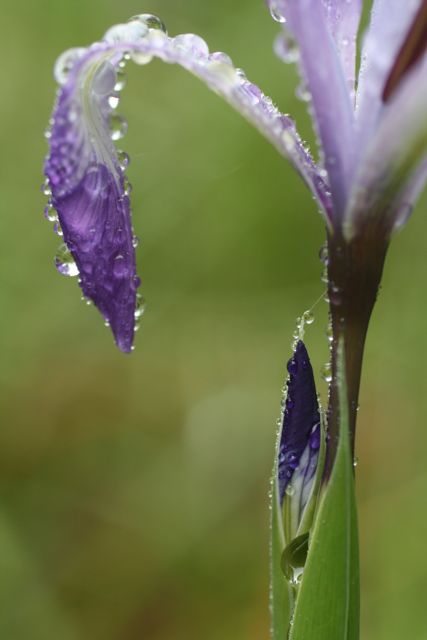
The three largest, lower petals can look like a cross between a watercolor and a stained-glass window, with dark veins blocking out yellows, whites and purples – but with the color fading gently towards the edge of the petal. Above it is what appears to be a paler, less gaudy petal (it’s actually part of the pistil). Sandwiched between the two is the dark purple tongue of the stamen, dusted underneath with pollen, and invisible unless you pry the flower open or look very close. Often you’ll see bees rummaging around and coming out with their legs laden with pollen.

Douglas iris (Iris douglasiana) is the most common wild iris species, but coast iris (Iris longipetala) and ground iris (Iris macrosiphon) are also somewhat common. And keying them is a trick!! Every book or expert gives different suggestions about how to distinguish one from another. The Marin Flora says you can identify a Douglas iris if the pollen is yellow and the surface of the leaf is shinier than the underside and the long purple tube below the flower (the perianth tube) is about 2 centimeters long. But the Flora of Sonoma County suggests two ways to ID the Douglas. First  is if the leaf bases (but not the entire plant!) is reddish. Second is if the perianth tube is less than 3 centimeters long. So take your pick! Once I get a confident ID on another species I’ll post about those as well.

1 Comment

Filed under Good for gardens, Native, Plant of the day

Plant of the day: two eyed violet

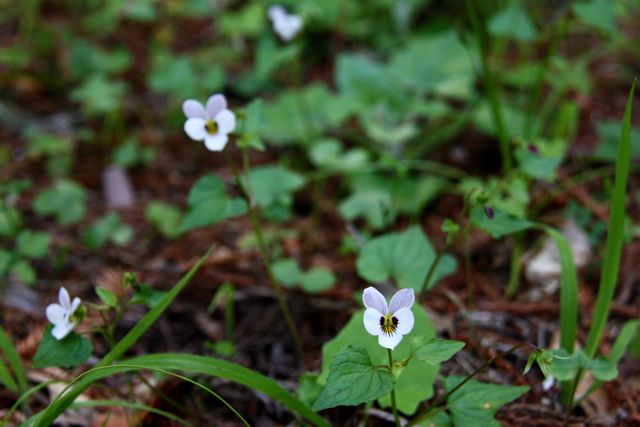
There’s not much that is prettier than a glade filled with violets. They are tougher than they look – two eyed violets like serpentine soil, as well as grassy meadows or rocky hillsides. I saw the ones pictured here growing on the edge of a redwood forest, under some pepperwood trees. Two eyed violets (Viola ocellata) are distinctively named, as they can be distinguished from all other local violets by the two purple spots on their lateral petals. According to the Marin Flora, there is only one other purple violet in the area, and it lacks the paired spots. All the other violets around are yellow.

These little beauties are endemic to the north-western parts of California, and even though they look like a fragile annual they are actually perennials!

Leave a comment

Filed under Good for gardens, Native, Plant of the day

Plant of the day: crimson columbine

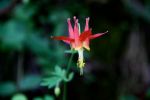
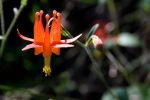
Crimson columbine is a bizarre confection of a flower. With its bright red turrets and awnings, and a dangling bouquet of long yellow stamens, Aquilegia formosa is one of the most sculptural flowers around. It looks like it was designed by Frank Lloyd Wright just to grow in the gardens of the Marin Civic Center – though it doesn’t, as far as I know. Believe it or not, this extravagant bloom is in the same family (Ranunculaceae) as the simple buttercup!

These columbine prefer moist spots and stream banks, where you can find their flaming blossoms high above an airy nest of deeply lobed leaves. In general, the plants grow one to three feet tall, and they are found in all the western states. I saw the beauties photographed here on the Concrete Pipe Trail on the Marin Municipal Water District lands. This is an unpaved access road with a steep bank running along one side for much of its length, and it’s a great spot for seeing a diverse collection of spring flowers.

2 Comments

Filed under Good for gardens, Native, Plant of the day

Plant of the day: harlequin lotus

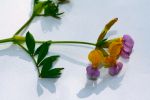
Low, gaudy patches of yellow and purple are splashed across the grass of a wet meadow. This is Lotus formosissiumus, which has numerous common names including harlequin lotus, bicolored lotus, coast lotus or (if you’re in the mood for a bit of a tongue-twister) seaside bird’s foot trefoil. I find harlequin lotus the most descriptive, though coast lotus is also a good monniker since it’s range doesn’t go very far inland.

With it’s typical two-lipped flowers it’s clearly in the pea family. But what coloring! The upper lips are a rich, bright yellow, and the lower lips are a flashy pinkish purple that can, in some plants, fade out towards white with age. The Peterson guide says it grows 1 to 2 feet tall, but I have never seen one more than 5 or so inches high, and other books don’t mention height as a diagnostic trait.

Leave a comment

Filed under Native, Plant of the day