Tag Archives: wildflower

Plant of the day: common catchfly

Common catchfly

This plant is a weed, but I kinda like it. The whole plant is sticky (is that why it’s called catchfly?) and the small pinkish-white flowers are perched atop a vase-shaped calyx. The petals are fused together, with little toothlike projections sticking up like a fringe around the inner edge. There are distinctive stripes running perpendicularly along the calyx (which is all the sepals taken together). The whole thing is a nice bit of floral architecture – if you can forget that it’s an invasive that was introduced from Europe!

Also, Silene gallica is another member of the Caryophyllaceae (a.k.a pink, or carnation) family. So check for the swollen nodes where the opposite pairs of leafs join the stem that I talked about a few posts back!

You may wonder why I always talk about families – the reason is that whether you are keying or looking plants up in a guidebook, being able to confidently narrow your options down to one or two families makes the whole process a lot easier. It also helps train your eye and mind in the detailed way of looking at plants that is needed for good identification.
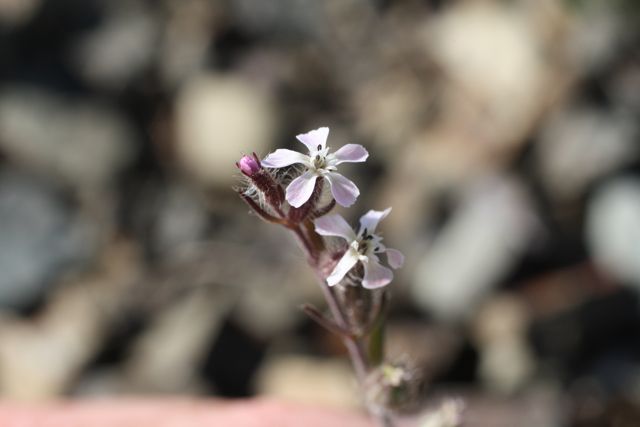
Silene Gallica
Leave a comment

Filed under Non-native, Plant of the day

Plant of the day: Douglas’ sandwort

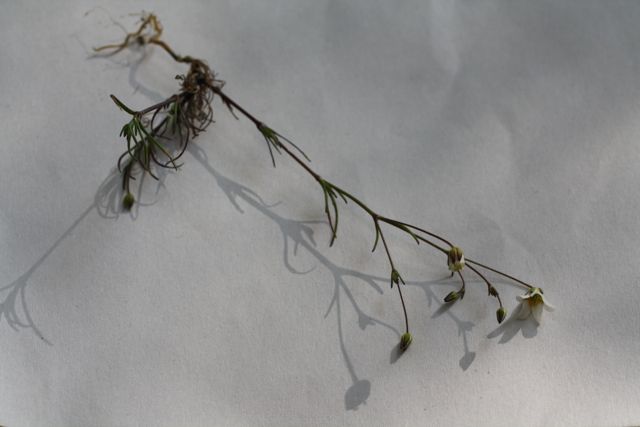
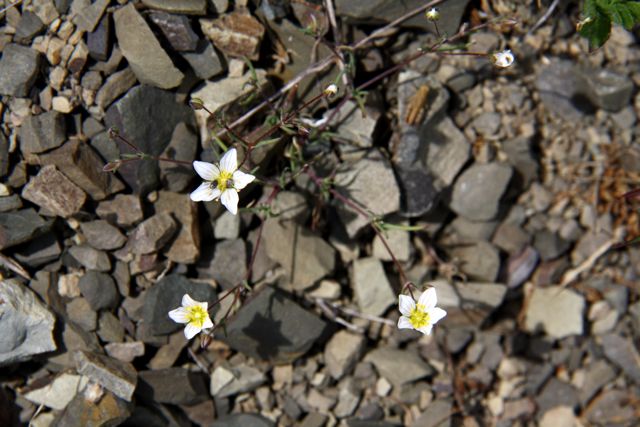
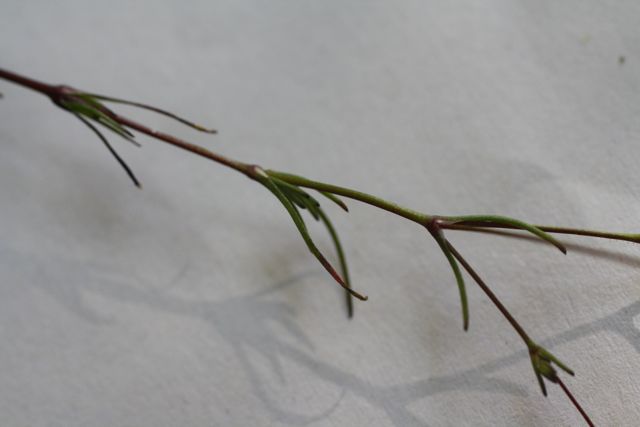
On a barren, rocky slope is a tremendously delicate little plant. Five tissue-thin petals veined with tiny lines surround a cluster of delicate yellow stamen. The reddish stems are threat-thin and sparsely decorated with green needlelike leaves.

Douglas’ sandwort (Minuartia douglasii) is fairly common, but it’s so small you might never have noticed it before. It is strongly associated with serpentine, which is where I saw it.  The paired leaves clasp around the stem, and if you look close you’ll see that this joint (or “node”) is swollen slightly—it bulges out from the rest of the stem. If you’re keying plants, this is an excellent hint that what you are looking at is in the Caryophyllaceae, or pink, family. The common store-bought carnation is a common example of this family; so is the garden flower rose campion. Look at their stems to see how they all have the swollen nodes in common!

There are several other species of sandwort in the San Francisco Bay Area, but though they seem really similar in the key, they don’t look at all similar to this one in their actual growth form. At least not as far as I can tell. But I might have to wait until a while to keep looking for different growth forms – I took these photos of the sandwort about a month ago, and they are now pretty much done blooming. We might not be seeing any more until next spring.

Leave a comment

Filed under Native, Plant of the day

Plant of the day: long beaked stork’s bill

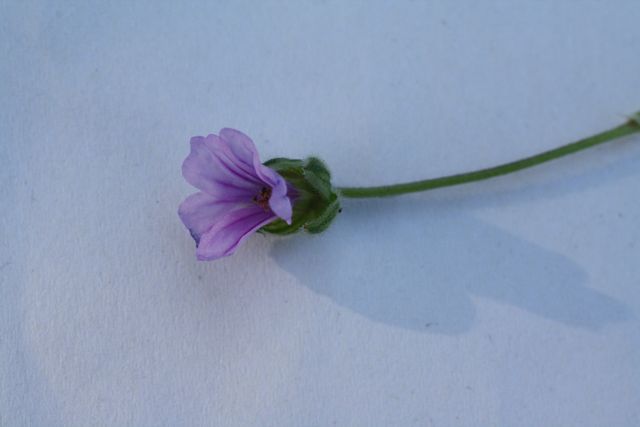
Long beaked stork’s bill is a ubiquitous sight in the fields of the bay area. This invasive little weed and its cousins, other types of stork’s bills, have naturalized across most of California. The long beaked stork’s bill (Erodium botrys) is distinctive because of the particularly long, beak-like seed pod, but also because of its leaf – it is the only one with a long narrow leaf that isn’t actually dissected into separate leaflets.

There are several species of wild geraniums with flowers that look quite a bit like those of stork’s bills – small, pinkish-purple. Again, look to the leaf to know what plant it is. The geraniums (sometimes called crane’s bills) have deeply dissected leaves that are overall roundish in shape. In other words, if you drew a line around the outside of the leaf, ignoring the details, you’d come up with a circle as opposed to the overall tongue-shaped leaves of the stork’s bills. The wild geranium petals are usually notched at the end, giving them a toothed look. Almost all of the wild geraniums are also invasive, with a few exceptions.

Leave a comment

Filed under Invasive, Non-native, Plant of the day

Plant of the day: foxglove

Tall spikes of white or purple flowers are bursting like flares across Marin. This is the season for foxglove, another striking-looking invasive. Native to all parts of Europe, it has now colonized much of North America, where it appears to prefer the coastal areas to the heartland. You can find it in from Alaska to Mexico, and on much of the east coast as well. Digitalis purpurea can grow to be taller than a full-grown person and is quick to colonize areas that have been disturbed such as road sides, logging or building sites.

Foxglove is also highly toxic so don’t eat it!! Small amounts have been known to be fatal. Some of its other names give you a clue that this is a bad idea: Witches’ Gloves, Dead Men’s Bells, Bloody Fingers, and Fairy’s Glove just name a few. Yet in its noteworthy history, Digitalis was also used as a medicinal plant by herbalists. They were on to something: extracts from the plant are now used pharmaceutically to treat congestive heart failure. As much as I appreciate folk remedies, this is one I’m glad the scientific establishment has gotten involved with; messing around with a plant that supposedly killed some kids who drank the water from a vase containing foxgloves seems like a bad idea!

Leave a comment

Filed under Invasive, Non-native, Plant of the day, Poisonous

Plant of the day: Douglas iris

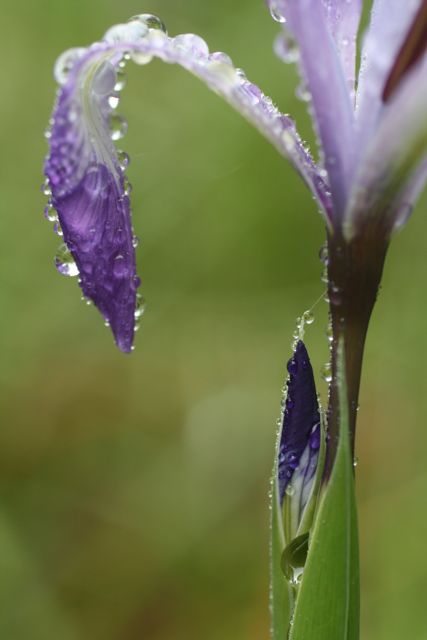
The wild irises of California are a spring delight. You can see them in forest clearings and meadows, sometimes in great green and purple masses. Other times one plant will appear singly, a burst of color against the browns of an understory. With their many variations in color and decoration they are a never-ending visual treat ranging from dark purple to pale yellow.

This slideshow requires JavaScript.

The three largest, lower petals can look like a cross between a watercolor and a stained-glass window, with dark veins blocking out yellows, whites and purples – but with the color fading gently towards the edge of the petal. Above it is what appears to be a paler, less gaudy petal (it’s actually part of the pistil). Sandwiched between the two is the dark purple tongue of the stamen, dusted underneath with pollen, and invisible unless you pry the flower open or look very close. Often you’ll see bees rummaging around and coming out with their legs laden with pollen.

Douglas iris (Iris douglasiana) is the most common wild iris species, but coast iris (Iris longipetala) and ground iris (Iris macrosiphon) are also somewhat common. And keying them is a trick!! Every book or expert gives different suggestions about how to distinguish one from another. The Marin Flora says you can identify a Douglas iris if the pollen is yellow and the surface of the leaf is shinier than the underside and the long purple tube below the flower (the perianth tube) is about 2 centimeters long. But the Flora of Sonoma County suggests two ways to ID the Douglas. First  is if the leaf bases (but not the entire plant!) is reddish. Second is if the perianth tube is less than 3 centimeters long. So take your pick! Once I get a confident ID on another species I’ll post about those as well.

1 Comment

Filed under Good for gardens, Native, Plant of the day