Tag Archives: wildflowers

Plant of the day: salsify

With a spiky green sheath of bracts surrounding several layers of purple petal-like flowers, salsify (Trapopogon porrifolius) is a beautiful and slightly cruel looking plant. The inner flowers of the head are dusted with yellow pollen that is the perfect ornament on the dark purple petals. Each of the large-ish, showy flowers is actually many flowers, since this is a member of the Asteraceae family. Once the flower has gone to seed, it produces a big dandelion poof that can be a few inches across.

This slideshow requires JavaScript.

This plant is also called oyster-root, and it was introduced from Europe where the carrot-like root is eaten; the flavor is described as similar to oyster or artichoke. Here in California it is an escaped ornamental, and likes to grow in dry grassy areas. You usually will see it in disturbed places, not too far from town.

.

Leave a comment

Filed under Edible, Non-native, Plant of the day

Plant of the day: yarrow

Achillea millefolium

Knee-high clumps of creamy flowers stand atop a narrow stalk. Each yarrow flower has a sweetly classic daisy shape to it – and like a daisy, it is actually many flowers. If you look close you’ll see the demure inner “disc” petals surrounded by the flashy outer “ray” petals.

In the southwest, yarrow is sometimes called Plumajillo, or little feather, because of its delicate plume-shaped leaves. It is listed as being mildly toxic by the California Poison Control system, but historically has been used as a tea to treat colds, nausea, cramps, hives, measles and kidney ailments. Yarrow (Achillea millefolium) also was used externally to treat cuts, stop nosebleeds, and as a hair wash to prevent baldness!

Leave a comment

Filed under Native, Plant of the day

Spectacular Steep Ravine/Dipsea loop

Ramble downhill through a wonderland of ferns and old-growth redwoods. Huge old trunks tower over your head, and beams of sunlight filter down along with birdsong and the sweet smell of the branches. This is the Steep Ravine trail, and it’s aptly named. The ravine that it follows is steep, with towering canyon walls rising up on both sides from a narrow boulder-strewn creek below. In places, giant redwoods have fallen and wedged between the banks, like rustic bridges or a giant game of pick-up sticks. The trail itself is also steep, dropping precipitously down the flanks of Mt. Tam. A little over half-way from the Pantoll Parking Lot, there’s a sturdy 10-foot wooden ladder to help hikers down a particularly steep spot.

This slideshow requires JavaScript.

The uphill leg of the loop is a chunk of the Dipsea trail, which Steep Ravine merges in to after nearly two miles. At this junction you can either keep heading downhill to Stinson Beach, or you can turn left to head up the Dipsea (I like to do the loop hike in this direction since this part of the Dipsea has a LOT of steep stairs, which can get slippery when it’s wet. But in any weather I’d rather go up these stairs than down them).

The Dipsea leg is as beautiful as the Steep Ravine leg – the first section of the climb is so steep that it feels like you’re in a tree fort. The crowns of big old Doug firs are at eye level when you look out over the canyon. Later in the hike you pass through huckleberry stands, dense groves of skinny (young?) redwoods, gnarled oaks and bays, and then out into the high Tamalpais grassland with sweeping views of the Pacific ocean. The trail heads south for a ways before meeting up with the Coastal Fire Road that leads you back to Pantoll.

This loop is a great spot to see a lot of different kinds of plants. The microclimate changes sharply as you move up and down the mountain, from the narrow moist ravine into the open high-elevation grassland. There are many species of shade-loving ferns and lots of wildflowers. At this time of year, a lot of plants were in fruit but I still saw lots of blooms as well.

If you’re coming from Stinson Beach, you can also start this hike at the bottom end of the loop instead of at Pantoll. Park in the large turnout near a metal access gate, right before the big metal “Mt. Tamalpais State Park” sign. Then you can head uphill on the Dipsea for half a mile, until you come to the Steep Ravine junction. Veer left across a aged wooden footbridge to do the uphill leg of the loop on the Dipsea. 

Leave a comment

Filed under TRAIL NOTES

Plant of the day: Mt. Tamalpais jewelflower

Mt. Tamalpais jewelflower

On a bare serpentine outcrop high above the Pacific ocean is a low leafless stalk with a few small purple flowers. This is the Mt. Tamalpais jewelflower, a sub-species of Streptanthus glandulosus which is found only in Marin County. Though the plant is unassuming, when you look close the flowers have earned their name. Narrow, crinkled petals flare out above a colorful pouch that is faceted and luminous like a gem.

The jewelflower is in the same family as radish and milkmaid. The long, narrow, fleshy seed pods that are pictured below are typical of the family, though the unusual flowers are not! I saw this beauty, S. glandulosus ssppulchellus, near Rock Springs on Mt. Tam during the MMWD/Cal Academy Bioblitz last weekend, and owe thanks for the ID to Terry Gosliner. I wrote about secund jewelflower back in May – which is also a sub-species of S. glandulosus, and the only jewelflower in Marin that isn’t listed as either rare or endangered.

Leave a comment

Filed under Native, Plant of the day, Rare

Plant of the day: marsh zigadene (death camas)

Growing alongside a meadow stream are many spikes of pale flowers. This is marsh zigadene, or Toxicoscordion micranthus. A few long, linear leaves sit unobtrusively at the base of the plant, which is decked with several dozen creamy white blossoms. The six-petalled flowers have a small yellow spot at the base of each grooved petal, and a short tight cluster of stamens with oversized anthers.

Marsh zigadene is a native that is usually found growing in damp places, often near serpentine, according to the Flora of Marin. It’s common in this county but is rare elsewhere.

The common name for the several similar-looking species in the Toxicoscordion genus is “death camas.” These species are another example of highly toxic beauty. I have always known these plants as Zigadenus species, but they were recently moved to a different group (something that is always happening in the botany world – it can be hard to keep track!). They are still listed in most floras under the old name, but are in online databases under the new name.

Leave a comment

Filed under Native, Plant of the day, Poisonous, Rare

Plant of the day: yellow mariposa

A constellation of yellow lilies blooms on a serpentine ridge atop Mt. Tam. The yellow mariposa lilies (Calochortus luteus) are little works of art: delicate patterns of red and orange decorate the inside of the petals. No two are alike. Some are plain, some are complex. All are lovely. Beetles seem to think so too; I’ve often seen them hanging out inside. When I saw the ones pictured here, some still held water from the previous night’s rain in their cup-shaped blossoms.

This slideshow requires JavaScript.

This mariposa lily is a California endemic that can be found as far north as Humboldt and as far south as LA.

Leave a comment

Filed under Native, Plant of the day

Plant of the day: pink honeysuckle

A bough of pink flowers droops down at me from the nearby tree. But I’m not looking at a blooming branch; the narrow, twining stem is tough but not woody enough to stand this high on its own. Here is a vine of pink honeysuckle, or Lonicera hispidula. The whorled cluster of flowers perches at the end of the vine, right at eye-height. They don’t always grow this way (I’ve seen them at ankle level alongside trails) but I got lucky this time with an easy view of the pretty flowers.

This slideshow requires JavaScript.

The upper petal is a soft, rosy pink and is dramatically rolled back. Five stamens are on prominent display, waiting for a passing bumble bee or hummingbird. Each stamen is T-shaped, with the brown bar of the anther dusted in pollen and delicately balanced on the greenish-yellow filament. This vine is often recommended for native plant gardens because it is so attractive to birds. Hummers love the sweet nectar, and other birds feast on the berries.

Honeysuckle is easy to recognize even when it isn’t blooming because the pattern of leaves is distinctive. The oval leaves are paired, and often fuse together into a disc around the stem when they are young. More mature leaves are separate, but often have a small leaflet at their base that is fused to the stem.

Leave a comment

Filed under Good for gardens, Native, Plant of the day

Plant of the day: California spikenard

Here is a big, tall plant of the shadows. Smallish, round tufts of flowers are surrounded by large jagged-edged leaves. The unopened flowers are particularly beautiful – they look like a sculptor’s version of the childhood game of Jacks.

Usually this plant, which grows up to nine feet tall, is found in deep shady woods. I saw it deep in the Mt. Tam watershed, growing on a hillside among redwoods and tanoaks. California spikenard (Aralia californica) is in the ginseng family, and is used by herbalists as a tonic. The roots (and sometimes other parts of the plant) were used extensively by various Native American tribes to treat a wide variety of ailments from cancer to fainting to stopping periods. Most commonly it seems it was used to prevent skin infection, or as a tonic for colds. It has also been called elk’s clover or prairie sagewort.

Spikenard in fruit (September)

2 Comments

Filed under Medicinal, Native, Plant of the day

Plant of the day: candy flower


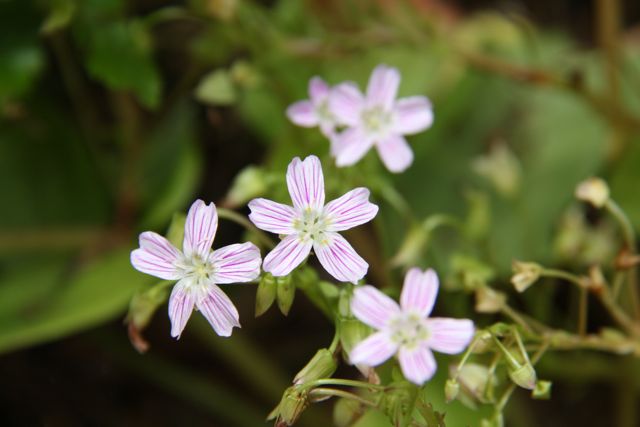
Leggy stalks sprawl at the base of an oak tree, or single plants grow scattered under some rushes. Candy flower, or Claytonia siberica, can have several different growth forms depending on where it is – and how old it is. The five petals are white or pale pink, and striped with a darker pink (I wonder if the name candy flower came from the classic uniform of the “candy stripers”?)

You can tell by looking at the fleshy leaves that this is a close relative of miner’s lettuce, though they don’t have the distinctive circular form. Instead, there is usually just one set of paired leaves, and a long stalk of flowers that rises above that. Candy flower prefers to grow in swamps or on moist slopes. Even if the ground doesn’t look wet, it’s a good indicator that there’s moisture around at least part of the time.

Candy Flower

Leave a comment

Filed under Native, Plant of the day

Plant of the day: wintergreen

Under the shade of a redwood grove, slender red stalks rise leafless from the duff. Flowers are scattered sparsely along the stalk, with those toward the bottom opening first. Five pink petals nod toward the ground. If you look underneath, you’ll see an oddly curved pistil surrounded by yellow-dusted stamen.

This slideshow requires JavaScript.

This is Pyrola picta, or wintergreen. I saw it in Sonoma County, but it grows in almost all parts of the state – and in all states as far east as South Dakota. There are other types of Pyrola, but none that have been found in the bay area. In many places it has a handful of dark green leaves at its base, but around here it is almost always leafless. It also is often white instead of pink.

Leave a comment

Filed under Native, Plant of the day