Tag Archives: wildflowers

Plant of the day: ice plant

On a trip to the ocean, I wade through a thick reddish-green mat of rubbery plants to get to the beach. The ankle-high leaves are spiky and break off under my feet with a crunch. Large yellow flowers are scattered across this green carpet, each with hundreds of skinny petals surrounding a nest of pollen-dusted stamens. This is Carpobrotus edulis, one of several kinds of iceplant in the area. None are native.

The fruit of Carpobrotus edulis, as its name suggests, was traditionally eaten back in its original territory of South Africa. It was deliberately brought to California, planted to bind coastal soils together and help stop erosion. It does seem to be successful at that job – you can see it growing on beaches and even in colorful tapestries drooping over the edge of cliffs. However, it’s another good intention gone wrong since it has turned out to be highly invasive; an “ecological bulldozer,” along the lines of broom, that wreaks havoc on the delicate dune ecosystem. All the species of ice plant look at least somewhat similar, though not all of them are closely related (there are five species in four different genera, with the two types of Carpobrotus being the most common around here, as far as I can tell).

3 Comments

Filed under Edible, Non-native, Plant of the day

Plant of the day: Tangier pea

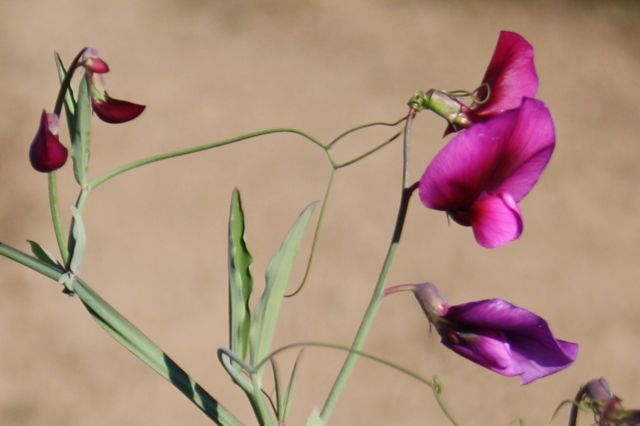
Lathyrus tingitanus

Showy pink blossoms, delicate fragrance and winding tendrils – it’s sweet pea season. I’ve been seeing them growing along roads and trails, in gardens, and in bouquets on people’s tables or shop counters. This is an invasive species that it’s hard not to love – a guilty botanical pleasure!

As with yesterday’s plant, this is one where I learned more than I bargained for in the identification. I had naively assumed that there was only one type of sweet pea and that every time I saw that distinctive pink blossom it was the same species. Wrong again! There are several different kinds, and also some native species with paler pink blooms, so you have to look close. Tangier pea, or Lathyrus tingitanus, has the winged stem, two-parted leaves and large, deep pink flowers that mark it as one of the non-native species. You can tell Tangier pea from sweet pea because it is an annual, and also because it only has two or three blossoms per stalk.

Leave a comment

Filed under Invasive, Non-native, Plant of the day

Plant of the day: coast buckwheat

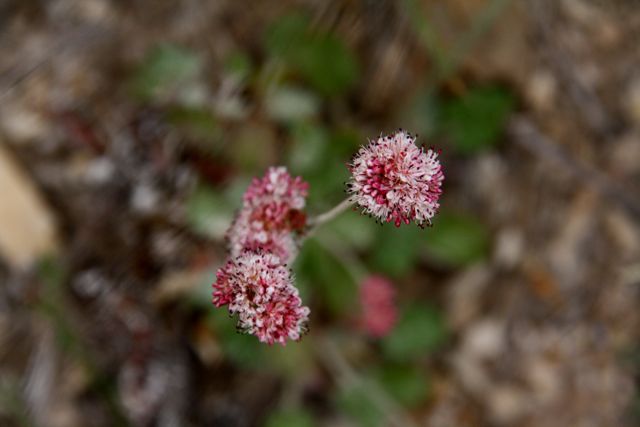
Like the pink pom-poms of an elfin cheerleader, coast buckwheat tosses little bursts of color alongside the trail. The flower heads range from fuschia to pale pink atop a grayish stem. The buds are the darker pink, and the heads turn pale as they open to reveal the lighter petals and the curious long antenna of stamens. All the leaves are gathered in a cluster at the base of the long stems.

This slideshow requires JavaScript.

Coast buckwheat (Eriogonum latifolium) can be found all along the coast of California. It prefers to grow along exposed dunes, mesas, bluffs and coastal hills. It’s a member of the buckwheat family, or Polygonaceae. There are 125 different species of Erigonum in California, though only four are listed in the Marin Flora as growing in this county. In general, the group is distinguished by having clustered heads of small flowers atop a long stem that grows out of a basal mound of leaves. The five-petaled flowers generally have obvious stamens, like this species does, but sometimes the heads of flowers are smaller.

Leave a comment

Filed under Native, Plant of the day

Plant of the day: sneezeweed

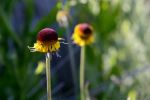
A brown golf ball is dressed in a short yellow skirt. Well not really, but that’s what this funny flower looks like: a big round ball, fringed at its very lower edge with dangling petals. I found this patch of Helenium puberulum perched alongside Highway One just south of Stinson Beach.

There are several different kinds of sneezeweed (a.k.a. Helenium) and they all look like variations on this theme.  The “classic” sneezeweed shown here has many flowers per plant, noticeably short petals – they almost look like an afterthought! – and leaves that attach to the stem (the botanical term is decurrent). This combination of traits lets you know you’re looking at plain ‘ol sneezeweed instead of Bigelow’s sneezeweed or yellow sneezeweed. Actually as far as I can tell you don’t even need to look at the leaves or number of flowers – the other sneezeweeds both seem to have larger petals. But it’s always good to ID a plant using more than one feature, since individuals of the same species can show a LOT of variation in its shape, color, size and so on.

The sneezeweeds are in the enormous Asteraceae family, and if you look close you’ll see that the brown ball is made up of hundreds of individual “disc” flowers, and the yellow skirt is the showier “ray” petals.

Leave a comment

Filed under Good for gardens, Native, Plant of the day

Plant of the day: cow parsnip

This is a fearsome plant. It’s rough, tough leaves are larger than my head: pointed and creased like thick green origami. Its stem is hollow and thick as a hose, and it can heft its dense umbel of flowers as much as seven feet in the air. I prefer the scientific name—Heracleum maximumto the common name “cow parsnip”. That is far too pedestrian for this beast. Cows are placid, parsnips are passive underground things. This is a vigorous creature of light and growth. The implied size is appropriate, but that’s about all.

Right now it is out in abundance and it’s hard to hike (or drive) near the ocean without seeing it. It clusters along stream-banks and hangs over the curves on Highway One. There is nothing else that looks like this plant; it’s the only one of its genus around here. It has a vague similarity to its other cousins in the carrot family like Queen Anne’s lace or poison hemlock—but all the others have divided, lacy leaves whereas our bovine parsnip boasts solid, maple-like leaves as large as dinner platters.

2 Comments

Filed under Native, Plant of the day

Plant of the day: dwarf brodiaea

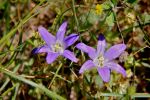
In grassy meadows and along open hillsides, these low-growing flowers open their purple petals to the sun. Each plant has one or two medium-sized flowers that have the classic lily family form. Six gracefully pointed petals fade to white towards the center. Three flat, white, tongue-like spurs (which are actually sterile stamen called staminodia) sit at the base of alternating petals. These staminodia in turn alternate with an interior cluster of flat, fertile stamen dusted with yellow pollen, which at first look like a stout, three-sided pistil.  To see the actual pistil, you have to gently tug on the petals to draw the stamens apart.

The easiest way to tell this from similar species is that it is so low to the ground, with the flower only rising a few inches off the ground. It truly is Brodiaea terrestris.

Leave a comment

Filed under Native, Plant of the day

Plant of the day: wild radish

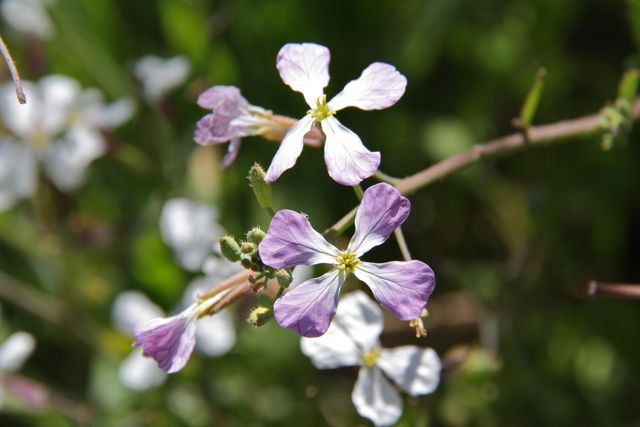
Masses of delicate easter-colored flowers fill fields and hillsides, standing as tall as your waist or even shoulder. These pale yellow, purple, and white flowers are wild radish, or Raphanus sativus. You can see a fantastic showing of them along the first part of the Pierce Point trail on the Point Reyes Penninsula.

These flowers also taste good—take a trailside nibble or add flowers and pods to a salad for a spicy radish taste. And there are those four simple petals again! That’s right, the wild radish is in the Brassicaceae, or mustard, family that I wrote about last week.

According to the Marin Flora, the local wild radish is actually a hybrid between R. sativus and its cousin, R. raphanistrum.

Leave a comment

Filed under Edible, Invasive, Non-native, Plant of the day

Plant of the day: rough hedge nettle

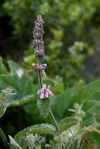
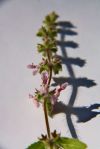
Rough hedge nettle is widespread in the area, and hedge nettles in general are easy to recognize. Though they don’t have the typical smell, hedge nettles are in the mint family! Mints are often hairy and smelly (like some rugged botanist-types that I know?!) and they have a tubular flower that usually is distinctly two-lipped. For the hedge nettles this is certainly the case. But the real giveaway for this family is that they have a square stem. Just roll it between your fingers to see what this means – all mint stems are distinctly four-sided (see the stem close-up below). There are other families that have square stems, but the many local species in the mint family (Lamiaceae) are by far the most common.

Stachys rigida is usually found in dry places—woods, shrublands, or grasslands. There are other hedge nettles (such as S. chamissonis, with its showy purple flowers) that prefer wetlands but our S. rigida is almost always on slopes, in gravel, clay or rocky soil. And, if you want to get technical, you should know that the Marin Flora lists Stachys rigida var. quercitorum as the local variety.

Leave a comment

Filed under Native, Plant of the day