Monthly Archives: June 2012

Plant of the day: Scotch broom

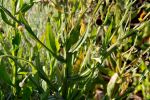
This is another badnasty invasive broom species that you’ll see frequently throughout the Bay Area. Scotch broom (Cytisus scoparius) has pretty yellow pea-like flowers and long, narrow leaves that press closely against its multi-sided stems. Though it occasionally has some rounded leaflets as well, the overall lean, linear look to its foliage makes it easy to tell from its French broom cousin that I wrote about a few weeks ago.

This slideshow requires JavaScript.

In California, French broom is a nastier problem than Scotch broom, but throughout the rest of the country the Scottish Cytisus scoparius is the worst broom around. Even worse, both were deliberately originally introduced as ornamental species!

This plant is so nasty because it is hearty and vigorous, and spreads fast because it produces a LOT of seeds. A single Scotch broom plant can live for up to 7 years, and produce over 150,000 seeds per year. It’s a mind-boggling number! The seeds stay in the ground, ready to sprout, for between 5 and 30 years. These plants grow up to 12 feet tall and smother any native plants that would otherwise have grown where they are. There’s no sharing if you’re a broom species! Scotch broom is a rampant invasive across much of the western and eastern seaboards of North America – from Alaska to Baja and from Maine to Georgia, as well as in other countries like Australia and New Zealand. It’s native to northern Africa and parts of Europe.

There is one more broom species that you might see in the area, and that’s Portuguese broom. It’s not nearly as common, but it does cover about 65 acres in the Marin Headlands where it was planted in the 1960s as part of a landscaping and slope stabilization program – another good idea gone wrong! Portuguese broom looks a lot like Scotch broom, except the seed pods are inflated instead of compressed around the seeds. Also they have 8-10 sided twigs, as opposed to the 5-sided twigs of Scotch broom.

Leave a comment

Filed under Invasive, Non-native, Plant of the day

Plant of the day: Ithuriel’s spear

Triteleia laxa

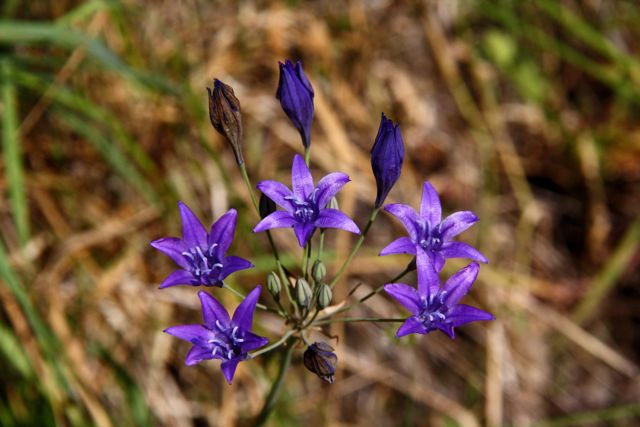
Here is another one of the lovely leggy lilies that I wrote about last week. Triteleia laxa sports a loose umbel of trumpet-shaped purple flowers. The color is usually the rich royal purple shown here, but it can be paler as well. The way to tell this beauty from the similar species is to look inside and see that it has six classic-looking stamens.

The young plant is spear-shaped when it first emerges from the earth. Evidently the name is (for you literary types!) a reference to Milton’s Paradise Lost, in which the angel Ithuriel finds Satan has approached Eve in the shape of a toad. Ithuriel touched him with her spear and revealed his true form. I think toads are beautiful and charismatic critters, and for me this is the best part of the fable – that a toad is what was chosen to infiltrate the ranks of goodness!

See the six distinct stamens

Leave a comment

Filed under Native, Plant of the day

Plant of the day: sneezeweed

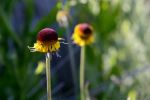
A brown golf ball is dressed in a short yellow skirt. Well not really, but that’s what this funny flower looks like: a big round ball, fringed at its very lower edge with dangling petals. I found this patch of Helenium puberulum perched alongside Highway One just south of Stinson Beach.

There are several different kinds of sneezeweed (a.k.a. Helenium) and they all look like variations on this theme.  The “classic” sneezeweed shown here has many flowers per plant, noticeably short petals – they almost look like an afterthought! – and leaves that attach to the stem (the botanical term is decurrent). This combination of traits lets you know you’re looking at plain ‘ol sneezeweed instead of Bigelow’s sneezeweed or yellow sneezeweed. Actually as far as I can tell you don’t even need to look at the leaves or number of flowers – the other sneezeweeds both seem to have larger petals. But it’s always good to ID a plant using more than one feature, since individuals of the same species can show a LOT of variation in its shape, color, size and so on.

The sneezeweeds are in the enormous Asteraceae family, and if you look close you’ll see that the brown ball is made up of hundreds of individual “disc” flowers, and the yellow skirt is the showier “ray” petals.

Leave a comment

Filed under Good for gardens, Native, Plant of the day

Plant of the day: common catchfly

Common catchfly

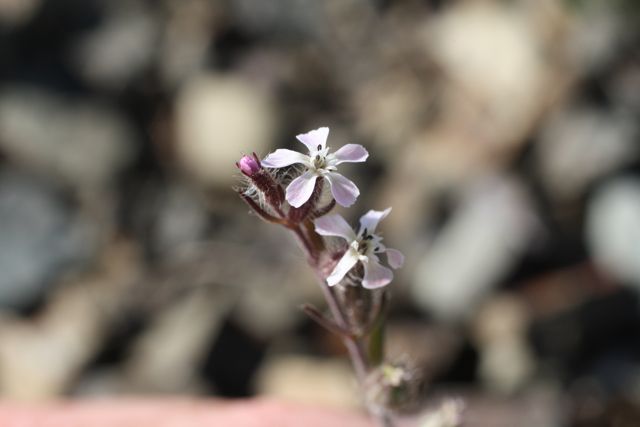
This plant is a weed, but I kinda like it. The whole plant is sticky (is that why it’s called catchfly?) and the small pinkish-white flowers are perched atop a vase-shaped calyx. The petals are fused together, with little toothlike projections sticking up like a fringe around the inner edge. There are distinctive stripes running perpendicularly along the calyx (which is all the sepals taken together). The whole thing is a nice bit of floral architecture – if you can forget that it’s an invasive that was introduced from Europe!

Also, Silene gallica is another member of the Caryophyllaceae (a.k.a pink, or carnation) family. So check for the swollen nodes where the opposite pairs of leafs join the stem that I talked about a few posts back!

You may wonder why I always talk about families – the reason is that whether you are keying or looking plants up in a guidebook, being able to confidently narrow your options down to one or two families makes the whole process a lot easier. It also helps train your eye and mind in the detailed way of looking at plants that is needed for good identification.

Silene Gallica

Leave a comment

Filed under Non-native, Plant of the day

Flower petals and false petals

So if you are actually trying to key a flower there are a bunch of words you need to know. The colorful flower itself typically is made up of petals, surrounding the reproductive organs and in turn surrounded at the base by a sheath of sepals that are usually green and look sort of like leaves. All the petals taken together are called the corrolla and all the sepals taken together are called the calyx.

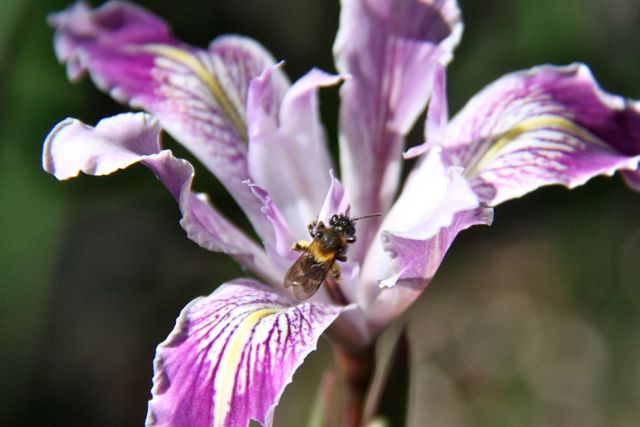
This seems pretty straightforward, and usually it is, but sometimes it can get complicated. So don’t take anything for granted! For example, sometimes other parts of can look exactly like petals—colorful and showy. Irises are an example of this. They only have three petals but it looks like they have six, three that are less showy than the others. The smaller ones are actually stamen. A lot of plants can also have sepals or leaves that look like petals. Examples of this are dogwood “flowers” or the crimson leaves of the poinsettia. In both cases, those showy displays are false petals, and the diminutive nubs in the center are the actual flowers.

Modified stamens on a Douglas iris

Leave a comment

Filed under Botany basics

Plant of the day: cow parsnip

This is a fearsome plant. It’s rough, tough leaves are larger than my head: pointed and creased like thick green origami. Its stem is hollow and thick as a hose, and it can heft its dense umbel of flowers as much as seven feet in the air. I prefer the scientific name—Heracleum maximumto the common name “cow parsnip”. That is far too pedestrian for this beast. Cows are placid, parsnips are passive underground things. This is a vigorous creature of light and growth. The implied size is appropriate, but that’s about all.

Right now it is out in abundance and it’s hard to hike (or drive) near the ocean without seeing it. It clusters along stream-banks and hangs over the curves on Highway One. There is nothing else that looks like this plant; it’s the only one of its genus around here. It has a vague similarity to its other cousins in the carrot family like Queen Anne’s lace or poison hemlock—but all the others have divided, lacy leaves whereas our bovine parsnip boasts solid, maple-like leaves as large as dinner platters.

2 Comments

Filed under Native, Plant of the day

Plant of the day: Douglas’ sandwort

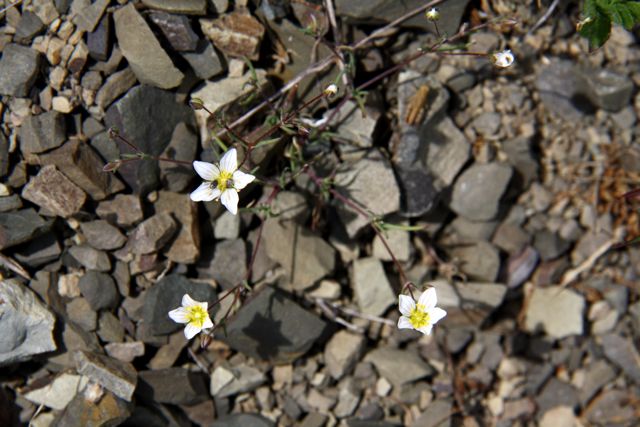
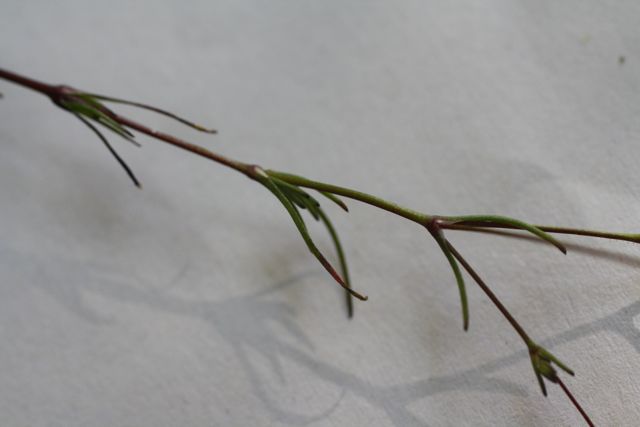
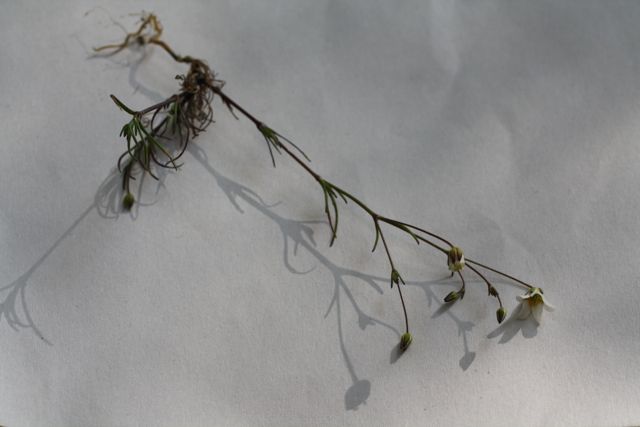
On a barren, rocky slope is a tremendously delicate little plant. Five tissue-thin petals veined with tiny lines surround a cluster of delicate yellow stamen. The reddish stems are threat-thin and sparsely decorated with green needlelike leaves.

Douglas’ sandwort (Minuartia douglasii) is fairly common, but it’s so small you might never have noticed it before. It is strongly associated with serpentine, which is where I saw it.  The paired leaves clasp around the stem, and if you look close you’ll see that this joint (or “node”) is swollen slightly—it bulges out from the rest of the stem. If you’re keying plants, this is an excellent hint that what you are looking at is in the Caryophyllaceae, or pink, family. The common store-bought carnation is a common example of this family; so is the garden flower rose campion. Look at their stems to see how they all have the swollen nodes in common!

There are several other species of sandwort in the San Francisco Bay Area, but though they seem really similar in the key, they don’t look at all similar to this one in their actual growth form. At least not as far as I can tell. But I might have to wait until a while to keep looking for different growth forms – I took these photos of the sandwort about a month ago, and they are now pretty much done blooming. We might not be seeing any more until next spring.

Leave a comment

Filed under Native, Plant of the day

Plant of the day: marsh tritileia

True to its name, this flower prefers to grow in wet places. Triteleia peduncularis is a graceful beauty, growing up to three feet tall, and is often found near serpentine. The flowers are whitish with a striking purple midvein. Six stamen are tucked away inside the trumpet- or funnel-shaped mouth of the flower.

There are two other triteleia species in the area: wild hyacinth and wally basket. They all are unique looking, as the hyacinth is white but bowl-shaped and the wally basket is purple throughout. Neither have the sleek elegance of the marsh triteleia.

Leave a comment

Filed under Native, Plant of the day

Plant of the day: selfheal

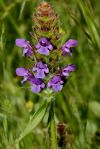
These small sturdy towers of purple flowers are usually found in meadows and wet places. Though it only grows to be about five inches tall, it’s a hardy and versatile little plant – Prunella vulgaris is found in every state in the continental US as well as in Europe, Asia and many parts of Canada.

As the name suggests, this is also a traditional medicinal plant that has been used in teas, in stews and for compresses.The square stem and two-lipped flower reveals this flower as a member of the mint family.

Leave a comment

Filed under Edible, Medicinal, Native, Plant of the day

Alamere Falls hike

For one of the best hikes in Marin, take the trek past Bass Lake to Alamere Falls. All through the spring this trail offers a wildflower bonanza–but it’s a treat at any time of year. The views are any over-the-top word you’d like to use: spectacular, breath-taking, awesome. But my favorite thing is that you pass through such a diversity of landscapes. Beginning from the eucalyptus forest at the Palomarin trailhead, you follow the Coast Trail along the bluffs high above the ocean. The wide and well-maintained trail bends inland in places, so when you aren’t walking along windswept and view-ridden hillsides, you dip down into lush and sheltered gullies filled with greenery and the trickling sound of small creeks. The gentle ups and downs of the trail give you a workout but nothing particularly daunting.

This slideshow requires JavaScript.

After (very approximately) two miles of this, you reach the only climb of any steepness on the trail, which dog-legs away from the water and heads up a smallish ridge. You then hike in and out of a forest of Douglas fir and alder until the views give way unexpectedly to Bass Lake, a placid tree-skirted spot. Not long after this, you begin to drop down out off of the ridge, passing another little lake (Pelican) on your left and once again heading into the treeless coastal scrub. The trail down to Alamere Falls is unmaintained, but used often enough that it’s not too overgrown. The trail is somewhat eroded though, and it’s a tiny bit of a scramble to reach the falls. But very well worth it. What unusual falls these are!

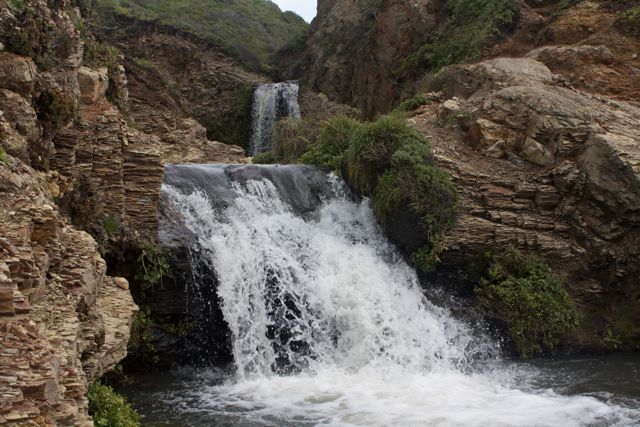
As you approach them, you’re not even sure what you’re seeing. You’re walking toward the ocean but high above it on a bluff, headed the same direction as the stream. As you get closer, you realize that the creek stair-steps down low crumbled cliffs, streams across the level surface of the bluff, and then disappears over the cliff to crash onto the beach about 50 feet below.

Pack a lunch if you go since the total distance is just over eight miles, round trip. And if you’re not a people-person, be warned that this trail can be jam-packed by midmorning on weekends. It’s on the popular Coast Trail, which links up with many other trails on the Point Reyes Peninsula, and also connects to various campgrounds. Check here for more info, directions and so on.

Leave a comment

Filed under TRAIL NOTES