Category Archives: Invasive

Plant of the day: Himalayan blackberry

In ditches and along river banks, the berries are beginning to ripen. Great green mounds of shrubs – all leaves and thorny branches – are speckled with dark purple fruit. Younger berries are still green or red, and most bushes still have flowers on them as well.

This is the Himalayan blackberry (Rubus armeniacus), one of the most common berries around. It is also one of the only non-native invasive berries in the area. Though it’s delicious in pies, smoothies and endless other treats, this shrub can be a nasty problem for native habitats: I’ve seen it smother entire fields, leaving no space for native plants and the animals that depend on them. Usually you’ll see it in disturbed places and on poor soils. Despite the name, the bush originally came from western Europe and there is “no evidence” that it came from the Himalayas.

One nifty thing about this “fruit” is that it’s actually a bunch of small fruits – each little nub on the berry is called a “drupelet” in botany-speak.
Leave a comment

Filed under Edible, Invasive, Non-native, Plant of the day

Plant of the day: Spanish broom

With flamboyant, showy flowers, Spanish broom is probably the most beautiful of all the evil brooms. It is still evil, though. Don’t be fooled by the big yellow flowers with their many exuberant stamens and pretty wing-like petals.

This slideshow requires JavaScript.

This plant has the lean, linear look of Scotch broom but with even fewer leaves. The California Invasive Plant Council lists Spanish broom (Spartium junceum) as a species that can cause serious problems for native ecosystems. It can grow up to 15 feet tall and form dense stands that smother all other plants in the area. According the IPC, it is native to Spain, Morocco and other parts of southern Europe. It was introduced to California in 1848 as a decorative plant, and in the 1930s was planted along mountain highways in Southern California. Oops.

In Marin, it is one of the least common brooms. I saw the ones pictured here clinging to the slopes of what looks like an old rock quarry owned by the Marin Municipal Water District.

2 Comments

Filed under Invasive, Non-native, Plant of the day

Plant of the day: pride of Madeira

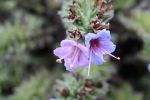
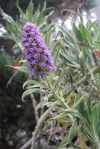
You’ll see these towering purple spikes looming from road cuts and clifftops. This is pride of Madeira, or Echium candicans. It’s a common sight – especially in more coastal areas. It grows to more than seven feet tall, and is very striking with its gray-green leaves and massive heads of flowers (easily over a foot long).

Sadly, this plant isn’t native to the US. It’s another escaped ornamental species that’s still commonly used in landscaping. Birds and butterflies love it, and deer don’t. In inland areas this isn’t a problem but in the coastal climate it spreads on its own, gradually creeping into wild areas. Because it spreads slowly it is only considered to be moderately invasive, but it’s still not recommended for local gardens.

Leave a comment

Filed under Invasive, Non-native, Plant of the day

Plant of the day: oxeye daisy

Hiking across a remote meadow, I suddenly find myself in a knee-high field of daisies. This is the invasive oxeye daisy (Leucanthemum vulgare), a striking flower with stark white petals around a yellow center.

This bloom was introduced from Europe and is now widespread throughout Marin and much of California. It has a cousin, Shasta daisy, which is less common and has (very slightly) larger flowers and leaves. Oxeye daisy is a moderately problematic invasive, growing so densely in places that it excludes other native vegetation. It also is known for giving cows’ milk an unpleasant taste if they eat it.

Leave a comment

Filed under Invasive, Non-native, Plant of the day

Plant of the day: rattlesnake grass

The brown hills of California are far from monochromatic. Look closely and you’ll see a complex tapestry of colors, textures, shapes, sizes–and sounds! Do you hear that rustling rattle as you brush through the grass? Look close and you’ll see graceful stalks of rattle-shaped grass heads.

This is rattlesnake grass, or Briza maximaone of my favorite plants of the summer. Sadly this nice-looking plant is also fairly invasive (introduced from Europe, and occasionally planted as an ornamental). It’s now become naturalized in the Coast Range and in scattered other parts of California, which is why you see it almost everywhere.

Leave a comment

Filed under Invasive, Non-native, Plant of the day

Plant of the day: poison hemlock

With lacy leaves and delicate flowers, this plant doesn’t look like a deadly killer. But it is. This is the same plant that is fabled to have poisoned Socrates, and is the bane of ranchers since it can kill undiscriminating cows (it’s also responsible for “crooked calf disease“). There’s no antidote. So – admire this one from a distance, but don’t eat it, crush it, or take any other liberties. The root is the most poisonous part (unnerving, since it’s part of the inviting-looking carrot family!)

This slideshow requires JavaScript.

Conium maculatum isn’t native to California, but it is found throughout most of the state, often in open or disturbed places. Plants can grow to more than six feet tall, and have many flat umbels of lacy white flowers. Its similar-looking cousins, water hemlock, are also poisonous. But when I saw some on the open space above Mill Valley the other day, the lady bugs were having a wonderful time hanging out on the hemlock flowers!

Leave a comment

Filed under Invasive, Non-native, Plant of the day, Poisonous

Plant of the day: Tangier pea

Lathyrus tingitanus

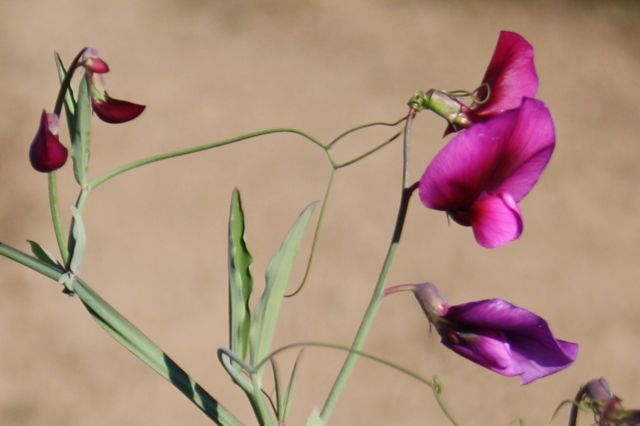
Showy pink blossoms, delicate fragrance and winding tendrils – it’s sweet pea season. I’ve been seeing them growing along roads and trails, in gardens, and in bouquets on people’s tables or shop counters. This is an invasive species that it’s hard not to love – a guilty botanical pleasure!

As with yesterday’s plant, this is one where I learned more than I bargained for in the identification. I had naively assumed that there was only one type of sweet pea and that every time I saw that distinctive pink blossom it was the same species. Wrong again! There are several different kinds, and also some native species with paler pink blooms, so you have to look close. Tangier pea, or Lathyrus tingitanus, has the winged stem, two-parted leaves and large, deep pink flowers that mark it as one of the non-native species. You can tell Tangier pea from sweet pea because it is an annual, and also because it only has two or three blossoms per stalk.

Leave a comment

Filed under Invasive, Non-native, Plant of the day

Plant of the day: Scotch broom

This is another badnasty invasive broom species that you’ll see frequently throughout the Bay Area. Scotch broom (Cytisus scoparius) has pretty yellow pea-like flowers and long, narrow leaves that press closely against its multi-sided stems. Though it occasionally has some rounded leaflets as well, the overall lean, linear look to its foliage makes it easy to tell from its French broom cousin that I wrote about a few weeks ago.

This slideshow requires JavaScript.

In California, French broom is a nastier problem than Scotch broom, but throughout the rest of the country the Scottish Cytisus scoparius is the worst broom around. Even worse, both were deliberately originally introduced as ornamental species!

This plant is so nasty because it is hearty and vigorous, and spreads fast because it produces a LOT of seeds. A single Scotch broom plant can live for up to 7 years, and produce over 150,000 seeds per year. It’s a mind-boggling number! The seeds stay in the ground, ready to sprout, for between 5 and 30 years. These plants grow up to 12 feet tall and smother any native plants that would otherwise have grown where they are. There’s no sharing if you’re a broom species! Scotch broom is a rampant invasive across much of the western and eastern seaboards of North America – from Alaska to Baja and from Maine to Georgia, as well as in other countries like Australia and New Zealand. It’s native to northern Africa and parts of Europe.

There is one more broom species that you might see in the area, and that’s Portuguese broom. It’s not nearly as common, but it does cover about 65 acres in the Marin Headlands where it was planted in the 1960s as part of a landscaping and slope stabilization program – another good idea gone wrong! Portuguese broom looks a lot like Scotch broom, except the seed pods are inflated instead of compressed around the seeds. Also they have 8-10 sided twigs, as opposed to the 5-sided twigs of Scotch broom.

Leave a comment

Filed under Invasive, Non-native, Plant of the day

Plant of the day: rose clover

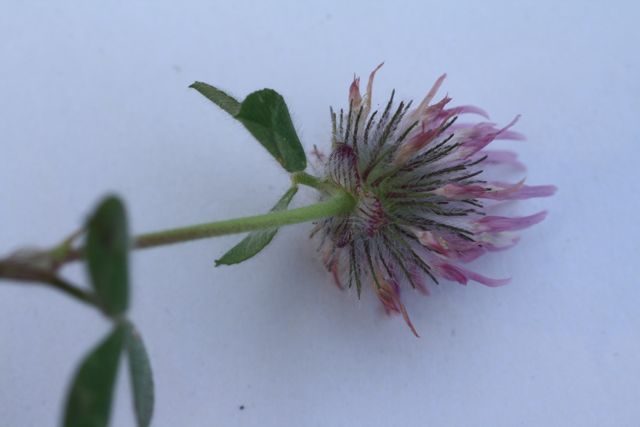
There are so many clovers around that they can be daunting to identify. But this little one has long caught my eye—partly because of the pretty pink color of its petals, combined with the many long green teeth of the calyx. But mostly I just like how it invariably has one little leaf coming directly off the flower. It may be strange but I find that adorable. Of course it turns out that botanically speaking the leaf isn’t actually part of the flower, it just appears to be so. In science-speak, the “heads are sessile above the uppermost leaves and stipules”. But that is good enough for me.

Rose clover (Trifolium hirtum) is native to Europe, not California. But it is now so ubiquitous as to be described by the authorities as “one of the most common” of the European species that have naturalized here.

You can pretty much tell rose clover from other species of clover because it has all of the following features: (a) It is hairy but doesn’t get cottony when it goes to seed; (b) Its showy, rosy flowers; (c) It’s an annual not a perennial; (e) That cute little leaf.

Leave a comment

Filed under Invasive, Non-native, Plant of the day

Plant of the day: wild radish

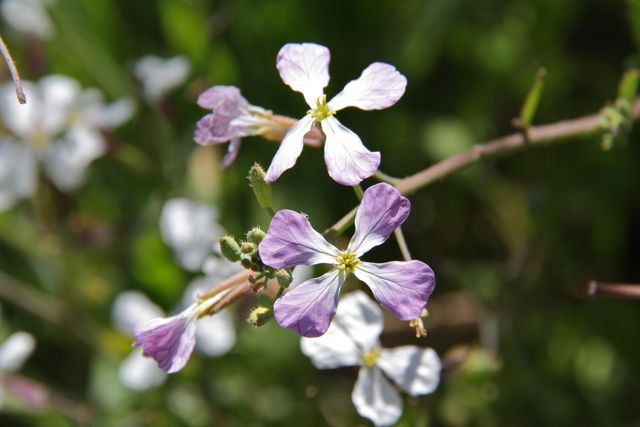
Masses of delicate easter-colored flowers fill fields and hillsides, standing as tall as your waist or even shoulder. These pale yellow, purple, and white flowers are wild radish, or Raphanus sativus. You can see a fantastic showing of them along the first part of the Pierce Point trail on the Point Reyes Penninsula.

These flowers also taste good—take a trailside nibble or add flowers and pods to a salad for a spicy radish taste. And there are those four simple petals again! That’s right, the wild radish is in the Brassicaceae, or mustard, family that I wrote about last week.

According to the Marin Flora, the local wild radish is actually a hybrid between R. sativus and its cousin, R. raphanistrum.

Leave a comment

Filed under Edible, Invasive, Non-native, Plant of the day