Category Archives: Native

Plant of the day: California everlasting

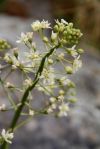
Like dried flowers in a storebought display, California everlasting has crispy, white, straw-like petals. But actually these petals are bracts – you have to look close, and at the right time, to see the real (yellow) petals peeking through from the flower inside. When done flowering, the bracts open wide around a dandelion-like puff of seeds.

Pseudognaphalium californicum is a native that’s found in most parts of North America. It’s in the Asteraceae family, along with dandelion, chamomile, burdock and daisy. It dries out as nicely as its name suggests!

There are several similar-looking species to this one, including others in the Pseudognaphalium family.  But I first mistook this plant for the very similar lookalike: pearly everlasting (Anaphalis margaritaceae – thanks to Doreen for setting me straight!). I’m still trying to figure out a good way to tell the two apart – in the key, the main difference is that California everlasting has a taproot while the roots of pearly everlasting are fibrous. I think that the flowers of the first are either bisexual (a typical flower, with both male and female parts) or only female, while the latter has separate male and female flowers. But since they are in the aster family, with little teeny tiny flowers, this is a hard difference to spot.

Just from looking at the photos, it seems that California everlasting has a much sleeker, smoother look to the shape of the bracts, while pearly everlasting seems to have a spiky look to each flower head, with the many pointy tips of the bracts bent backwards a little bit.

I’ll offer more tips on how to tell these two apart, as I come up with them!
6 Comments

Filed under Native, Plant of the day

Plant of the day: marsh zigadene (death camas)

Growing alongside a meadow stream are many spikes of pale flowers. This is marsh zigadene, or Toxicoscordion micranthus. A few long, linear leaves sit unobtrusively at the base of the plant, which is decked with several dozen creamy white blossoms. The six-petalled flowers have a small yellow spot at the base of each grooved petal, and a short tight cluster of stamens with oversized anthers.

Marsh zigadene is a native that is usually found growing in damp places, often near serpentine, according to the Flora of Marin. It’s common in this county but is rare elsewhere.

The common name for the several similar-looking species in the Toxicoscordion genus is “death camas.” These species are another example of highly toxic beauty. I have always known these plants as Zigadenus species, but they were recently moved to a different group (something that is always happening in the botany world – it can be hard to keep track!). They are still listed in most floras under the old name, but are in online databases under the new name.

Leave a comment

Filed under Native, Plant of the day, Poisonous, Rare

Plant of the day: chaparral pea

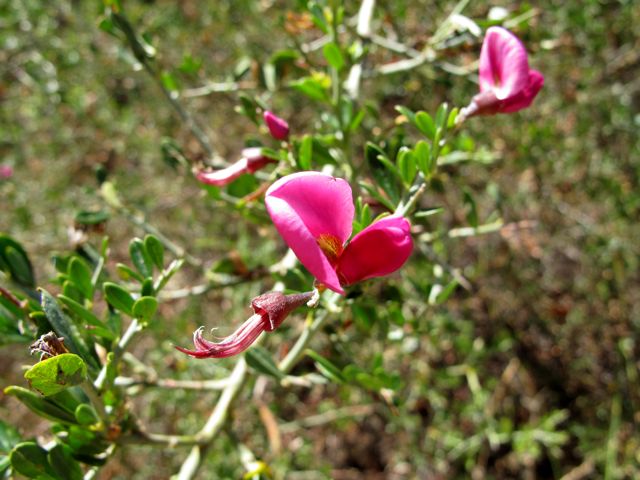
At first glance, the chaparral pea looks like a French broom… with bright pinkish-purple flowers. But this pretty bush is a California native. Pickeringia montana has medium-sized flowers and three-leaftleted leaves that are a shiny, vivid green. It can grow to more than six feet tall, and sprawls a little – just like broom does. But if the color and the shiny leaves weren’t enough to convince you that this isn’t a broom, then the thorns might do the trick! So watch out for it when you’re hiking.

It’s often found (as the name suggest) in the chaparral. Black-tailed deer love to browse on it, delicately nibbling their way around the thorns. This pretty shrub doesn’t reproduce well by seed in this area, but it does spread by rhizomes (spreading underground stems) or from its own roots. It comes back strongly after a fire has burned through.

Leave a comment

Filed under Native, Plant of the day

Plant of the day: yellow mariposa

A constellation of yellow lilies blooms on a serpentine ridge atop Mt. Tam. The yellow mariposa lilies (Calochortus luteus) are little works of art: delicate patterns of red and orange decorate the inside of the petals. No two are alike. Some are plain, some are complex. All are lovely. Beetles seem to think so too; I’ve often seen them hanging out inside. When I saw the ones pictured here, some still held water from the previous night’s rain in their cup-shaped blossoms.

This slideshow requires JavaScript.

This mariposa lily is a California endemic that can be found as far north as Humboldt and as far south as LA.

Leave a comment

Filed under Native, Plant of the day

Plant of the day: common bedstraw

Bedstraw – a.k.a goose grass, cleavers, or stickywilly

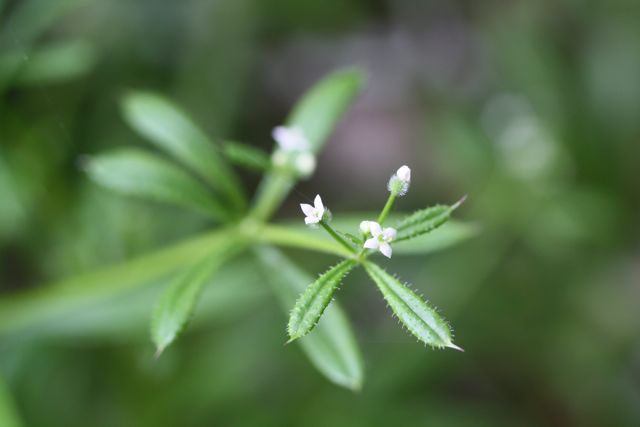
If you walk through a patch of bedstraw, you’ll know it right away. The stalks grow long and sprawling, and will wrap around your ankles. But they also are sticky! And the leaves are studded with tiny hook-like bristles! They don’t hurt to brush up against, but they certainly do cling. Its other names include goose grass, cleavers – and stickywilly.

The flowers of Galium aparine are tiny, white, four-petalled stars. But the plant’s most distinctive feature is its leaves: they stick out all around the stem like the spokes on a wagon wheel. Bristly, green, tongue-shaped spokes.

Bedstraw is widespread – not only across California, but throughout the US and southern South America, as well as Europe. A Scottish friend was just telling me that kids will grab handfuls and stick it on one another as a game. It’s listed as a native both in California and in Europe, but is described as an invasive/non-native in other states (like Arizona), so it is clearly aggressive. Bedstraw is used as a medicinal plant, taken as a tincture, juice or tea to treat maladies such as adenoids, nodules, kidney stones, roseola, and cough. It’s also been used on the skin to treat psoriasis, and eczema.

1 Comment

Filed under Medicinal, Native, Plant of the day

Plant of the day: pink honeysuckle

A bough of pink flowers droops down at me from the nearby tree. But I’m not looking at a blooming branch; the narrow, twining stem is tough but not woody enough to stand this high on its own. Here is a vine of pink honeysuckle, or Lonicera hispidula. The whorled cluster of flowers perches at the end of the vine, right at eye-height. They don’t always grow this way (I’ve seen them at ankle level alongside trails) but I got lucky this time with an easy view of the pretty flowers.

This slideshow requires JavaScript.

The upper petal is a soft, rosy pink and is dramatically rolled back. Five stamens are on prominent display, waiting for a passing bumble bee or hummingbird. Each stamen is T-shaped, with the brown bar of the anther dusted in pollen and delicately balanced on the greenish-yellow filament. This vine is often recommended for native plant gardens because it is so attractive to birds. Hummers love the sweet nectar, and other birds feast on the berries.

Honeysuckle is easy to recognize even when it isn’t blooming because the pattern of leaves is distinctive. The oval leaves are paired, and often fuse together into a disc around the stem when they are young. More mature leaves are separate, but often have a small leaflet at their base that is fused to the stem.

Leave a comment

Filed under Good for gardens, Native, Plant of the day

Plant of the day: California spikenard

Here is a big, tall plant of the shadows. Smallish, round tufts of flowers are surrounded by large jagged-edged leaves. The unopened flowers are particularly beautiful – they look like a sculptor’s version of the childhood game of Jacks.

Usually this plant, which grows up to nine feet tall, is found in deep shady woods. I saw it deep in the Mt. Tam watershed, growing on a hillside among redwoods and tanoaks. California spikenard (Aralia californica) is in the ginseng family, and is used by herbalists as a tonic. The roots (and sometimes other parts of the plant) were used extensively by various Native American tribes to treat a wide variety of ailments from cancer to fainting to stopping periods. Most commonly it seems it was used to prevent skin infection, or as a tonic for colds. It has also been called elk’s clover or prairie sagewort.

Spikenard in fruit (September)

2 Comments

Filed under Medicinal, Native, Plant of the day

Plant of the day: soaproot

For most of the year, soaproot is an innocuous plant. A tuft of narrow leaves grows straight from the ground like a bouquet of wavy, pale green ribbons. But in bloom they’re a spectacular sight! A long, branched stalk shoots up from the center of the leaves, with white flowers scattered along it like stars. Six long but very narrow petals bend backwards, with six long sepals rising surrounding a long slender pistil. The flowers are delicate but large, and striking enough that I saw them while driving and pulled over for a closer look.

This slideshow requires JavaScript.

One reason that I haven’t seen this little agave-family lily in bloom more often is that it only opens in the early evening, and closes again in the morning. The flower stalk can grow up to seven feet long, but is delicate enough that it’s easy to miss when the flashy flowers are closed.

Chlorogalum pomeridianum, also known as amole, star lily, soap lily, or soap plant contains saponins and was traditionally used as its name suggests. The crushed bulb foams up nicely and was used to wash hair, bodies and anything else. The plant was also used in fishing, since saponins are toxic to ichtyoids. The crushed bulb would be tossed into a stream, and soon the hapless fish could be scooped out.

Leave a comment

Filed under Native, Plant of the day

Plant of the day: candy flower


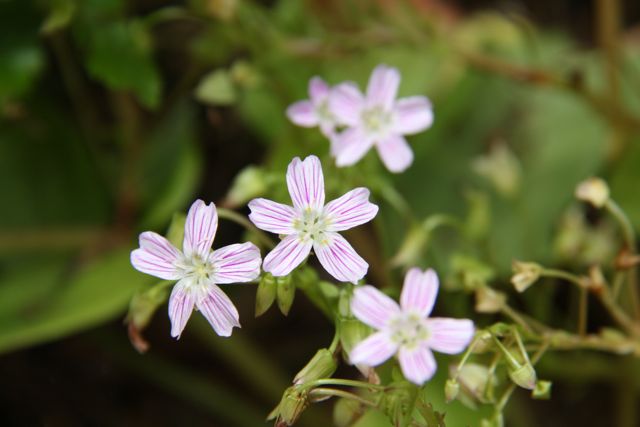
Leggy stalks sprawl at the base of an oak tree, or single plants grow scattered under some rushes. Candy flower, or Claytonia siberica, can have several different growth forms depending on where it is – and how old it is. The five petals are white or pale pink, and striped with a darker pink (I wonder if the name candy flower came from the classic uniform of the “candy stripers”?)

You can tell by looking at the fleshy leaves that this is a close relative of miner’s lettuce, though they don’t have the distinctive circular form. Instead, there is usually just one set of paired leaves, and a long stalk of flowers that rises above that. Candy flower prefers to grow in swamps or on moist slopes. Even if the ground doesn’t look wet, it’s a good indicator that there’s moisture around at least part of the time.

Candy Flower

Leave a comment

Filed under Native, Plant of the day

Plant of the day: phantom orchid

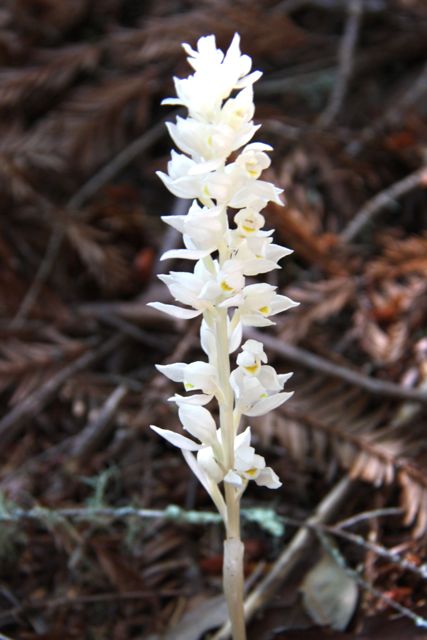
A stark white stalk of flowers catches a beam of sunlight in the woods of Sonoma’s coast range. This dense cone of blooms is completely white; the only color is a pale yellow smudge on each flower’s bottom lip. Phantom orchid, or Cephalanthera austiniae, is the only orchid in North America that has no chlorophyll at all.

No chlorophyll means it can’t make its own food, so the phantom orchid has to steal all of its nutrients from other plants. There are a variety of different ways that plants do this, but the phantom orchid uses fungi as go-betweens! There’s no direct contact between the orchid and its host plant (in this case, actually, the dead plants rotting on the forest floor). Instead, the tiny fibers of the fungus enter the roots of the host plant and pass nutrients along to them. I’m not yet sure what they get out of the deal, but it’s pretty nifty. The technical term for this is “mycoheterotrophic”.

As far as I know this striking orchid doesn’t grow in Marin, but you may see it when you’re hiking in Sonoma and the northern counties, or down in areas around Monterey as well.

4 Comments

Filed under Native, Plant of the day