Category Archives: Non-native

Plant of the day: showy St. John’s wort

Yellow flowers and myriad long, wild stamens deck this creekside bush. Here is a St. John’s wort–Hypericum grandifolium. It looks out of place along a not-very-remote trail, and upon looking it up later I realize that impression was spot on. There are several species in the Hypericum genus dubbed St. John’s wort, of both native and non-native varieties. I happen to have stumbled across what is really a slightly misguided garden plant. The CalFlora database only lists two observations in the state!

There are several other species of Hypericum that are much more common that you can keep an eye out for. All will have similar flamboyant yellow flowers. Possibly the most common is Hypericum perforatum, a low-growing shrubby plant that naturalized from Europe. It has long been used as a medicine in homeopathy, naturopathy and traditional remedies. It is acclaimed for having antibiotic and antidepressant properties, and for soothing nerve pain. The plant’s compound hypericin is said to inhibit HIV.
 

Leave a comment

Filed under Non-native, Plant of the day

Plant of the day: white clover

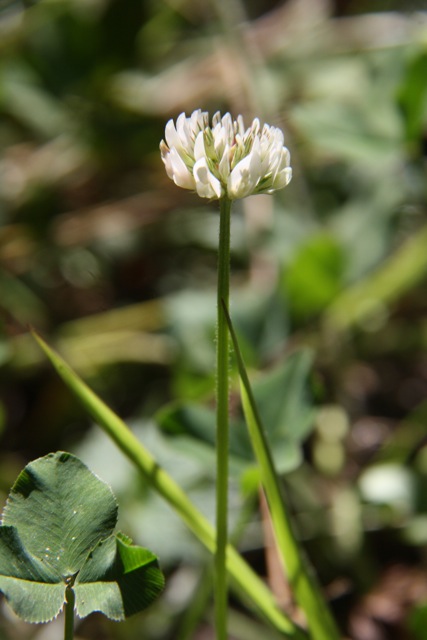
White heads of flowers dot the unmowed ball field like cotton balls scattered freely. But look close and the blooms are not at all cottony; this is a clover, each head a cluster of dozens of small pea-type flowers. The leaves are distinctively bisected with a faint crescent line that looks like a watermark, or the pattern left behind on paper that was soaked and then dried.

Everpresent in lawns and weedy berms, white (Trifolium repens) clover is one of the most common (and dare I say overlooked) plants around. Rare, shy, or temperamental flowers are a treat to find and behold–but I also like to take the time to get to know the species that are so common that they are easy to ignore. This little European invader is certainly one of those. But it turns out that not only is it a favorite snack for livestock, but humans can eat it too! Young leaves can be used in salads or soups, or it can be cooked like spinach. Dried flowers and seed pods have been ground into a high-protein flour that can be used on its own or as a garnish. The plant can be boiled for a tea, either just because its tasty or as a traditional Cherokee treatment for fever. Roots can be cooked and eaten, and evidently the leaves give baked goods a vanilla-like flavor. Who knew.

Trifolium repens

Leave a comment

Filed under Edible, Medicinal, Non-native, Plant of the day

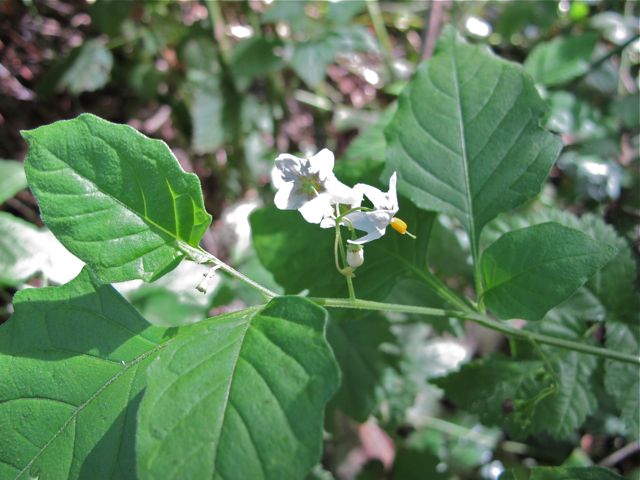
Plant of the day: common nightshade

Solanum americanum

As a kid I called this plant deadly nightshade, which may be why it has always looked sinister to me. It likes to grow in shady places, where its white or purple flowers gleam like little stars. Solanum americanum twines its narrow stem up through bushes, or drapes over tree branches. The deep green leaves are arrow-shaped–like a weapon, or the head of a rattlesnake or pit bull. It may look pretty but its very outline says “don’t mess with me.”

Despite being in the same family as peppers, potatoes and tomatoes, nightshade is quite toxic. My childhood respect was well-founded; eating the unripe berries has been fatal to more hapless tots. But just how poisonous nightshade is can vary with population, environment, and the age of the plant. Farmers don’t like it because the berries can’t be separated from peas and some beans, it is resistant to some herbicides, and the vines can gum up the harvesting machinery as well (according to the CA Department of Food and Agriculture).

I’m not sure whether this is a plus or not, but nightshade also contains salasodine, a natural compound that is used in some countries to manufacture steroid hormones.

Common nightshade is considered native, but there is a chance that it was an early introduction from South America.

Leave a comment

Filed under Non-native, Plant of the day, Poisonous

Plant of the day: hedge parsley

This is one of the many unassuming plants that will be leaving souvenirs in your socks throughout the summer. With seed pods studded with hooked barbs, it catches easily on fabric and fur. Hedge parsley, or Torilis arvensis, is a mildly invasive species that has spread throughout much of the state (below 5,249 feet according to CalFlora, though such a precise number seems a tad arbitrary).

With tiny white flowers and only a few small leaves scattered along the stem, this calf-high plant is easily missed–though its burrs are more noticeable. Hedge parsley is in the large and diverse carrot family (or Apiaceae), landing on the untasty end of the spectrum that ranges from poison hemlock to culinary parsley.

Leave a comment

Filed under Non-native, Plant of the day

Plant of the day: chicory

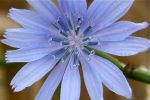
This tough, blue-eyed plant is a rugged survivor (aka, a weed). Chicory (Cichorium intybus) thrives on the edges of human activity: roadsides and empty lots. It was originally native to Europe, but now it is so well established across North America that it often is described as “naturalized”.

Chicory also has a long relationship with people as a food. It’s roots–roasted, toasted and ground–are a renowned coffee substitute. They also can be cooked and eaten like parsnips. The bitter leaves are used in salads or spaghetti; they are less bitter in the wintertime. Because chicory plants have plenty of inulin (a type of starch that diabetics can’t digest) they are a recommended food for people trying to limit their glucose.

Their pretty blue flowers are light sensitive, opening at dawn and closing by the afternoon.

Leave a comment

Filed under Edible, Non-native, Plant of the day

Plant of the day: stinging nettle

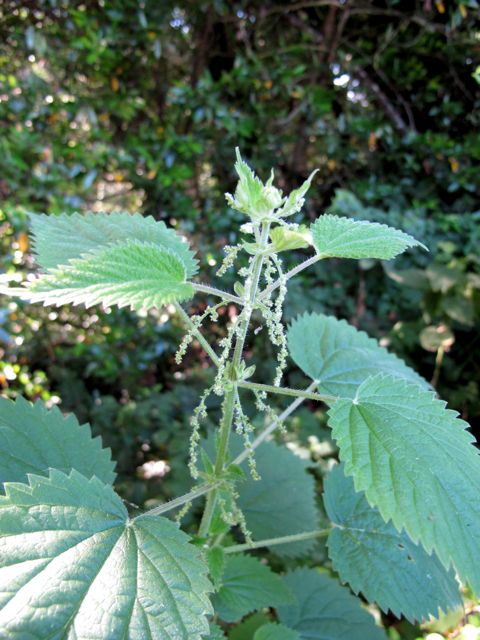
Urtica dioica

Stinging nettles are a common denizen of the shady forest. These tall plants have heart-shaped leaves with jagged edges like the edge of a bread knife. Though seemingly delicate, Urtica dioica packs a hidden weapon: stinging hairs that give a painful bite to the bare skin of any unwary passersby.

But these plants are friend as well as foe. They are tasty as a tea, in soup, and also as an addition to one of my favorite fancy cheeses. Nettle wine is still being made. Even brief exposure to heat destroys the sting, but some actually seek it out–a British nettle eating competition is a vivid example. One winning contender ate the leaves off 48 feet of stalks! I don’t recommend trying this. But I can vouch that a tea made from the fresh leaves is delicious. Collect them using a plastic bag or gloves, and simply pour boiling water over them in a cup. The water turns a dark green with a rich flavor, and when you drain your cup the leaves can be eaten as well. The plant contains large amounts of chlorophyll, and is a natural source of magnesium, iron, and calcium. Plus it’s delicious!

Nettles have had many uses besides food over the centuries as well. The fibrous plants are great for textiles–they have been made into shrouds, sailcloth, rope, silk-like fabric, and military uniforms.

Stinging nettles are native to Europe, Asia and also North America. There is another, less common type of nettle as well. Dwarf nettle is low growing, less than 1.5 feet tall as opposed to stinging nettle which grows 3 to 10 feet tall. Also, it isn’t native to California.

1 Comment

Filed under Non-native, Plant of the day

Plant of the day: Indian teasel

Dipsacus sativus

The distinctive silhouette of teasel (Dipsacus sativus) is a familiar sight in the coastal parts of California. Thick, pointed bracts jut out, like splayed arms beneath the cone-shaped flower head. This structure stays standing long after the small white flowers have faded; people collect the dried stems for decoration. The spiny flower heads are so stiff they were used to card wool before metal carding combs were created!

Sadly this odd-looking plant is also a fairly nasty invasive. It can form dense chest-high thickets that are impassable to both people and animals. This European invasive likes to grow in disturbed areas: along roadways, in ditches and on grasslands. Another species, wild teasel (Dipsacus fullonum) is less common locally but more widespread throughout North America. It has pink-to-purple flowers and sharply upcurved bracts. Just to confuse things, both species also go by the common name of  Fuller’s teasel.

Leave a comment

Filed under Invasive, Non-native, Plant of the day

Plant of the day: bull thistle

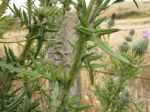
One of the most common thistles around is bull thistle, an invasive species from Europe. Its showy purple flowers are beloved by bumble bees and other insects, but its spiny leaves are a bane to ranchers.

Bull thistle (Cirsium vulgare) grows most abundantly in coastal grasslands, along the edge of marshes, and in sunny openings in forests, according to the California Invasive Plant Council – but it is found in every state in the country. You can recognize this species because the leaves don’t stop when they meet the stem; instead they run down along it like little spiny wings.

This plant thrives on disturbance; it grows most readily when the soil is disrupted by plowing, logging, digging and so on. Even gopher activity can give it a boost!

Leave a comment

Filed under Invasive, Non-native, Plant of the day

Plant of the day: creeping buttercup

In low wet places, a mat of green leaves and yellow flowers grows. The flowers have five glossy, spreading petals and many stamens. Pale green splotches dot the leaves, which are three-parted and ragged at their ends.

This slideshow requires JavaScript.

This is creeping buttercup, or Ranunculus repens. It’s a mildly invasive plant that is becoming common along trails and roadsides where it can form large patches. Its stem can sprout roots where it touches the ground, enabling it to spread easily.

This flower is a relative of the taller, leggy California buttercup (a native).

Leave a comment

Filed under Invasive, Non-native, Plant of the day

Plant of the day: pennyroyal

As I walk down the marshy trail there is a strong minty smell in the air. This is coming from small purple-flowered plants: pennyroyal, or Mentha pulegium is in the mint family and almost always grows in wetlands. Even if the ground appears dry, it’s a strong indicator that a low summer-dried fields or valleys was wet in the spring, according to the Flora of Marin. Pennyroyal is another weedy non-native species native to Ireland and other parts of Europe.

This slideshow requires JavaScript.

There are a lot of other members of the mint family that have tuft-like purple flowers, but pennyroyal is the only one in the area that has discrete whorls of leafless (or small-leaved) flowers in stacks along the stem.

Leave a comment

Filed under Invasive, Non-native, Plant of the day