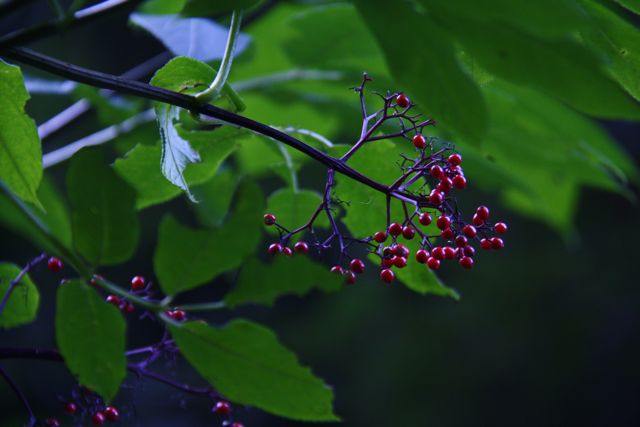
Plant of the day: red elderberry

In the shade of the forest, clusters of brilliant red berries seem to glow with color. This is red elderberry (Sambucus racemosa), the cousin of blue elderberry which I wrote about yesterday. There is a lot less written about this beautiful plant–some sources say the berries are edible, some say they are not. My guess is that even if you can safely eat them they aren’t nearly as tasty as their blue cousins or more info would be available.

Despite their names, the Jepson database says that red elderberry can also be a blueish-black color; the way to tell it isn’t blue elderberry is that the dark form of the berries lack the glaucous white coating on their surface.

Leave a comment

Filed under Native, Plant of the day

Plant of the day: blue elderberry

Clusters of grayish-blue fruits hang from the branches of a small tree. Blue elderberry (Sambucus nigra) is a beautiful plant with arching branches. Its shaggy bark is wrapped around with furrows in older plants. The leaves are a fresh green and paired; each pinnate leaf actually looks like several leaves, since it is composed of 3–9 little leaflets.

Elderberry has a rich history of being used in cuisine, crafts, and medicine–but it must be approached with caution since the green parts of the plant and the unripe berries are quite toxic. The roots are the most toxic of all. But ripe berries make a delicious syrup, jam or wine, and the plant has long been cherished by traditional cultures. Petals can be eaten raw, made into a tea, or used to flavor pancakes. Some have even dipped the entire flower head in batter and fried it! Elderberry syrup is said to be an effective treatment for the flu; you can buy bottles of it at most health food stores. Native Americans used the branches for baskets, flutes and arrow shafts, and the fruit was a main food source.

Before the fruit is ripe, you can tell blue elderberry from its cousin, red elderberry, by the shape of the flower head. Blue elderberry has a flat-topped cluster, whereas red elderberry flowers are arranged in a pyramidal or roundish shape.

Notice the flower head is flat, not cone-shaped

Leave a comment

Filed under Edible, Good for gardens, Medicinal, Native, Plant of the day, Poisonous

Plant of the day: narrow leaf cattail

This tall reed rustles its leaves above a small pond. Long cylindrical flower heads look like two plump brown sausages on a spit. The sausages are actually flower heads, with the female flowers clustered in the lower, plumper segment while the male flowers are clustered together above.

These are narrow leaf cat-tails, a common sight in wetlands or roadside ditches. There are actually three species here in the Bay Area that hybridize with one another; the main way to tell them apart is by the flower heads (if the skinnier flower head is stacked immediately above the fatter one with no gap of stem visible in between, you’re looking at common cattail, or Typha latifolia). The two species of narrowleaf cattail (T. domingensis and T. angustifolia) are harder to tell apart–look for orange or yellow flowers, and dark dots on the inside of the lower leaf, to ID T. domingensis.

Leave a comment

Filed under Native, Plant of the day

Plant of the day: salty Susan

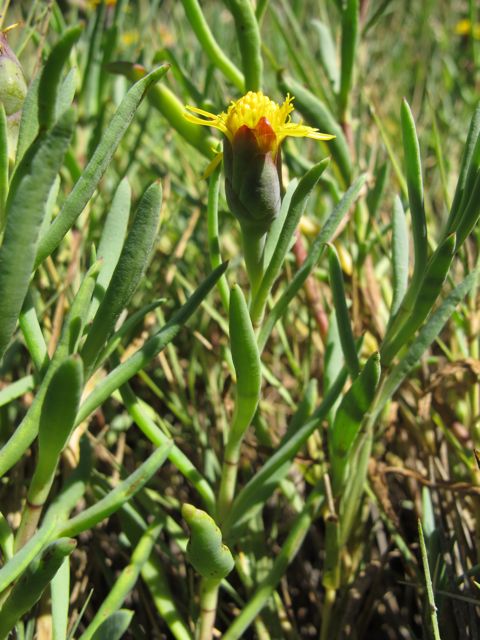
Jaumea carnosa

Nestled among the pickleweed are patches of grayish-green plants with bright yellow flowers. This fleshy-leaved little aster is Jaumea carnosa  (also known as marsh jaumea or salty Susan), and the patchiness is because it spreads by rhizome, or underground stem. Jaumea is common in the upper reaches of salt marshes along the Pacific coast from California to Canada. It’s affinity to the sea is a strong one: you won’t find it growing above 16 feet in elevation!

Even though Jaumea stands out as one of the comparatively few plants that grow in salt marshes, there’s not much information on this little plant. As far as I can tell, it’s not edible and hasn’t got any significant cultural or historical uses. It’s just an upstanding citizen that likes to grow at the upper edge of the tide, quietly going about its business of flowering and photosynthesizing.

Leave a comment

Filed under Native, Plant of the day

Plant of the day: showy St. John’s wort

Yellow flowers and myriad long, wild stamens deck this creekside bush. Here is a St. John’s wort–Hypericum grandifolium. It looks out of place along a not-very-remote trail, and upon looking it up later I realize that impression was spot on. There are several species in the Hypericum genus dubbed St. John’s wort, of both native and non-native varieties. I happen to have stumbled across what is really a slightly misguided garden plant. The CalFlora database only lists two observations in the state!

There are several other species of Hypericum that are much more common that you can keep an eye out for. All will have similar flamboyant yellow flowers. Possibly the most common is Hypericum perforatum, a low-growing shrubby plant that naturalized from Europe. It has long been used as a medicine in homeopathy, naturopathy and traditional remedies. It is acclaimed for having antibiotic and antidepressant properties, and for soothing nerve pain. The plant’s compound hypericin is said to inhibit HIV.


Leave a comment

Filed under Non-native, Plant of the day

Plant of the day: white clover

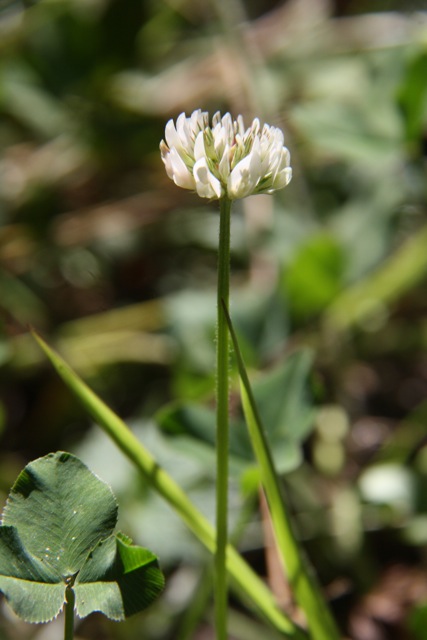
White heads of flowers dot the unmowed ball field like cotton balls scattered freely. But look close and the blooms are not at all cottony; this is a clover, each head a cluster of dozens of small pea-type flowers. The leaves are distinctively bisected with a faint crescent line that looks like a watermark, or the pattern left behind on paper that was soaked and then dried.

Everpresent in lawns and weedy berms, white (Trifolium repens) clover is one of the most common (and dare I say overlooked) plants around. Rare, shy, or temperamental flowers are a treat to find and behold–but I also like to take the time to get to know the species that are so common that they are easy to ignore. This little European invader is certainly one of those. But it turns out that not only is it a favorite snack for livestock, but humans can eat it too! Young leaves can be used in salads or soups, or it can be cooked like spinach. Dried flowers and seed pods have been ground into a high-protein flour that can be used on its own or as a garnish. The plant can be boiled for a tea, either just because its tasty or as a traditional Cherokee treatment for fever. Roots can be cooked and eaten, and evidently the leaves give baked goods a vanilla-like flavor. Who knew.

Trifolium repens

Leave a comment

Filed under Edible, Medicinal, Non-native, Plant of the day

Plant of the day: spearmint

Mentha spicata

Purple spikes grow as high as my shoulder in the creek bed. This tall purple mint looks like the big brother of pennyroyal, which I wrote about last month. But its whorls of lavender purple flowers merge together towards the top of the spire, instead of remaining separated in distinct tiers. As with all the mints, it has a square stem and paired leaves.

Native to Europe, Mentha spicata is found across much of the United States and Canada.

Leave a comment

Filed under Plant of the day

Plant of the day: wood rose

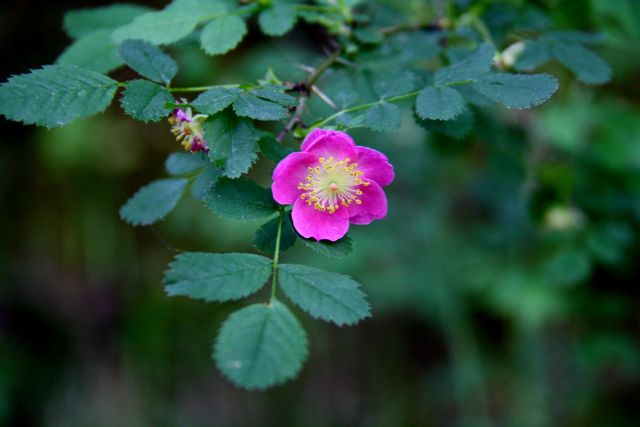
Rosa sp.

In spring, the native roses bloom with graceful pink blossoms. In the summer, they are decked with clusters of red fruit. And year-round, the elegant bushes are lush with small round leaves. A wild rose is a treat in any season or any setting, whether forest or garden. Telling the different species apart can be tricky (the local key requires fruit which isn’t helpful in spring). But at this time of year, the wood rose–Rosa gymnocarpa–stands out because it loses its sepals as its fruit begins to ripen; other species retain the sepals (and sometimes the dried remains of the stamens too) on the ends of the fruit. One of its other common names is “bald hip rose”.

Though technically edible, the small red hips are packed full of seeds that are nestled inside a dense layer of hair that grows on the inside of the fleshy shell. Not exactly succulent, they have a tart, good-for-you, vitamin-C kind of tang. I read that the seeds are a good source of Vitamin E. The petals also can be eaten, and both petal and hip can be steeped for a tea. Historically, leaves were sometimes chewed as a remedy for bee stings, while the soaked bark was a wash for sore eyes.

See how the end of the fruit is smooth?

Leave a comment

Filed under Edible, Good for gardens, Medicinal, Native, Plant of the day

Plant of the day: common nightshade

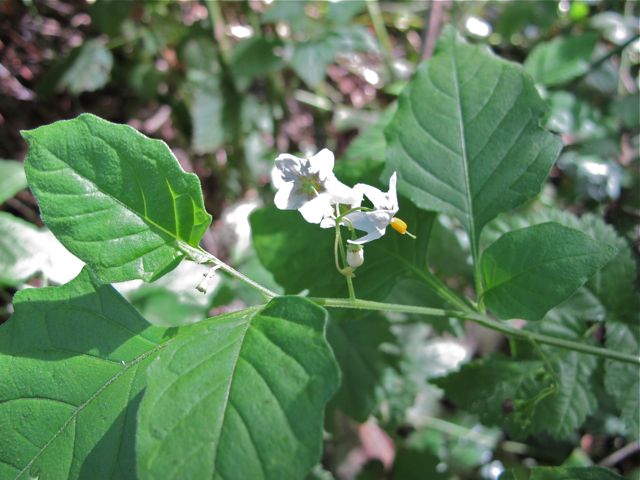
Solanum americanum

As a kid I called this plant deadly nightshade, which may be why it has always looked sinister to me. It likes to grow in shady places, where its white or purple flowers gleam like little stars. Solanum americanum twines its narrow stem up through bushes, or drapes over tree branches. The deep green leaves are arrow-shaped–like a weapon, or the head of a rattlesnake or pit bull. It may look pretty but its very outline says “don’t mess with me.”

Despite being in the same family as peppers, potatoes and tomatoes, nightshade is quite toxic. My childhood respect was well-founded; eating the unripe berries has been fatal to more hapless tots. But just how poisonous nightshade is can vary with population, environment, and the age of the plant. Farmers don’t like it because the berries can’t be separated from peas and some beans, it is resistant to some herbicides, and the vines can gum up the harvesting machinery as well (according to the CA Department of Food and Agriculture).

I’m not sure whether this is a plus or not, but nightshade also contains salasodine, a natural compound that is used in some countries to manufacture steroid hormones.

Common nightshade is considered native, but there is a chance that it was an early introduction from South America.

Leave a comment

Filed under Non-native, Plant of the day, Poisonous

Plant of the day: hedge parsley

This is one of the many unassuming plants that will be leaving souvenirs in your socks throughout the summer. With seed pods studded with hooked barbs, it catches easily on fabric and fur. Hedge parsley, or Torilis arvensis, is a mildly invasive species that has spread throughout much of the state (below 5,249 feet according to CalFlora, though such a precise number seems a tad arbitrary).

With tiny white flowers and only a few small leaves scattered along the stem, this calf-high plant is easily missed–though its burrs are more noticeable. Hedge parsley is in the large and diverse carrot family (or Apiaceae), landing on the untasty end of the spectrum that ranges from poison hemlock to culinary parsley.

Leave a comment

Filed under Non-native, Plant of the day