Tag Archives: Flora

Plant of the day: yellow bush lupine

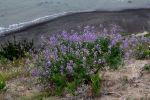
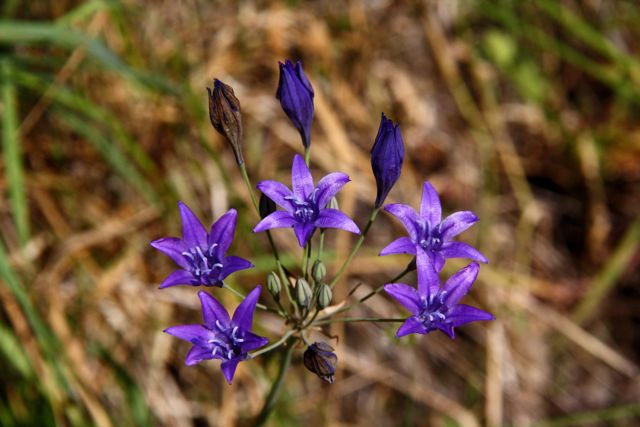
Despite the obvious, these pretty purple-flowered shrubs are indeed a yellow bush lupine. This was news to me! I didn’t even realize the two color types were the same species until I went to look up the Latin name. After all, I was sure I already knew the common name: purple bush lupine, right?

Wrong. No such plant exists, according to the field guide. So I turned to the key—and couldn’t find it! The darn thing kept keying out to yellow bush lupine (Lupinus arboreous). There are other purple, shrubby lupines (silver lupine and dune bush lupine) but both have distinctively hairy upper petals. This one didn’t. I’m embarrassed to admit that it took a long time for me to read through to the second page of the yellow bush lupine species description where I found the explanation: “It is usually yellow, but always yellow-flowered in the dunes and blue-flowered in the coastal scrub, bishop pine forest, and elsewhere.” The species is also sometimes called coastal bush lupine, which I think is a much better name!

Whatever their name and whatever their color, these lush shrubs dish out fragrant towers of  blossoms. They can grow to be as tall as a person, though often are knee height or lower: spreading mounds of silky-haired, fan-shaped leaves. Look for them on sand dunes and hillsides from Washington state to San Diego. They cling to cliffs and roadsides and are very popular among insects—and rodents too! Each plant produces hundreds of seed pods that our furry friends love to munch.

Leave a comment

Filed under Native, Plant of the day

Plant of the day: Ithuriel’s spear

Triteleia laxa

Here is another one of the lovely leggy lilies that I wrote about last week. Triteleia laxa sports a loose umbel of trumpet-shaped purple flowers. The color is usually the rich royal purple shown here, but it can be paler as well. The way to tell this beauty from the similar species is to look inside and see that it has six classic-looking stamens.

The young plant is spear-shaped when it first emerges from the earth. Evidently the name is (for you literary types!) a reference to Milton’s Paradise Lost, in which the angel Ithuriel finds Satan has approached Eve in the shape of a toad. Ithuriel touched him with her spear and revealed his true form. I think toads are beautiful and charismatic critters, and for me this is the best part of the fable – that a toad is what was chosen to infiltrate the ranks of goodness!

See the six distinct stamens

Leave a comment

Filed under Native, Plant of the day

Plant of the day: sneezeweed

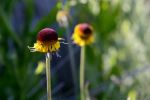
A brown golf ball is dressed in a short yellow skirt. Well not really, but that’s what this funny flower looks like: a big round ball, fringed at its very lower edge with dangling petals. I found this patch of Helenium puberulum perched alongside Highway One just south of Stinson Beach.

There are several different kinds of sneezeweed (a.k.a. Helenium) and they all look like variations on this theme.  The “classic” sneezeweed shown here has many flowers per plant, noticeably short petals – they almost look like an afterthought! – and leaves that attach to the stem (the botanical term is decurrent). This combination of traits lets you know you’re looking at plain ‘ol sneezeweed instead of Bigelow’s sneezeweed or yellow sneezeweed. Actually as far as I can tell you don’t even need to look at the leaves or number of flowers – the other sneezeweeds both seem to have larger petals. But it’s always good to ID a plant using more than one feature, since individuals of the same species can show a LOT of variation in its shape, color, size and so on.

The sneezeweeds are in the enormous Asteraceae family, and if you look close you’ll see that the brown ball is made up of hundreds of individual “disc” flowers, and the yellow skirt is the showier “ray” petals.

Leave a comment

Filed under Good for gardens, Native, Plant of the day

Plant of the day: common catchfly

Common catchfly

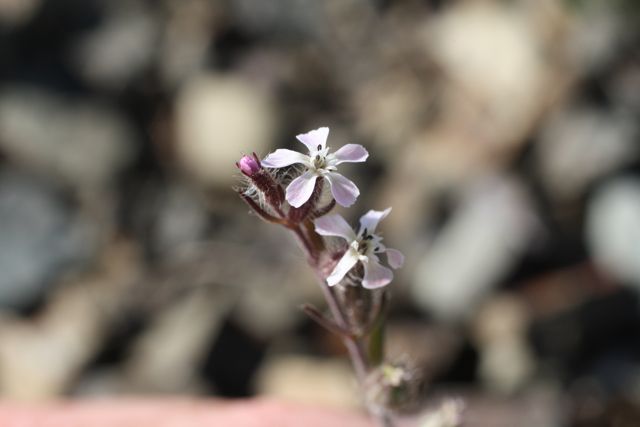
This plant is a weed, but I kinda like it. The whole plant is sticky (is that why it’s called catchfly?) and the small pinkish-white flowers are perched atop a vase-shaped calyx. The petals are fused together, with little toothlike projections sticking up like a fringe around the inner edge. There are distinctive stripes running perpendicularly along the calyx (which is all the sepals taken together). The whole thing is a nice bit of floral architecture – if you can forget that it’s an invasive that was introduced from Europe!

Also, Silene gallica is another member of the Caryophyllaceae (a.k.a pink, or carnation) family. So check for the swollen nodes where the opposite pairs of leafs join the stem that I talked about a few posts back!

You may wonder why I always talk about families – the reason is that whether you are keying or looking plants up in a guidebook, being able to confidently narrow your options down to one or two families makes the whole process a lot easier. It also helps train your eye and mind in the detailed way of looking at plants that is needed for good identification.

Silene Gallica

Leave a comment

Filed under Non-native, Plant of the day

Plant of the day: cow parsnip

This is a fearsome plant. It’s rough, tough leaves are larger than my head: pointed and creased like thick green origami. Its stem is hollow and thick as a hose, and it can heft its dense umbel of flowers as much as seven feet in the air. I prefer the scientific name—Heracleum maximumto the common name “cow parsnip”. That is far too pedestrian for this beast. Cows are placid, parsnips are passive underground things. This is a vigorous creature of light and growth. The implied size is appropriate, but that’s about all.

Right now it is out in abundance and it’s hard to hike (or drive) near the ocean without seeing it. It clusters along stream-banks and hangs over the curves on Highway One. There is nothing else that looks like this plant; it’s the only one of its genus around here. It has a vague similarity to its other cousins in the carrot family like Queen Anne’s lace or poison hemlock—but all the others have divided, lacy leaves whereas our bovine parsnip boasts solid, maple-like leaves as large as dinner platters.

2 Comments

Filed under Native, Plant of the day

Plant of the day: rose clover

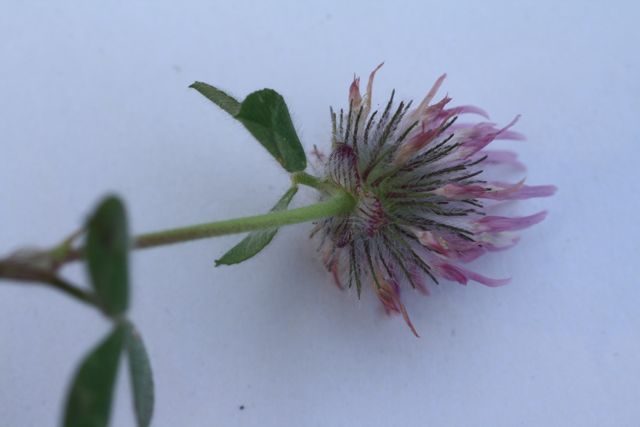
There are so many clovers around that they can be daunting to identify. But this little one has long caught my eye—partly because of the pretty pink color of its petals, combined with the many long green teeth of the calyx. But mostly I just like how it invariably has one little leaf coming directly off the flower. It may be strange but I find that adorable. Of course it turns out that botanically speaking the leaf isn’t actually part of the flower, it just appears to be so. In science-speak, the “heads are sessile above the uppermost leaves and stipules”. But that is good enough for me.

Rose clover (Trifolium hirtum) is native to Europe, not California. But it is now so ubiquitous as to be described by the authorities as “one of the most common” of the European species that have naturalized here.

You can pretty much tell rose clover from other species of clover because it has all of the following features: (a) It is hairy but doesn’t get cottony when it goes to seed; (b) Its showy, rosy flowers; (c) It’s an annual not a perennial; (e) That cute little leaf.

Leave a comment

Filed under Invasive, Non-native, Plant of the day

Plant of the day: wild radish

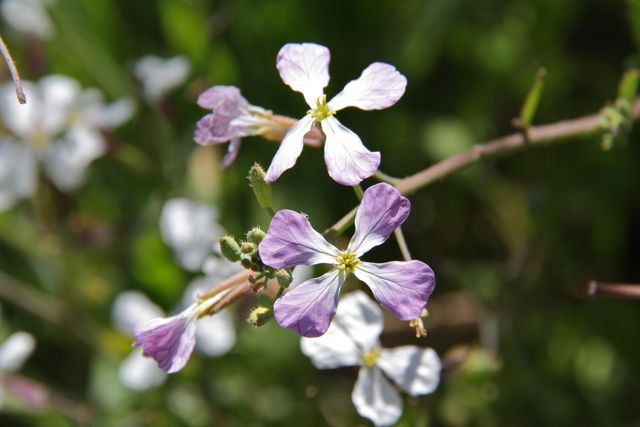
Masses of delicate easter-colored flowers fill fields and hillsides, standing as tall as your waist or even shoulder. These pale yellow, purple, and white flowers are wild radish, or Raphanus sativus. You can see a fantastic showing of them along the first part of the Pierce Point trail on the Point Reyes Penninsula.

These flowers also taste good—take a trailside nibble or add flowers and pods to a salad for a spicy radish taste. And there are those four simple petals again! That’s right, the wild radish is in the Brassicaceae, or mustard, family that I wrote about last week.

According to the Marin Flora, the local wild radish is actually a hybrid between R. sativus and its cousin, R. raphanistrum.

Leave a comment

Filed under Edible, Invasive, Non-native, Plant of the day

Plant of the day: buckeye

It’s buckeye season – one of my favorite stages of spring. These spreading trees with their tall, pinkish-white spires of flowers can be seen along roadsides, streamsides, in mixed woodlands and even at the edge of pebbly beaches on Tomales Bay. I’ve seen Aesculus californica growing so close to the water that the lower branches were draped with streamers of dried eelgrass.

This slideshow requires JavaScript.

This lovely tree is unique to California, and can be found across much of the state. It has loads of character, with knobby, gnarled trunks and wide palmately compound leaves. It leafs out during the winter, offering cool shade on hot days into the early summer, and then it goes dormant. In the fall it drops beautiful shiny chestnut-colored nuts (ok, actually they are “capsules” since the hard exterior contains several seeds). I like to gather them and use them for decoration. But don’t eat any! They are toxic, known to depress the nervous system, cause abortions in cattle and be toxic to bees. Native Americans would use extract of the seed topically (for hermerrhoids?!). In tough times the seeds were sometimes eaten (after careful preparation to leach the poison out). Buckeye also provided food in a different way: pouring a ground-up powder of the seed into a stream would stupify fish for easier catching!

Leave a comment

Filed under Good for gardens, Medicinal, Native, Plant of the day, Poisonous

Plant of the day: fairy lantern

This is one of the most beautiful flowers of the Bay Area. It’s aptly named, with its complex blossom looking like a delicately wrought lantern nodding on a slender stem. The three upper sepals curve upward like a pagoda roof, while the fringed petals below curl inwards as if to protect a flame. It’s not hard to imagine them as fixtures in a tiny magical kingdom. Keep your eye out for these little plants, and when you find one, look close!

The fairy lantern (Calochortus amabalis) is endemic to northern California, and is pretty much restricted to the coast range north of San Francisco bay. As such, Marin County is toward the southern-most end of the species’ range, and it is a rare sight here. These photos were taken in Sonoma county, where it is much more common.

Because all the parts are in threes, you can tell it is in the lily family, like the irises and blue-eyed grass.

Leave a comment

Filed under Native, Plant of the day

Plant of the day: rough hedge nettle

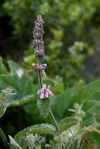
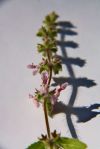
Rough hedge nettle is widespread in the area, and hedge nettles in general are easy to recognize. Though they don’t have the typical smell, hedge nettles are in the mint family! Mints are often hairy and smelly (like some rugged botanist-types that I know?!) and they have a tubular flower that usually is distinctly two-lipped. For the hedge nettles this is certainly the case. But the real giveaway for this family is that they have a square stem. Just roll it between your fingers to see what this means – all mint stems are distinctly four-sided (see the stem close-up below). There are other families that have square stems, but the many local species in the mint family (Lamiaceae) are by far the most common.

Stachys rigida is usually found in dry places—woods, shrublands, or grasslands. There are other hedge nettles (such as S. chamissonis, with its showy purple flowers) that prefer wetlands but our S. rigida is almost always on slopes, in gravel, clay or rocky soil. And, if you want to get technical, you should know that the Marin Flora lists Stachys rigida var. quercitorum as the local variety.

Leave a comment

Filed under Native, Plant of the day