Category Archives: Non-native

Plant of the day: sweet pea

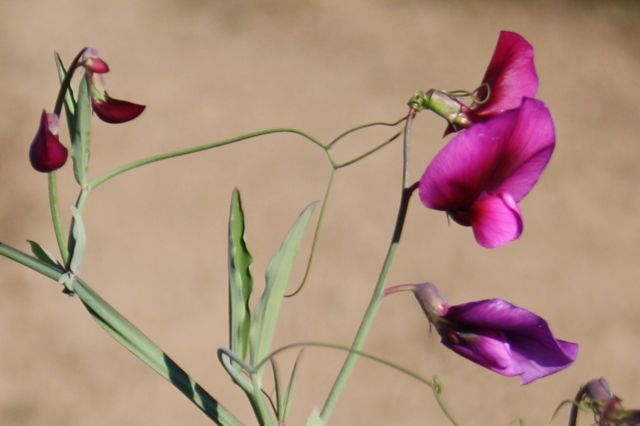
These flashy pink flowers are everywhere right now. Like the Tangier pea that I wrote about a few weeks ago, the sweet pea (Lathyrus latifolius) is an escaped garden plant. It has many sweet-smelling pink or purple flowers growing at the end of climbing stalks. The stem is dramatically flared, or winged, with a flat leaflike shelf projecting out from either side. The leaves are narrow and paired, like bunny ears.

As I mentioned in the last pea post, there are several different kinds of sweet peas growing in the area – I had always thought there was only one! Today’s post is about the true “sweet pea”, which is distinguished by the broad stem wings and by the fact that it’s a perennial, not an annual. You can tell the non-native sweet peas from the native species by looking at the leaves. All the non-natives have the paired “bunny ear” type of leaf, while the native species have many (more than five) leaflets on a stalk.

Leave a comment

Filed under Non-native, Plant of the day

Plant of the day: poison hemlock

With lacy leaves and delicate flowers, this plant doesn’t look like a deadly killer. But it is. This is the same plant that is fabled to have poisoned Socrates, and is the bane of ranchers since it can kill undiscriminating cows (it’s also responsible for “crooked calf disease“). There’s no antidote. So – admire this one from a distance, but don’t eat it, crush it, or take any other liberties. The root is the most poisonous part (unnerving, since it’s part of the inviting-looking carrot family!)

This slideshow requires JavaScript.

Conium maculatum isn’t native to California, but it is found throughout most of the state, often in open or disturbed places. Plants can grow to more than six feet tall, and have many flat umbels of lacy white flowers. Its similar-looking cousins, water hemlock, are also poisonous. But when I saw some on the open space above Mill Valley the other day, the lady bugs were having a wonderful time hanging out on the hemlock flowers!

Leave a comment

Filed under Invasive, Non-native, Plant of the day, Poisonous

Plant of the day: ramping fumatory

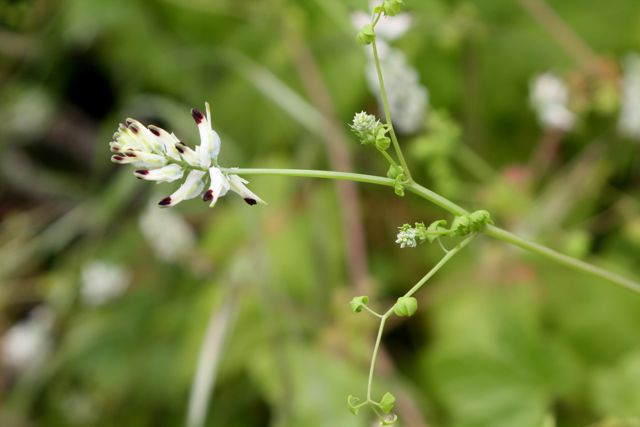
This twining, white-flowered plant seems unobtrusive but it is also very distinct. When I first saw it, I knew that I had never seen it before – and it turns out that isn’t surprising. White ramping fumatory (Fumaria capreolata) is a mildly invasive species that is slowly spreading throughout the state. I first saw it in Sutro Forest, and since have seen it regularly in Bolinas. Right now it’s only found in a handful of counties up and down California. The only other states it is found in are New York and Florida.

Its diminutive white blossoms are tipped with a dark brownish red, and delicate three-parted leaves are spread sparsely along twining stems. Despite somewhat pea-like flowers, fumatory is actually in the Papaveraceae family – a diverse group that also hold both poppies and bleeding hearts!

Leave a comment

Filed under Non-native, Plant of the day

Plant of the day: ice plant

On a trip to the ocean, I wade through a thick reddish-green mat of rubbery plants to get to the beach. The ankle-high leaves are spiky and break off under my feet with a crunch. Large yellow flowers are scattered across this green carpet, each with hundreds of skinny petals surrounding a nest of pollen-dusted stamens. This is Carpobrotus edulis, one of several kinds of iceplant in the area. None are native.

The fruit of Carpobrotus edulis, as its name suggests, was traditionally eaten back in its original territory of South Africa. It was deliberately brought to California, planted to bind coastal soils together and help stop erosion. It does seem to be successful at that job – you can see it growing on beaches and even in colorful tapestries drooping over the edge of cliffs. However, it’s another good intention gone wrong since it has turned out to be highly invasive; an “ecological bulldozer,” along the lines of broom, that wreaks havoc on the delicate dune ecosystem. All the species of ice plant look at least somewhat similar, though not all of them are closely related (there are five species in four different genera, with the two types of Carpobrotus being the most common around here, as far as I can tell).

3 Comments

Filed under Edible, Non-native, Plant of the day

Plant of the day: Tangier pea

Lathyrus tingitanus

Showy pink blossoms, delicate fragrance and winding tendrils – it’s sweet pea season. I’ve been seeing them growing along roads and trails, in gardens, and in bouquets on people’s tables or shop counters. This is an invasive species that it’s hard not to love – a guilty botanical pleasure!

As with yesterday’s plant, this is one where I learned more than I bargained for in the identification. I had naively assumed that there was only one type of sweet pea and that every time I saw that distinctive pink blossom it was the same species. Wrong again! There are several different kinds, and also some native species with paler pink blooms, so you have to look close. Tangier pea, or Lathyrus tingitanus, has the winged stem, two-parted leaves and large, deep pink flowers that mark it as one of the non-native species. You can tell Tangier pea from sweet pea because it is an annual, and also because it only has two or three blossoms per stalk.

Leave a comment

Filed under Invasive, Non-native, Plant of the day

Plant of the day: Scotch broom

This is another badnasty invasive broom species that you’ll see frequently throughout the Bay Area. Scotch broom (Cytisus scoparius) has pretty yellow pea-like flowers and long, narrow leaves that press closely against its multi-sided stems. Though it occasionally has some rounded leaflets as well, the overall lean, linear look to its foliage makes it easy to tell from its French broom cousin that I wrote about a few weeks ago.

This slideshow requires JavaScript.

In California, French broom is a nastier problem than Scotch broom, but throughout the rest of the country the Scottish Cytisus scoparius is the worst broom around. Even worse, both were deliberately originally introduced as ornamental species!

This plant is so nasty because it is hearty and vigorous, and spreads fast because it produces a LOT of seeds. A single Scotch broom plant can live for up to 7 years, and produce over 150,000 seeds per year. It’s a mind-boggling number! The seeds stay in the ground, ready to sprout, for between 5 and 30 years. These plants grow up to 12 feet tall and smother any native plants that would otherwise have grown where they are. There’s no sharing if you’re a broom species! Scotch broom is a rampant invasive across much of the western and eastern seaboards of North America – from Alaska to Baja and from Maine to Georgia, as well as in other countries like Australia and New Zealand. It’s native to northern Africa and parts of Europe.

There is one more broom species that you might see in the area, and that’s Portuguese broom. It’s not nearly as common, but it does cover about 65 acres in the Marin Headlands where it was planted in the 1960s as part of a landscaping and slope stabilization program – another good idea gone wrong! Portuguese broom looks a lot like Scotch broom, except the seed pods are inflated instead of compressed around the seeds. Also they have 8-10 sided twigs, as opposed to the 5-sided twigs of Scotch broom.

Leave a comment

Filed under Invasive, Non-native, Plant of the day

Plant of the day: common catchfly

Common catchfly

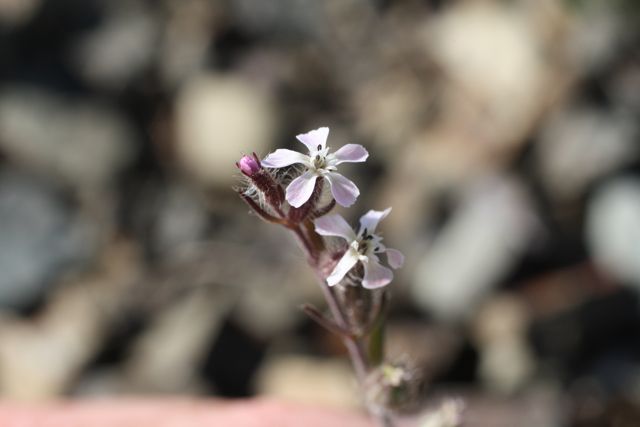
This plant is a weed, but I kinda like it. The whole plant is sticky (is that why it’s called catchfly?) and the small pinkish-white flowers are perched atop a vase-shaped calyx. The petals are fused together, with little toothlike projections sticking up like a fringe around the inner edge. There are distinctive stripes running perpendicularly along the calyx (which is all the sepals taken together). The whole thing is a nice bit of floral architecture – if you can forget that it’s an invasive that was introduced from Europe!

Also, Silene gallica is another member of the Caryophyllaceae (a.k.a pink, or carnation) family. So check for the swollen nodes where the opposite pairs of leafs join the stem that I talked about a few posts back!

You may wonder why I always talk about families – the reason is that whether you are keying or looking plants up in a guidebook, being able to confidently narrow your options down to one or two families makes the whole process a lot easier. It also helps train your eye and mind in the detailed way of looking at plants that is needed for good identification.

Silene Gallica

Leave a comment

Filed under Non-native, Plant of the day

Plant of the day: rose clover

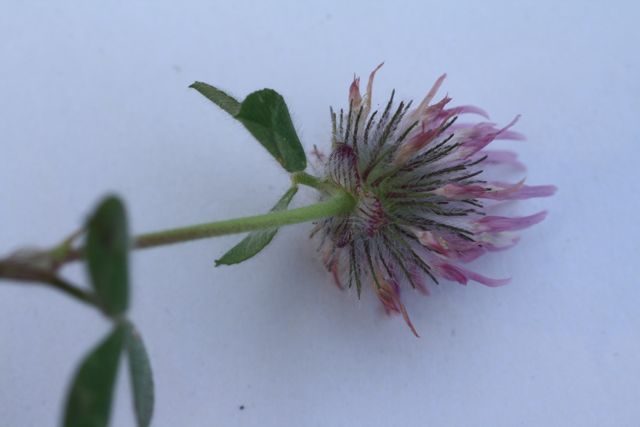
There are so many clovers around that they can be daunting to identify. But this little one has long caught my eye—partly because of the pretty pink color of its petals, combined with the many long green teeth of the calyx. But mostly I just like how it invariably has one little leaf coming directly off the flower. It may be strange but I find that adorable. Of course it turns out that botanically speaking the leaf isn’t actually part of the flower, it just appears to be so. In science-speak, the “heads are sessile above the uppermost leaves and stipules”. But that is good enough for me.

Rose clover (Trifolium hirtum) is native to Europe, not California. But it is now so ubiquitous as to be described by the authorities as “one of the most common” of the European species that have naturalized here.

You can pretty much tell rose clover from other species of clover because it has all of the following features: (a) It is hairy but doesn’t get cottony when it goes to seed; (b) Its showy, rosy flowers; (c) It’s an annual not a perennial; (e) That cute little leaf.

Leave a comment

Filed under Invasive, Non-native, Plant of the day

Plant of the day: wild radish

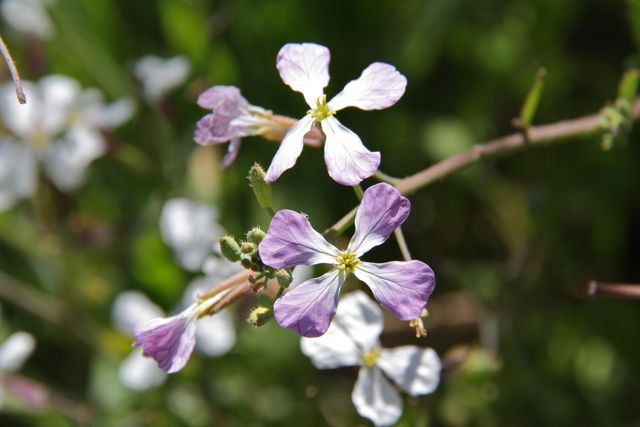
Masses of delicate easter-colored flowers fill fields and hillsides, standing as tall as your waist or even shoulder. These pale yellow, purple, and white flowers are wild radish, or Raphanus sativus. You can see a fantastic showing of them along the first part of the Pierce Point trail on the Point Reyes Penninsula.

These flowers also taste good—take a trailside nibble or add flowers and pods to a salad for a spicy radish taste. And there are those four simple petals again! That’s right, the wild radish is in the Brassicaceae, or mustard, family that I wrote about last week.

According to the Marin Flora, the local wild radish is actually a hybrid between R. sativus and its cousin, R. raphanistrum.

Leave a comment

Filed under Edible, Invasive, Non-native, Plant of the day

Plant of the day: long beaked stork’s bill

Long beaked stork’s bill is a ubiquitous sight in the fields of the bay area. This invasive little weed and its cousins, other types of stork’s bills, have naturalized across most of California. The long beaked stork’s bill (Erodium botrys) is distinctive because of the particularly long, beak-like seed pod, but also because of its leaf – it is the only one with a long narrow leaf that isn’t actually dissected into separate leaflets.

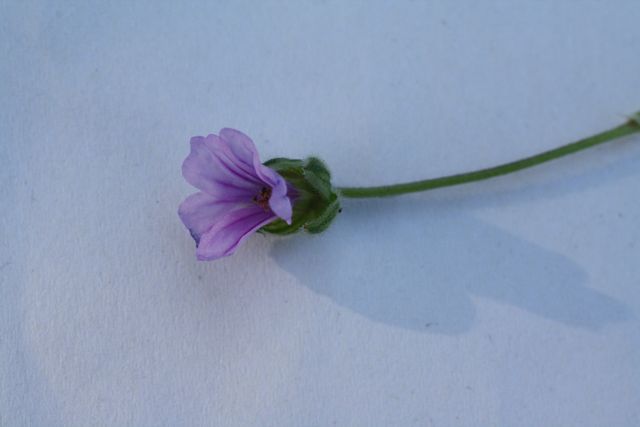
There are several species of wild geraniums with flowers that look quite a bit like those of stork’s bills – small, pinkish-purple. Again, look to the leaf to know what plant it is. The geraniums (sometimes called crane’s bills) have deeply dissected leaves that are overall roundish in shape. In other words, if you drew a line around the outside of the leaf, ignoring the details, you’d come up with a circle as opposed to the overall tongue-shaped leaves of the stork’s bills. The wild geranium petals are usually notched at the end, giving them a toothed look. Almost all of the wild geraniums are also invasive, with a few exceptions.

Leave a comment

Filed under Invasive, Non-native, Plant of the day