Tag Archives: Botany

Plant of the day: common bedstraw

Bedstraw – a.k.a goose grass, cleavers, or stickywilly

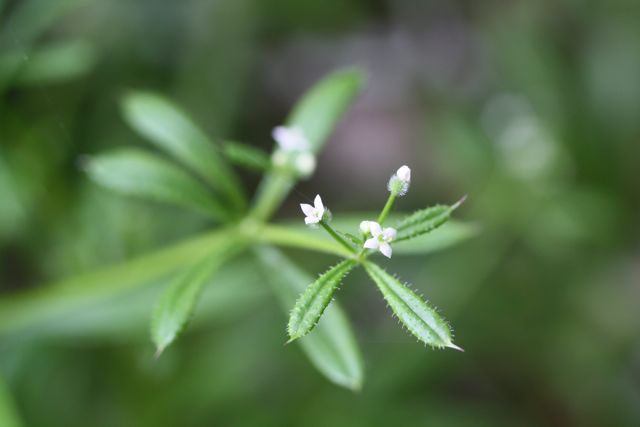
If you walk through a patch of bedstraw, you’ll know it right away. The stalks grow long and sprawling, and will wrap around your ankles. But they also are sticky! And the leaves are studded with tiny hook-like bristles! They don’t hurt to brush up against, but they certainly do cling. Its other names include goose grass, cleavers – and stickywilly.

The flowers of Galium aparine are tiny, white, four-petalled stars. But the plant’s most distinctive feature is its leaves: they stick out all around the stem like the spokes on a wagon wheel. Bristly, green, tongue-shaped spokes.

Bedstraw is widespread – not only across California, but throughout the US and southern South America, as well as Europe. A Scottish friend was just telling me that kids will grab handfuls and stick it on one another as a game. It’s listed as a native both in California and in Europe, but is described as an invasive/non-native in other states (like Arizona), so it is clearly aggressive. Bedstraw is used as a medicinal plant, taken as a tincture, juice or tea to treat maladies such as adenoids, nodules, kidney stones, roseola, and cough. It’s also been used on the skin to treat psoriasis, and eczema.
1 Comment

Filed under Medicinal, Native, Plant of the day

Plant of the day: pink honeysuckle

A bough of pink flowers droops down at me from the nearby tree. But I’m not looking at a blooming branch; the narrow, twining stem is tough but not woody enough to stand this high on its own. Here is a vine of pink honeysuckle, or Lonicera hispidula. The whorled cluster of flowers perches at the end of the vine, right at eye-height. They don’t always grow this way (I’ve seen them at ankle level alongside trails) but I got lucky this time with an easy view of the pretty flowers.

This slideshow requires JavaScript.

The upper petal is a soft, rosy pink and is dramatically rolled back. Five stamens are on prominent display, waiting for a passing bumble bee or hummingbird. Each stamen is T-shaped, with the brown bar of the anther dusted in pollen and delicately balanced on the greenish-yellow filament. This vine is often recommended for native plant gardens because it is so attractive to birds. Hummers love the sweet nectar, and other birds feast on the berries.

Honeysuckle is easy to recognize even when it isn’t blooming because the pattern of leaves is distinctive. The oval leaves are paired, and often fuse together into a disc around the stem when they are young. More mature leaves are separate, but often have a small leaflet at their base that is fused to the stem.

Leave a comment

Filed under Good for gardens, Native, Plant of the day

Plant of the day: ramping fumatory

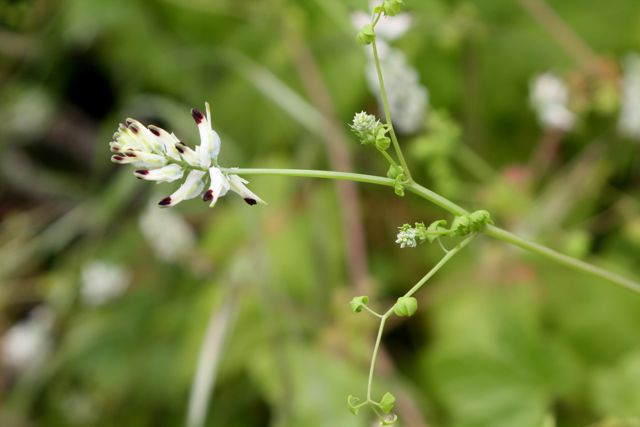
This twining, white-flowered plant seems unobtrusive but it is also very distinct. When I first saw it, I knew that I had never seen it before – and it turns out that isn’t surprising. White ramping fumatory (Fumaria capreolata) is a mildly invasive species that is slowly spreading throughout the state. I first saw it in Sutro Forest, and since have seen it regularly in Bolinas. Right now it’s only found in a handful of counties up and down California. The only other states it is found in are New York and Florida.

Its diminutive white blossoms are tipped with a dark brownish red, and delicate three-parted leaves are spread sparsely along twining stems. Despite somewhat pea-like flowers, fumatory is actually in the Papaveraceae family – a diverse group that also hold both poppies and bleeding hearts!

Leave a comment

Filed under Non-native, Plant of the day

Plant of the day: phantom orchid

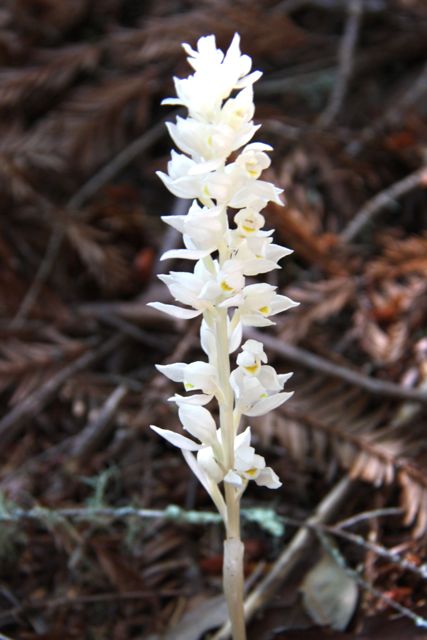
A stark white stalk of flowers catches a beam of sunlight in the woods of Sonoma’s coast range. This dense cone of blooms is completely white; the only color is a pale yellow smudge on each flower’s bottom lip. Phantom orchid, or Cephalanthera austiniae, is the only orchid in North America that has no chlorophyll at all.

No chlorophyll means it can’t make its own food, so the phantom orchid has to steal all of its nutrients from other plants. There are a variety of different ways that plants do this, but the phantom orchid uses fungi as go-betweens! There’s no direct contact between the orchid and its host plant (in this case, actually, the dead plants rotting on the forest floor). Instead, the tiny fibers of the fungus enter the roots of the host plant and pass nutrients along to them. I’m not yet sure what they get out of the deal, but it’s pretty nifty. The technical term for this is “mycoheterotrophic”.

As far as I know this striking orchid doesn’t grow in Marin, but you may see it when you’re hiking in Sonoma and the northern counties, or down in areas around Monterey as well.

4 Comments

Filed under Native, Plant of the day

Plant of the day: wintergreen

Under the shade of a redwood grove, slender red stalks rise leafless from the duff. Flowers are scattered sparsely along the stalk, with those toward the bottom opening first. Five pink petals nod toward the ground. If you look underneath, you’ll see an oddly curved pistil surrounded by yellow-dusted stamen.

This slideshow requires JavaScript.

This is Pyrola picta, or wintergreen. I saw it in Sonoma County, but it grows in almost all parts of the state – and in all states as far east as South Dakota. There are other types of Pyrola, but none that have been found in the bay area. In many places it has a handful of dark green leaves at its base, but around here it is almost always leafless. It also is often white instead of pink.

Leave a comment

Filed under Native, Plant of the day

Plant of the day: ice plant

On a trip to the ocean, I wade through a thick reddish-green mat of rubbery plants to get to the beach. The ankle-high leaves are spiky and break off under my feet with a crunch. Large yellow flowers are scattered across this green carpet, each with hundreds of skinny petals surrounding a nest of pollen-dusted stamens. This is Carpobrotus edulis, one of several kinds of iceplant in the area. None are native.

The fruit of Carpobrotus edulis, as its name suggests, was traditionally eaten back in its original territory of South Africa. It was deliberately brought to California, planted to bind coastal soils together and help stop erosion. It does seem to be successful at that job – you can see it growing on beaches and even in colorful tapestries drooping over the edge of cliffs. However, it’s another good intention gone wrong since it has turned out to be highly invasive; an “ecological bulldozer,” along the lines of broom, that wreaks havoc on the delicate dune ecosystem. All the species of ice plant look at least somewhat similar, though not all of them are closely related (there are five species in four different genera, with the two types of Carpobrotus being the most common around here, as far as I can tell).

3 Comments

Filed under Edible, Non-native, Plant of the day

Plant of the day: Scotch broom

This is another badnasty invasive broom species that you’ll see frequently throughout the Bay Area. Scotch broom (Cytisus scoparius) has pretty yellow pea-like flowers and long, narrow leaves that press closely against its multi-sided stems. Though it occasionally has some rounded leaflets as well, the overall lean, linear look to its foliage makes it easy to tell from its French broom cousin that I wrote about a few weeks ago.

This slideshow requires JavaScript.

In California, French broom is a nastier problem than Scotch broom, but throughout the rest of the country the Scottish Cytisus scoparius is the worst broom around. Even worse, both were deliberately originally introduced as ornamental species!

This plant is so nasty because it is hearty and vigorous, and spreads fast because it produces a LOT of seeds. A single Scotch broom plant can live for up to 7 years, and produce over 150,000 seeds per year. It’s a mind-boggling number! The seeds stay in the ground, ready to sprout, for between 5 and 30 years. These plants grow up to 12 feet tall and smother any native plants that would otherwise have grown where they are. There’s no sharing if you’re a broom species! Scotch broom is a rampant invasive across much of the western and eastern seaboards of North America – from Alaska to Baja and from Maine to Georgia, as well as in other countries like Australia and New Zealand. It’s native to northern Africa and parts of Europe.

There is one more broom species that you might see in the area, and that’s Portuguese broom. It’s not nearly as common, but it does cover about 65 acres in the Marin Headlands where it was planted in the 1960s as part of a landscaping and slope stabilization program – another good idea gone wrong! Portuguese broom looks a lot like Scotch broom, except the seed pods are inflated instead of compressed around the seeds. Also they have 8-10 sided twigs, as opposed to the 5-sided twigs of Scotch broom.

Leave a comment

Filed under Invasive, Non-native, Plant of the day

Plant of the day: Ithuriel’s spear

Triteleia laxa

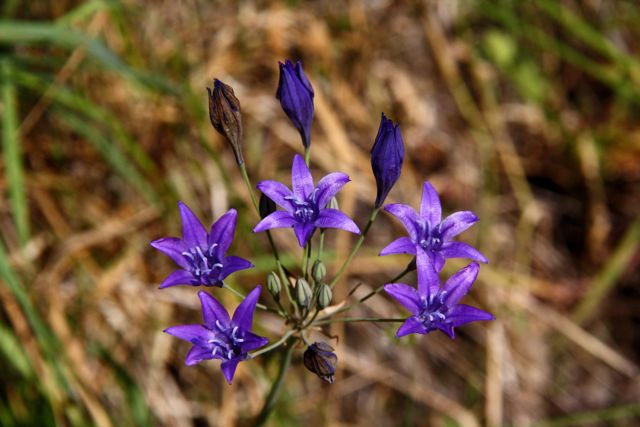
Here is another one of the lovely leggy lilies that I wrote about last week. Triteleia laxa sports a loose umbel of trumpet-shaped purple flowers. The color is usually the rich royal purple shown here, but it can be paler as well. The way to tell this beauty from the similar species is to look inside and see that it has six classic-looking stamens.

The young plant is spear-shaped when it first emerges from the earth. Evidently the name is (for you literary types!) a reference to Milton’s Paradise Lost, in which the angel Ithuriel finds Satan has approached Eve in the shape of a toad. Ithuriel touched him with her spear and revealed his true form. I think toads are beautiful and charismatic critters, and for me this is the best part of the fable – that a toad is what was chosen to infiltrate the ranks of goodness!

See the six distinct stamens

Leave a comment

Filed under Native, Plant of the day

Plant of the day: sneezeweed

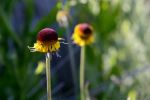
A brown golf ball is dressed in a short yellow skirt. Well not really, but that’s what this funny flower looks like: a big round ball, fringed at its very lower edge with dangling petals. I found this patch of Helenium puberulum perched alongside Highway One just south of Stinson Beach.

There are several different kinds of sneezeweed (a.k.a. Helenium) and they all look like variations on this theme.  The “classic” sneezeweed shown here has many flowers per plant, noticeably short petals – they almost look like an afterthought! – and leaves that attach to the stem (the botanical term is decurrent). This combination of traits lets you know you’re looking at plain ‘ol sneezeweed instead of Bigelow’s sneezeweed or yellow sneezeweed. Actually as far as I can tell you don’t even need to look at the leaves or number of flowers – the other sneezeweeds both seem to have larger petals. But it’s always good to ID a plant using more than one feature, since individuals of the same species can show a LOT of variation in its shape, color, size and so on.

The sneezeweeds are in the enormous Asteraceae family, and if you look close you’ll see that the brown ball is made up of hundreds of individual “disc” flowers, and the yellow skirt is the showier “ray” petals.

Leave a comment

Filed under Good for gardens, Native, Plant of the day

Plant of the day: cow parsnip

This is a fearsome plant. It’s rough, tough leaves are larger than my head: pointed and creased like thick green origami. Its stem is hollow and thick as a hose, and it can heft its dense umbel of flowers as much as seven feet in the air. I prefer the scientific name—Heracleum maximumto the common name “cow parsnip”. That is far too pedestrian for this beast. Cows are placid, parsnips are passive underground things. This is a vigorous creature of light and growth. The implied size is appropriate, but that’s about all.

Right now it is out in abundance and it’s hard to hike (or drive) near the ocean without seeing it. It clusters along stream-banks and hangs over the curves on Highway One. There is nothing else that looks like this plant; it’s the only one of its genus around here. It has a vague similarity to its other cousins in the carrot family like Queen Anne’s lace or poison hemlock—but all the others have divided, lacy leaves whereas our bovine parsnip boasts solid, maple-like leaves as large as dinner platters.

2 Comments

Filed under Native, Plant of the day